
Walk into any enterprise data center and you’ll find layers of security tools — firewalls, intrusion detection systems, endpoint protection. But none of those controls mean much once an attacker gets inside. If they reach the database, they read the data. If they intercept the traffic, they read that too. The only thing standing between a breach and an absolute disaster is encryption — specifically, whether the data itself is protected, not just the path to it.
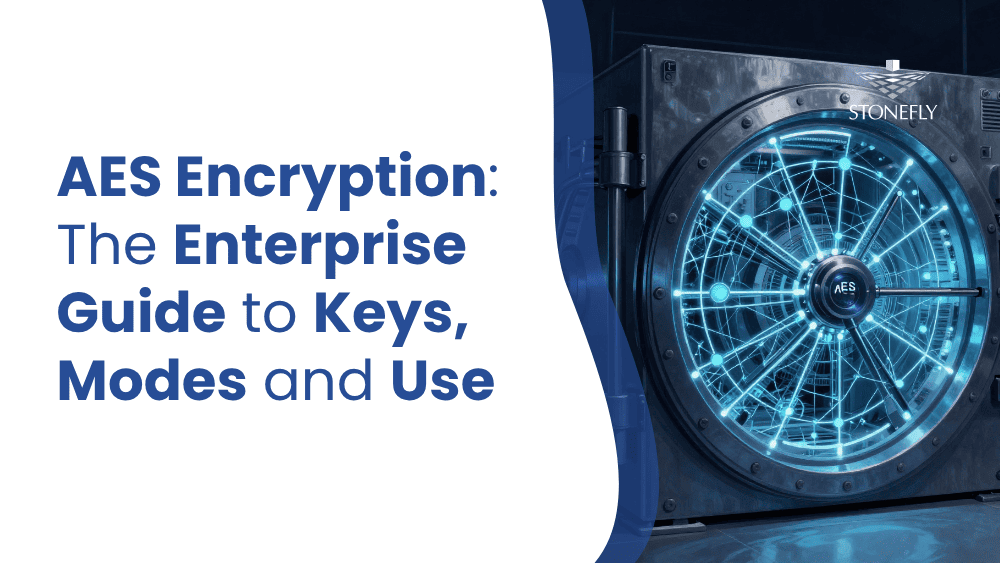
That’s where AES encryption comes in. The Advanced Encryption Standard is the algorithm that government agencies, cloud providers, financial institutions, and hospitals rely on to keep sensitive data unreadable to anyone without the right key. It’s been the global standard for over two decades, and it’s not going anywhere. Understanding how it works, which configuration to use, and how to implement it properly is one of the most practical things an enterprise security team can do.
This guide covers the full picture — from the internals of the AES algorithm to key size selection, modes of operation, real-world use cases, compliance requirements, and what the future looks like as quantum computing edges closer to practical reality.
AES stands for Advanced Encryption Standard. The National Institute of Standards and Technology (NIST) standardized it in 2001 as a replacement for the aging Data Encryption Standard (DES), which had become vulnerable to brute-force attacks as computing power grew. After a public competition that ran for several years, NIST selected the Rijndael algorithm — developed by Belgian cryptographers Joan Daemen and Vincent Rijmen — as the new standard.
AES is a symmetric encryption algorithm. That means the same key is used for both encryption and decryption. This is different from asymmetric encryption — like RSA or ECC — where one key encrypts and a separate key decrypts. Symmetric encryption is faster and less computationally expensive, which makes it the right tool for encrypting large volumes of data: think full disk encryption, database fields, backup archives, or VPN traffic.
AES processes data in fixed 128-bit blocks — regardless of the key size. What changes between the three variants (AES-128, AES-192, and AES-256) is the key length itself. Each block of data passes through a series of transformation rounds, with the number of rounds depending on the key: 10 for AES-128, 12 for AES-192, and 14 for AES-256. More rounds mean more transformation, which means stronger encryption.
Since its adoption, AES has been embedded into virtually every layer of enterprise infrastructure. It’s built into CPUs via Intel’s AES-NI instruction set, integrated into storage controllers, cloud platforms, TLS protocols, and database systems. It’s the de facto standard for a reason — it’s been tested extensively, validated by NIST under FIPS 197, and no practical attack against a properly implemented AES system has ever succeeded.
The inner workings of AES follow a structured sequence of transformations. When data enters the AES encryptor, the first step is organizing it into a 4×4 matrix of bytes — called the state array. From there, the data moves through a series of rounds, each one making it harder to reverse-engineer without the key.
Each round (except the final one) applies four operations in sequence. SubBytes replaces every byte in the state array using a substitution box, known as an S-box. This introduces non-linearity — meaning the output doesn’t follow a predictable pattern relative to the input — which makes mathematical attacks much harder. ShiftRows then shifts each row of the matrix by different amounts, spreading data across the block. MixColumns applies a mathematical transformation to each column using Galois Field arithmetic, further scrambling the relationships between bytes. Finally, AddRoundKey combines the transformed block with a round key derived from the original encryption key, using an XOR operation.
The final round skips MixColumns but still applies SubBytes, ShiftRows, and AddRoundKey. This produces the ciphertext: data that looks completely random and carries no detectable trace of the original plaintext.
Decryption runs these steps in reverse order using the same key. The round keys are applied in the opposite sequence, and each transformation is inverted. Because AES is symmetric, the decryption process is structurally similar to encryption — which is part of what makes it efficient to implement in hardware.
The key schedule is what generates the round keys from the original key. For AES-256, the key schedule produces 15 round keys through a series of byte rotations, substitutions, and XOR operations with constants. This expansion means that even if an attacker captured the output of one round, they would still face an enormous challenge working backward to the original key.
The question of which AES key size to use is one that comes up in almost every enterprise encryption discussion. The short answer is that all three variants are secure — no practical attack exists against any of them. The decision comes down to what your workload demands and what your compliance obligations require.
AES-128 uses a 128-bit key, which creates 2¹²⁸ possible key combinations. A brute-force attack against AES-128 would require more computational effort than current technology can produce — by a vast margin. It runs faster than AES-256 because it performs fewer rounds, which makes it a good fit for high-throughput environments where latency matters: real-time communications, embedded applications, and large-scale database operations.
AES-256 doubles the key length to 256 bits and adds four more transformation rounds. The number of possible keys is 2²⁵⁶ — a number so large that even modeling a brute-force attack is practically meaningless. This is the version used by the U.S. government for classified information and is required under compliance frameworks like FIPS 140-3 and CJIS. For enterprises handling financial records, health data, intellectual property, or anything that carries long-term sensitivity, AES-256 is the standard choice.
AES-192 sits in between but sees far less use. It’s not mandated by most compliance frameworks, and because its performance profile is nearly identical to AES-256, organizations that need the intermediate option usually just go with 256. Support for AES-192 is also less consistent across tools and libraries, which creates interoperability headaches that most IT teams would rather avoid.
When making the key size decision, factor in three things: how sensitive is the data, how long does it need to stay confidential, and what do your regulatory requirements say? Data that needs to remain secure for decades — like medical records or legal documents — should be encrypted with AES-256 to account for future increases in computing capability. Data with a shorter sensitivity window in a performance-critical environment might be a reasonable fit for AES-128.
AES as a block cipher defines how a single 128-bit block of data gets encrypted. But real-world data is rarely exactly 128 bits. Modes of operation define how AES handles multiple blocks in sequence — and the choice of mode has a significant impact on both security and performance.
Electronic Codebook (ECB) is the most basic mode. Each block is encrypted independently with the same key. The problem is that identical plaintext blocks produce identical ciphertext blocks. If your data has any repeating structure — which most real data does — ECB leaks patterns. You can actually see structural information in ECB-encrypted images, which makes this mode unsuitable for anything beyond encrypting a single small, random value.
Cipher Block Chaining (CBC) addresses this by feeding each encrypted block into the encryption of the next one. An initialization vector (IV) — a random value — is applied before the first block to ensure that even identical plaintexts produce completely different ciphertext. CBC is widely used for data at rest, but it requires sequential processing, which limits parallelism and can create a performance bottleneck under heavy load.
CFB and OFB modes convert AES into a stream cipher, processing data in smaller chunks rather than full 128-bit blocks. These modes are useful for network traffic and streaming applications where data arrives in irregular sizes. Like CBC, they require careful IV management — reusing an IV with the same key compromises the encryption.
Galois/Counter Mode (GCM) is the current gold standard for enterprise deployments. GCM combines Counter Mode encryption — which allows parallel processing across blocks — with a Galois authentication tag that verifies data integrity. This means GCM provides both encryption and authentication in a single pass, catching any tampering before decryption is completed. GCM takes full advantage of multi-core processors and hardware acceleration, which is why it’s the mode of choice for TLS 1.3, IPsec, and most cloud storage encryption implementations. For enterprises deploying AES-256 at scale, GCM is almost always the right mode.
AES doesn’t operate in isolation. Enterprise encryption architectures almost always combine symmetric and asymmetric encryption — because each one is suited to a different problem.
AES is fast. Because both encryption and decryption use the same key, there’s no asymmetric mathematical overhead. Hardware-accelerated AES via AES-NI can process billions of blocks per second on a standard server processor. This makes it the right choice for bulk data encryption: full-disk encryption, database encryption, backup protection, and encrypted file systems.
Asymmetric encryption — RSA, ECC — is computationally expensive but solves a problem that symmetric encryption can’t: it allows two parties to establish a shared secret without having met before and without exchanging a key over an insecure channel. RSA-2048 or ECDHE can negotiate a session key, and then AES takes over to encrypt the actual communication. This is exactly how TLS works: asymmetric cryptography handles the handshake, and AES handles the data.
The practical implication for enterprise architects is clear. Don’t use RSA or ECC to encrypt large datasets — the latency and resource cost are prohibitive. Don’t use AES alone for key exchange between parties who don’t already share a key. Combine them: asymmetric methods for key establishment and identity verification, AES for everything else.
AES shows up across nearly every layer of an enterprise IT environment. The following are the most common — and most important — deployment scenarios.
Full-disk encryption protects data on endpoints, servers, and storage arrays. If a drive is physically stolen, the data is unreadable without the decryption key. Self-encrypting drives (SEDs) handle this at the hardware level using AES, offloading the encryption workload from the host CPU. Storage arrays in enterprise SAN and NAS environments use AES-256 to protect entire volumes, including snapshots and archives.
Not all database fields need the same level of protection. Column-level encryption lets organizations encrypt specific fields — social security numbers, credit card numbers, health record identifiers, passwords — while leaving non-sensitive fields unencrypted for query performance. An AES-256 encryptor applied at the schema level ensures that even a database administrator with read access to the database engine cannot view the decrypted values without the key. This approach is a requirement under PCI DSS for cardholder data and under HIPAA for certain categories of patient information.
AES-GCM is embedded into TLS 1.2 and TLS 1.3, securing HTTPS traffic between browsers and web servers, API calls between microservices, and communication between cloud-hosted applications. IPsec VPNs use AES to encrypt tunnels between remote users and corporate networks. Any data crossing an untrusted network — the internet, a shared cloud fabric, a branch office connection — should be wrapped in AES encryption.
Cloud platforms like AWS, Azure, and GCP all use AES-256 for storage encryption by default. Organizations can manage their own keys through cloud KMS services or bring-your-own-key (BYOK) programs for additional control. Virtual machine disk images, object storage buckets, and database snapshots are all candidates for AES encryption — and in regulated industries, this isn’t optional.
AES’s efficiency makes it viable even on constrained hardware. Industrial control systems, medical devices, and IoT endpoints increasingly use AES-128 or AES-256 to protect telemetry data and command channels. A compromised industrial controller that accepts unencrypted commands is a significant operational and safety risk — AES encryption on the communication layer closes that exposure.
AES-256 is about as strong as encryption gets. But the algorithm is only one part of the security equation. Most AES-related failures in enterprise environments come not from breaking the cipher but from mishandling the keys. If the key is stored alongside the encrypted data, the encryption offers almost no protection. If the key is hardcoded in application code, any developer or attacker with code access has what they need.
Hardware Security Modules (HSMs) are the gold standard for key protection in enterprise environments. HSMs are tamper-resistant devices designed to generate, store, and perform cryptographic operations with keys that never leave the hardware in plaintext form. Even if an attacker compromised the application server, they couldn’t extract the AES keys from an HSM. Cloud equivalents — AWS CloudHSM, Azure Dedicated HSM — provide the same model in hosted environments.
Key management systems (KMS) handle the operational side: generating keys with a cryptographically secure random number generator, distributing them to authorized systems, rotating them on a schedule, tracking their use in audit logs, and revoking them when a system is decommissioned or a breach is suspected. Enterprises should never use the same key across environments — production, development, and testing should each have their own key sets.
Key rotation is one of those practices that teams often deprioritize until it becomes critical. Rotating AES keys on a regular basis — annually for lower-sensitivity data, more frequently for critical systems — limits the damage if a key is eventually compromised. Pair key rotation with role-based access controls that restrict which personnel and systems can request decryption operations, and you significantly reduce the attack surface around your encryption infrastructure.
AES is standardized under FIPS 197 and is the only symmetric encryption algorithm approved for use in FIPS 140-3 validated cryptographic modules. For U.S. federal agencies, contractors, and any organization that sells to the U.S. government, FIPS 140-3 validation isn’t a nice-to-have — it’s a requirement. This means the AES implementation must run in a FIPS-validated module, not just any software library that claims to implement AES.
HIPAA doesn’t prescribe specific encryption algorithms by name, but it does require that electronic protected health information (ePHI) be rendered unusable and unreadable to unauthorized parties. NIST guidance under HIPAA points directly to AES as the appropriate mechanism, and using AES-256 for ePHI at rest and in transit is a defensible, auditable position that most regulators and insurers will accept.
GDPR takes a technology-neutral stance but references encryption as an appropriate technical measure for protecting personal data. Demonstrating AES-256 encryption of personal data fields — especially with verifiable key management practices — strengthens a data protection impact assessment and reduces liability exposure in the event of a breach. Under GDPR’s breach notification rules, encrypted data that was accessed without the key may not trigger the notification obligation at all.
PCI DSS requires strong cryptography for the protection of cardholder data, and AES-256 meets that standard. The specifics of how it’s implemented — which systems are in scope, how keys are managed, how access is controlled — determine whether you pass an audit, not just whether you’re using AES. Compliance is about the whole system, not just the algorithm.
One of the reasons AES displaced its predecessors and became the dominant enterprise encryption standard is its hardware efficiency. Intel introduced AES-NI — Advanced Encryption Standard New Instructions — in 2010, and AMD followed. These are CPU-level instructions that execute AES operations directly in silicon rather than through software routines. The performance difference is substantial: AES-NI can encrypt data at rates of tens of gigabytes per second on a single core.
For enterprises, this means AES encryption adds negligible latency to storage and network operations on any server manufactured in the last decade. Full-disk encryption on a server with AES-NI has no measurable impact on throughput under typical workloads. Storage controllers in enterprise arrays have dedicated AES engines that handle encryption independently of the host processor. Network interface cards in high-performance environments can offload TLS encryption entirely from the CPU.
This matters for deployment decisions. If your AES implementation isn’t using hardware acceleration — if a software library is computing AES operations without AES-NI — you’re leaving significant performance on the table and adding CPU load unnecessarily. Confirm that your encryption stack is hardware-accelerated before assuming that AES at scale will be free of performance impact.
Quantum computing has been on the enterprise security radar for years. The concern is Grover’s algorithm, which could theoretically reduce the effective security of a symmetric key by half — meaning AES-256 under a quantum attack would offer security equivalent to AES-128 on classical hardware. AES-128 under a quantum attack would drop to roughly 64-bit effective security, which is a problem.
The practical reality is that the quantum computers that could run Grover’s algorithm at cryptographically relevant scale don’t exist today — and the timeline for when they might is still measured in years to decades. AES-256 remains secure for the foreseeable future. But organizations that need to protect data with a sensitivity window of 10 or more years should be thinking about post-quantum readiness now, not when the threat becomes immediate.
The practical approach is a hybrid model: continue using AES-256 for data encryption, but adopt quantum-resistant key exchange mechanisms for key establishment. NIST finalized its first post-quantum cryptography standards in 2024, including algorithms based on lattice cryptography that can replace RSA and ECC in the key exchange role. In this hybrid architecture, AES handles bulk encryption while a quantum-safe key encapsulation mechanism (KEM) protects the key delivery.
Organizations operating in zero-trust architectures should begin inventorying which systems rely on key exchange protocols that would be vulnerable to quantum attacks. The AES layer itself doesn’t need to change — the surrounding infrastructure does. That’s a manageable transition, but it takes time and planning to execute without disruption.
AES is secure. Most of the failures organizations experience with AES-based encryption come from implementation errors, not weaknesses in the algorithm. A few patterns show up repeatedly.
IV reuse is one of the most dangerous mistakes. In CBC mode, reusing the same initialization vector with the same key can leak information about the plaintext. In GCM mode, IV reuse is catastrophic — it can completely break confidentiality and allow an attacker to recover the authentication key. IVs must be unique for every encryption operation. For GCM, this typically means using a counter or a cryptographically random 96-bit nonce and ensuring the counter never wraps around with the same key.
Weak key generation is another common issue. AES keys must be generated using a cryptographically secure random number generator (CSPRNG). Using a predictable seed, a weak PRNG, or a human-chosen password as a direct AES key creates a vulnerability that has nothing to do with AES itself. If deriving keys from passwords, use a proper key derivation function like PBKDF2, bcrypt, or Argon2.
Storing keys near the data they protect defeats the purpose of encryption. An attacker who finds a database backup with the AES key stored in the same directory, or embedded in a configuration file on the same server, has everything they need. Key storage must be separated from the encrypted data — physically if possible, or via an HSM or KMS at minimum.
Using ECB mode for anything other than encrypting a single small, random, non-repeating value is a mistake that surfaces more often than it should. Teams sometimes choose ECB because it’s simpler to implement — no IV management, no chaining. The tradeoff is that it exposes data patterns. GCM or CBC should be the starting point for any new AES implementation.
AES encryption has held its position as the enterprise standard for over two decades, and that’s not inertia — it’s earned. The algorithm is mathematically sound, hardware-accelerated, validated by NIST, and embedded into the security frameworks that govern industries from healthcare to finance to defense. No practical attack against a properly implemented AES system has succeeded, and the algorithm’s structure gives security researchers high confidence that one isn’t coming any time soon.
For enterprise security teams, the takeaways are concrete. Use AES-256 for sensitive data with a long sensitivity window, and don’t overthink AES-128 for high-throughput workloads where the data risk profile supports it. Use GCM mode unless you have a specific reason not to. Invest in proper key management — HSMs, a centralized KMS, key rotation policies, and strict access controls. Validate that your AES implementations are hardware-accelerated. And start planning for the post-quantum transition now, even if the urgency isn’t immediate.
Encryption is the one security control that protects data even after everything else fails. Firewalls get bypassed, credentials get phished, systems get misconfigured. But data encrypted with AES-256 under a well-managed key infrastructure remains unreadable to anyone who doesn’t have the key. That’s a guarantee worth building on.

Join our mailing list to receive the latest news, updates, and promotions from StoneFly.