
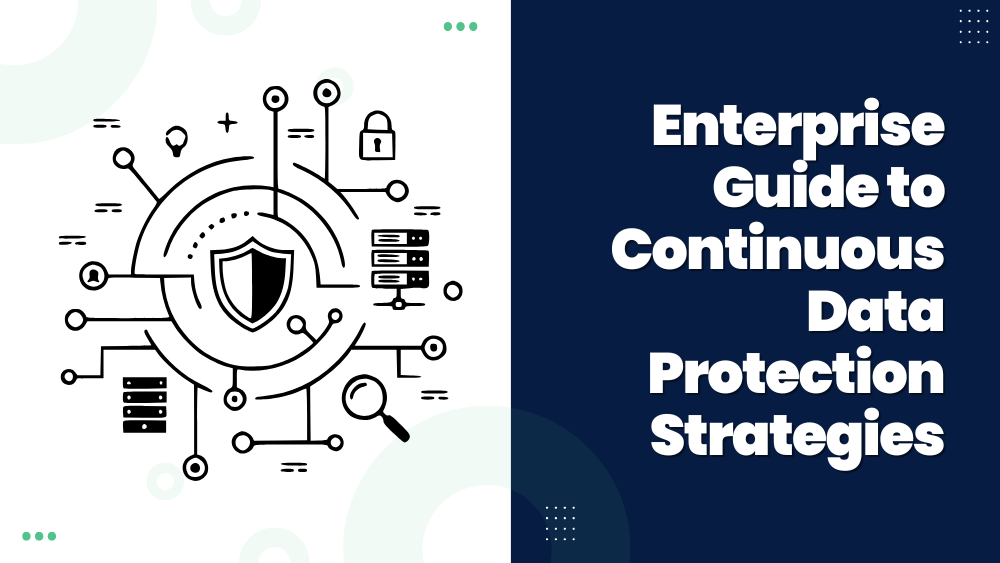
As enterprise IT environments evolve to include multi-cloud, edge, and hybrid infrastructures, the amount of data generated and managed is growing rapidly. With this growth comes a greater need for fast, reliable, and always-on data protection. Traditional backup methods—typically scheduled once a day or week—can’t keep up with the demands of modern business operations. That’s where Continuous Data Protection (CDP) comes in.
Continuous Data Protection (CDP) is a technology that automatically captures and stores changes to data in real time or near real time. Unlike legacy backup systems that create copies at scheduled intervals, CDP ensures every change is immediately saved and replicated. This provides the ability to recover data from virtually any point in time.
This real-time protection model is especially valuable in environments where downtime or data loss isn’t an option. CDP captures and redirects write operations to a secondary storage location, often using a high-speed, low-latency connection, so it doesn’t interfere with production systems.
To support CDP effectively, enterprises need robust storage architectures built for high performance. Solutions like StoneFly’s enterprise data protection platform are designed for these demands by combining intelligent data tiering with efficient, high-bandwidth connectivity to ensure reliable and scalable protection.
Adopting CDP offers a significant advantage in minimizing the risk and cost associated with data loss. With cyberattacks, accidental deletions, insider threats, hardware issues, and data corruption becoming more frequent, organizations require faster recovery capabilities than traditional backups can offer. Continuous data protection allows businesses to maintain an ultra-low recovery point objective (RPO), reducing potential data loss to just seconds.
By removing the need for scheduled backup windows, CDP makes it possible for IT teams to quickly revert to clean, consistent data states when needed. This shortens recovery times and helps organizations meet stringent compliance and data integrity requirements—especially critical for industries like healthcare, finance, law, and e-commerce.
CDP also plays a valuable role in business continuity efforts. In the event of a ransomware attack or unexpected infrastructure failure, data copies are immediately available and undamaged—ensuring operations can resume without major delays.
As more organizations shift to cloud-native infrastructure, adopt containers, and expand into edge computing, data protection strategies have had to adapt. Many enterprises are now opting for CDP solutions specifically engineered to support these modern environments.
Leading platforms such as Veeam and Rubrik offer continuous protection for virtual machines and cloud-native workloads. These solutions use hypervisor-level integration and API-based tracking to replicate data changes with minimal impact on production performance—making them particularly effective in high-demand settings.
Newer features like immutable storage and machine learning-based anomaly detection have also become integral parts of enterprise data protection. When combined with CDP, these enhancements provide a multi-layered defense that helps organizations prevent, detect, and respond to threats quickly.
Whether it’s through StoneFly’s highly scalable storage systems, Veeam’s seamless virtualization support, or Rubrik’s cloud-native tools, continuous data protection is becoming a standard part of every forward-thinking data strategy. No longer reserved for disaster recovery plans, CDP is now a central feature in maintaining business continuity, safeguarding operations, and securing enterprise data at scale.
Continuous Data Protection (CDP) has evolved beyond specialized use cases like high-frequency trading or mission-critical systems. For organizations looking to reduce downtime and meet stringent compliance requirements, CDP has become a key part of modern data protection strategies. Unlike snapshot-based backups or legacy systems that risk losing data between backup intervals, CDP records every data change as it happens—cutting the risk of data loss down to nearly nothing.
CDP works by continuously monitoring and recording data changes at the block level. Rather than depending on scheduled snapshots or periodic backups, it tracks every write operation in real time. By logging all changes in a journal, CDP makes it possible to recover data from virtually any point.
This approach is well-suited for high-change-rate environments such as transactional databases, virtual infrastructure, or hybrid cloud setups. With CDP, organizations can significantly reduce recovery point objectives (RPOs) and streamline recovery time objectives (RTOs) by removing the need for manual intervention or traditional restoration processes.
CDP can be implemented through software platforms like Veeam or as part of integrated backup appliances from vendors such as Rubrik. Whether deployed in software or hardware, enterprise-grade CDP is designed to perform efficiently in high-speed networks and high-throughput storage environments.
One topic IT teams often explore is the difference between real-time and near real-time replication in CDP systems. Real-time CDP replicates every data change to a secondary location almost immediately—often within milliseconds—assuming the infrastructure can support low-latency operations. This is typically achievable in environments using 10GbE or higher network bandwidths.
Near real-time CDP, on the other hand, introduces a short delay by bundling changes and sending them in intervals. The lag may range from a few seconds to a few minutes depending on configuration, workload, and available network bandwidth. While this slightly increases the RPO window, it provides more flexibility for environments with greater latency or limited network resources.
Choosing between these modes comes down to balancing the criticality of the workload, the tolerance for minimal data loss, and the capabilities of the infrastructure. Vendors usually offer adjustable replication settings, allowing teams to align protection levels with their specific needs.
Older backup systems rely on scheduled full or incremental backups—usually performed daily, weekly, or at set intervals. Snapshot-based methods improved on this by allowing faster restores and less frequent full scans, but both strategies still leave gaps between backup points.
Consider a case where incremental backups run every four hours. If a failure occurs three hours after the last backup, three hours of data could be permanently lost. CDP avoids this gap by recording data activity continuously, offering a far more comprehensive level of protection.
Traditional backup methods also tend to strain storage and compute resources during backup windows, which can slow down production environments. CDP spreads the load by journaling in the background—protecting data without disrupting ongoing operations.
While snapshots offer a convenient way to restore from specific system states, they lack the granularity of CDP. Snapshots capture fixed points in time, making them unsuitable for recovering to specific events or transactions. CDP, however, can restore both files and application states from any prior moment, making it more precise and flexible in real-world recovery scenarios.
CDP plays a vital role in creating effective data protection strategies for organizations focused on uptime, compliance, and seamless operations. As IT environments spread across on-prem, cloud, and edge infrastructures, the ability to back up data without interruptions or performance hit has become even more important.
By adopting CDP technologies—such as those offered by Veeam and Rubrik—businesses can better meet service level agreements, reduce the risk of data loss, and respond quickly to unexpected issues. Rather than reacting after a failure, CDP equips IT teams with proactive tools to maintain data integrity and minimize recovery times.
With its real-time capabilities and granular control, continuous data protection delivers the resilience today’s enterprises need—without the trade-offs typically associated with legacy backup methods.
Enterprise IT environments are growing increasingly complex. Between evolving compliance requirements, rising costs of downtime, and the growing range of cybersecurity threats, the need for reliable data protection is more critical than ever. While traditional backups have long served as the foundation of data security, they no longer provide the level of protection that modern businesses demand. Safeguarding enterprise data now calls for a more dynamic, real-time solution—specifically, continuous data protection (CDP).
Today’s enterprises depend on uninterrupted access to data and applications. Whether supporting customer-facing services, essential databases, or internal communication systems, even brief outages can lead to lost revenue and erode customer trust. According to a Gartner report, IT downtime costs large organizations around $5,600 per minute. In sectors like finance, healthcare, and online retail, that figure can quickly climb into the millions.
Traditional backups, typically scheduled hourly or daily, fall short in these scenarios. Any changes made since the last backup are lost if a failure occurs—potentially hours of unrecoverable data. CDP addresses this gap by capturing and replicating every write operation in real time to a secondary location. This approach brings the recovery point objective (RPO) down to just seconds, significantly reducing potential data loss and enabling faster restoration.
Solutions such as Veeam and Rubrik Continuous Data Protection replicate data at the I/O level across low-latency networks, avoiding the limitations of periodic backups. As a result, organizations benefit from faster recovery time objectives (RTOs) and near-zero RPOs.
Companies today are under growing pressure to meet stringent regulatory standards including GDPR, HIPAA, SOX, and ISO/IEC 27001. A failure to protect sensitive data can result in penalties, legal costs, and significant reputational harm—especially when involving personal, financial, or proprietary information.
Regulatory frameworks demand that data be recoverable, secure, and auditable on short notice. Legacy backup solutions often can’t provide the granularity or immediacy necessary for audits or investigations. CDP enables point-in-time recovery, versioned snapshots, and immutable journaling—features that help maintain regulatory compliance and support incident response.
By using CDP-integrated platforms, IT teams can restore systems to any moment before a breach or failure occurred. This not only helps resume operations quickly, but also strengthens legal positioning during compliance reviews or litigation.
The explosion of data from hybrid clouds, edge devices, and microservices presents a serious challenge for traditional backup methods. As environments expand, so do the opportunities for attacks. Cyber threats are constantly evolving—from ransomware that encrypts entire systems to zero-day exploits that bypass conventional defenses.
Older backup systems frequently struggle to scale with growing infrastructure. Their reliance on scheduled backup windows can lead to delays and reduce recovery precision. In high-demand environments, this creates bottlenecks and increases the risk of data exposure.
CDP responds to this challenge with continuous replication and real-time monitoring. Enterprise-grade solutions with CDP can replicate data across multiple systems or cloud environments without interrupting operations. Replication can be configured as asynchronous or near-synchronous, allowing organizations to prioritize critical workloads and reduce resource strain.
Moreover, CDP platforms offer advanced threat detection by monitoring data behavior as it’s written. Sudden changes or unusual activity can trigger alerts or automatic containment protocols—preventing issues like ransomware from causing large-scale damage.
To keep pace with business demands and evolving threats, IT teams need to move beyond scheduled backups and adopt protection strategies that operate continuously. CDP technologies make this shift possible, supporting virtual machines, cloud-native applications, and business-critical systems across diverse infrastructures.
StoneFly, Inc. delivers continuous data protection solutions designed to meet the needs of today’s enterprise workloads. By integrating CDP with high-performance storage and optimized networking, StoneFly enables organizations to eliminate backup windows and maintain uninterrupted access to critical data.
The advantages of CDP are clear: reduced data loss, faster recovery, improved compliance, and the ability to support growth without compromising protection. Relying solely on traditional backups leaves organizations vulnerable. As data becomes more central to business operations, the move to CDP is not just a strategic upgrade—it’s essential for business continuity.
Continuous Data Protection (CDP) has become a vital element of modern enterprise data protection strategies. Unlike traditional backup solutions that rely on scheduled snapshots, CDP records every change as it happens, making the most current version of data available for recovery at any moment. For businesses that depend on constant digital operations, losing even a few seconds of data is unacceptable. Below, we break down the main advantages of integrating CDP into your enterprise infrastructure.
A major advantage of CDP is how it dramatically lowers both Recovery Point Objective (RPO) and Recovery Time Objective (RTO).
RPO indicates how much data can potentially be lost during an outage, while RTO defines how quickly systems need to be restored. Conventional backups often operate on hourly or daily intervals, leaving gaps where data can be lost. CDP eliminates these gaps by continuously recording data changes, resulting in near-zero RPOs — ideal for systems requiring strict uptime and reliability, such as financial platforms, healthcare applications, and transactional systems.
CDP also improves RTO by letting IT teams restore data from any moment in time — even milliseconds before a ransomware attack or corruption event occurred. This level of precision speeds up recovery and reduces time spent identifying safe restore points.
CDP solutions integrated with VMware, Hyper-V, or physical server workloads can support automated failover and failback, minimizing disruption during failures. Vendors like Veeam and Rubrik offer platforms with intelligent journaling, application-aware recovery, and policy-driven automation — allowing businesses to meet demanding service levels with minimal manual input.
Together, real-time sync, fast storage networks, and smart snapshot management give administrators full control over RPO and RTO — aligning recovery goals with business needs.
Ransomware continues to threaten business data by encrypting files and disrupting operations. Attackers often use sophisticated methods like delayed triggers and lateral movement, making it harder to catch infections early. Backup systems that rely on fixed schedules run the risk of capturing corrupted data before an alert is raised.
CDP avoids this pitfall by capturing data continuously and saving it to an immutable journal. This makes it easier to pinpoint when suspicious activity began and quickly restore systems to a clean state — often within seconds of the initial infection.
Since CDP isn’t tied to backup intervals, response times are faster and data loss is minimal. Enterprises can recover swiftly without major service interruptions.
Platforms like Rubrik and Veeam offer CDP features designed to respond proactively to ransomware. These include anomaly detection, automated alerts, instant rollback, and secure networks that isolate backup environments from production systems. These layers of protection help stop ransomware from spreading and support fast, effective recovery.
For companies working under strict data protection and cybersecurity requirements, CDP offers a strong defense, helping maintain operations and data integrity.
The ability to restore from any point in time is one of CDP’s most powerful features. Unlike traditional backups that only allow restoration from set intervals, CDP gives administrators the flexibility to roll back to specific moments — down to the second — which reduces guesswork and prevents unnecessary data loss.
This is particularly important for organizations running critical systems like ERP, CRM, or custom applications. Whether caused by accidental deletion or a misconfigured script, issues can be addressed precisely by reverting to just before the error occurred.
For example, if a data corruption happened at 2:03:17 PM, CDP allows recovery to 2:03:16 PM — preserving the system state one second before the issue. This functionality extends to virtual machines, databases, and application environments, with many solutions offering both crash- and application-consistent recovery depending on the need.
Modern CDP platforms also support orchestration tools, automated recovery workflows, and metadata tracking, giving IT teams better visibility and control during the recovery process. This simplifies audits and speeds up resolution during unplanned outages.
CDP plays an essential role in business continuity by keeping data accessible even during outages, cyberattacks, or planned maintenance. Unlike traditional backups that often require full restoration from external storage or secondary sites, CDP allows rapid failover to up-to-date copies, helping systems stay online.
In high-availability environments, CDP keeps standby systems in sync through low-latency replication, ensuring that services can pick up without delay if the primary system goes down. This is especially useful for disaster recovery scenarios or mission-critical applications where downtime is costly.
Many CDP platforms are also storage-agnostic. This means businesses can protect data across different environments — on-premises, in the cloud, or at edge locations — using the same policies and management tools.
CDP also proves helpful during system upgrades, migrations, or patch deployments. Because data is continuously mirrored, organizations can roll back if needed, without causing downtime or data loss. That level of availability provides greater confidence during routine maintenance or infrastructure changes.
Integrating CDP into the core of your data protection architecture does more than enhance backup and recovery — it reshapes how your business handles disruptions and meets compliance goals.
With evolving regulations like GDPR, HIPAA, and CCPA, businesses must demonstrate consistent, verifiable data protection. CDP helps meet these requirements through features like immutable journaling, real-time data capture, and recovery logging — making compliance a standard part of operations rather than a challenge.
CDP is built to scale alongside your infrastructure. Whether you’re managing thousands of virtual machines, growing data lakes, or hybrid cloud environments, CDP can extend across your infrastructure while maintaining centralized oversight.
Organizations using CDP often report shorter backup windows, reduced recovery testing efforts, and less impact on production workloads — freeing up teams to focus on innovation rather than recovery drills.
Whether you’re using Veeam, Rubrik, or enterprise-grade CDP appliances from StoneFly, CDP offers a reliable and scalable path to secure, efficient data protection.
Continuous Data Protection (CDP) has significantly reshaped how enterprises think about availability, resilience, and data integrity. While traditional backup methods rely on fixed schedules—such as daily, weekly, or monthly routines—CDP works in real time, making it especially useful for mission-critical systems and environments requiring minimal data loss. When comparing CDP to legacy backup systems, three factors stand out: backup frequency, storage usage, and impact on system performance. Understanding how CDP performs in these areas helps IT teams choose a data protection strategy that meets evolving business objectives.
Traditional backup approaches—whether full, incremental, or differential—create windows of vulnerability between backup intervals. During these windows, any data created or modified remains unprotected. For instance, a system that runs a backup at 2 a.m. and doesn’t perform another until the next day is at risk of losing up to 24 hours of data in the event of failure or attack. This kind of delay is often unacceptable for industries dealing with sensitive or time-critical data, such as healthcare, finance, and cloud-based service providers.
CDP addresses this gap by continuously recording and replicating every write operation, either in real time or near real time. Whether using solutions from Veeam, Rubrik, or StoneFly, organizations can restore systems to precise moments—sometimes just seconds before a failure or attack occurred. This precision is especially valuable in recovering from ransomware incidents or data corruption, where even minor data loss could be damaging.
CDP systems rely on technologies like advanced journaling and block-level tracking to maintain continuous backups without the performance hit typically associated with traditional snapshot-based methods. As a result, organizations gain more control over recovery points and can better meet strict compliance standards such as HIPAA, GDPR, or SOX.
Storage usage is a major differentiator between CDP and traditional backup solutions. Older backup systems often store repeated full or incremental backups, leading to unnecessary data duplication. This not only consumes valuable storage space but also increases the time and resources required for backup and recovery operations. As storage usage grows, businesses are often faced with expensive hardware upgrades or added capacity, which can strain budgets.
Modern CDP platforms take a different approach. They offer built-in deduplication and compression technologies that reduce storage use by identifying and storing only new or changed blocks of data. This reduces redundancy across backups while maintaining complete data consistency.
Using platforms like Rubrik or StoneFly, repeated events—such as transactional data, system configurations, or common files replicated across multiple systems—are only stored once. This efficiency helps reduce the total storage footprint across local infrastructure and cloud-based storage, cutting costs and streamlining backup processes. In hybrid or multi-cloud environments, it also lowers bandwidth usage, improving performance during sync or replication tasks.
In addition to deduplication, many CDP platforms feature intelligent data tiering. This allows older or infrequently accessed backup data to be automatically moved to more cost-effective storage solutions, keeping crucial information readily available while optimizing overall storage expenses.
A common concern when deploying CDP is its potential impact on system performance. Traditional backup systems often cause slowdowns during snapshot creation or full backups—especially when running during business hours. These tasks can burden CPU resources, reduce IOPS, and slow down networks, which affects essential business applications.
CDP systems avoid these issues by using change block tracking (CBT) to monitor data writes as they happen. This enables the system to capture and replicate only what’s changed, avoiding large data transfers or full scans. The streamlined process puts far less pressure on production environments and keeps systems running smoothly.
However, to get the most from CDP, a reliable and low-latency network is essential—especially when replicating data across locations or between on-prem and cloud environments. Environments that use high-speed links, SD-WAN, or optimized VPN tunnels will see better results when deploying CDP.
Solutions like those provided by StoneFly are built with multi-site replication efficiency in mind. Features such as WAN acceleration and bandwidth management ensure that backup traffic doesn’t get in the way of day-to-day operations. Whether you’re backing up virtual machines, container workloads, or business-critical databases, CDP can do the job without disrupting core functionality.
Modern CDP platforms are also easier to deploy across a variety of systems. Many are agentless or use lightweight agents that have minimal impact on system performance. This allows teams to implement CDP across different environments—on-prem, cloud, or hybrid—while maintaining high availability for Tier 1 applications like ERP platforms, customer services, and financial systems.
By looking at backup frequency, storage efficiency, and system performance, it becomes clear that Continuous Data Protection offers a more proactive and cost-effective approach to enterprise data protection. Although strong network infrastructure and careful planning are necessary, CDP delivers lasting improvements in uptime, recoverability, and long-term cost savings for businesses looking to safeguard their data.
Continuous Data Protection (CDP) is becoming an essential part of modern enterprise data protection strategies. With growing demands for fast recovery, low Recovery Point Objectives (RPOs), and continuous application availability, CDP offers a reliable solution. Unlike scheduled backups, CDP tracks every change as it happens, reducing the risk of data loss and minimizing downtime.
Today’s organizations manage large volumes of data, complex infrastructure, and strict uptime requirements. To address these challenges, many are turning to CDP technology—whether through built-in options in solutions like Veeam or Rubrik, or through third-party integrations—to protect vital business systems and data.
Here are four practical use cases where enterprises benefit from implementing CDP backup solutions.
Organizations running VMware vSphere, Proxmox VE, or Microsoft Hyper-V need to maintain uptime and performance across virtual environments. Because a single issue can affect multiple workloads on the same host, ensuring rapid recovery is essential.
CDP captures every change in virtual machines (VMs) in near real time and stores it in an offsite backup. This allows IT teams to restore a VM to a specific point in time—sometimes down to the second—after an outage, cyberattack, or accidental configuration error. Unlike traditional snapshot-based backups, CDP offers more precise and timely data recovery.
Solutions with native CDP support are hypervisor-aware, optimizing system resources and maintaining performance even during active replication. For instance, StoneFly’s backup and DR solution can be configured to prioritize critical workloads and streamline failover processes for Proxmox VE environments. Features such as application-aware backups, integrated testing, and failover automation make CDP a solid choice for virtual disaster recovery.
Incorporating CDP into VM protection strategies strengthens overall business continuity and simplifies recovery workflows across primary and secondary locations.
Databases and business applications like Oracle, Microsoft SQL Server, SAP HANA, or Exchange are essential to daily operations. These systems often process real-time transactions and support core business functions, so downtime or data loss can have immediate consequences.
Traditional backup methods, such as daily or hourly snapshots, may not meet internal RPO standards or compliance needs. CDP continuously tracks and replicates every write operation, ensuring even the most recent changes are preserved. In the event of a system failure or security breach, CDP enables quick rollback to a stable data state just moments before the incident.
CDP platforms use journal-based replication to manage data at the block level, offering granularity and control. When combined with application-aware integrations—such as Rubrik CDP with Oracle RMAN or SQL VSS—CDP simplifies protection without affecting performance. These integrations also allow seamless automation and consistent protection for clustered or containerized deployments.
Common CDP use cases for critical applications include:
– Financial systems needing consistent transactional integrity and compliance.
– E-commerce platforms vulnerable to user errors or database threats.
– Healthcare workloads that must remain operational while meeting HIPAA requirements.
Paired with high-availability solutions and real-time monitoring, CDP delivers the reliable protection these applications require.
Organizations in healthcare, finance, government, legal, and energy sectors face strict regulations around how they store, access, and protect their data. Violations can result in fines, legal consequences, and reputational damage.
CDP backup helps regulated industries stay compliant by capturing data changes as they occur and storing them securely in line with audit and retention requirements. While traditional backups may miss changes between snapshots, CDP ensures ongoing data capture and availability.
Compliance standards such as HIPAA, PCI-DSS, GDPR, and SOX require secure storage, detailed logs, and fast recovery options. CDP-enabled solutions support these needs with features like immutable storage, access control, and searchable journal histories. By enabling rapid point-in-time restores and forensic-level data tracing, these tools help prove that data has not been lost, altered, or exposed without authorization.
Many organizations in regulated sectors operate in hybrid environments—spanning on-prem systems, certified cloud storage, and DRaaS providers. Modern CDP platforms allow flexible deployment and centralized management across these infrastructures. Features such as end-to-end encryption, geo-fencing, and secure retention policies help organizations meet data governance policies without sacrificing performance.
For businesses with regulatory obligations, CDP plays a key role in audit readiness and long-term data integrity.
As enterprises adopt hybrid and multi-cloud environments to improve scalability, reduce costs, and increase flexibility, data protection becomes more complex. With workloads running across physical, virtual, cloud, and edge environments, maintaining consistent protection is a growing challenge.
CDP fits well into this model by providing continuous protection across diverse environments. Whether backing up containerized workloads, virtual machines, or cloud-native services, CDP ensures that data remains safe and recoverable regardless of where it’s stored or processed.
In hybrid deployments, CDP can replicate data from on-premises systems to cloud-based disaster recovery environments. For example, a mission-critical SQL Server system can be mirrored in real time to encrypted storage in Azure, with automated failover triggered by policy.
Multi-cloud strategies often require workload-level data protection rather than location-specific policies. CDP addresses this by enabling protection based on data importance, not physical location—allowing coverage across platforms such as VMware Cloud on AWS, Azure Stack, or Google Cloud containers.
Benefits of using CDP in these environments include:
– Minimal data loss thanks to real-time change tracking.
– Optimized use of bandwidth through efficient replication.
– Flexible recovery automation with APIs and infrastructure-as-code integrations.
– Built-in support for dynamic infrastructure, including CI/CD pipelines and DevOps workflows.
With its scalability, automation options, and real-time safeguards, CDP provides the reliability enterprises need to secure their data across an increasingly diverse IT landscape.
Deploying Continuous Data Protection (CDP) requires organizations to assess and adjust their infrastructure to support real-time data recovery. As businesses move from scheduled backups to continuous protection, key components—such as network latency, storage performance, scalability, and virtualization support—must align with the selected CDP solution. Whether using Veeam CDP, Rubrik CDP, or a custom deployment, the underlying infrastructure must deliver the performance, flexibility, and resilience needed to protect workloads and meet compliance and recovery goals. This section breaks down the critical infrastructure elements that organizations should address for successful CDP deployment.
CDP works by continuously capturing and replicating every write operation in real time. For this process to function correctly, the network linking primary systems to CDP targets must minimize latency and maximize throughput. Even minor delays or inconsistent bandwidth can disrupt replication and compromise recovery points.
To keep latency low, many businesses establish redundant high-speed connections between key data center components. Technologies such as Remote Direct Memory Access (RDMA) over Converged Ethernet (RoCE) and NVMe over Fabrics (NVMe-oF) enable fast, low-overhead data transfers. When combined with optimized routing, Quality of Service (QoS) settings, and dedicated paths for CDP traffic, these tools help ensure reliable performance.
Many organizations also rely on software-defined WAN (SD-WAN) to dynamically manage traffic routes, especially when data spans multiple regions or cloud platforms. SD-WAN allows IT teams to prioritize CDP data and maintain performance across a distributed environment.
Ongoing monitoring is key to keeping the network ready for CDP workloads. Tools like iPerf and SolarWinds Network Performance Monitor help IT teams track latency, packet loss, and throughput, ensuring that network conditions meet CDP requirements.
Continuous data protection requires a storage infrastructure capable of handling high volumes of rapid, incremental write operations. Unlike traditional backups that store large snapshots periodically, CDP writes small data changes to secondary storage in near real time.
To meet this demand, many organizations deploy NVMe-based all-flash arrays to handle high IOPS requirements. Performance alone isn’t enough, though—storage efficiency is equally important. Techniques such as data deduplication, compression, and tiered storage help reduce the amount of space needed and cut down on replication bandwidth.
Improving bandwidth usage is also essential for CDP success. WAN optimization features—including TCP window scaling, data compression, caching, and deduplication-aware replication—help streamline data transfers across branch locations, edge devices, or cloud environments.
Enterprise storage solutions like StoneFly’s Scale Out NAS or S3-compatible storage appliances can be used as long-term CDP targets. These systems offer features like encryption, Air-Gapped Vault® and immutability, and object locking, providing strong protection against ransomware and unauthorized access while keeping storage costs manageable.
As businesses grow and workloads expand, CDP systems need to scale to keep pace. A system that works today might fall short under heavier data loads or more complex IT environments. Without flexible scalability, organizations risk slower recovery and system bottlenecks.
Organizations managing thousands of virtual machines, databases, or container workloads often turn to clustered storage architectures and distributed data pipelines. Scalable CDP solutions allow users to assign priority to specific workloads, ensuring that the most critical applications remain fully protected and responsive.
When evaluating CDP platforms, it’s important to consider features such as agentless support (where applicable), intelligent load balancing, and flexibility for on-premises, hybrid, or multi-cloud deployments. Integration with orchestration tools like Kubernetes has also become vital due to the dynamic nature of container environments.
Backup appliances such as those offered by StoneFly are built with scalability in mind. Their ability to expand performance and capacity linearly without disrupting operations makes them a strong option for growing CDP deployments.
Effective data protection requires the ability to support both on-premises infrastructure and cloud-native environments. CDP solutions that lack broad platform compatibility can lead to fragmented protection and inconsistent recovery strategies.
Modern CDP tools must support leading virtualization platforms—including VMware, Proxmox VE, and Hyper-V—as well as cloud providers such as Amazon Web Services (AWS), Microsoft Azure, and Google Cloud. Integration with hypervisors allows for efficient backup of mission-critical virtual machines without adding performance overhead or requiring in-guest agents.
In cloud-native environments, CDP must support components like RESTful APIs, metadata management, and elastic resource scaling. Seamless compatibility with storage platforms—such as S3, Azure Blob, or Google Cloud Storage—is essential for storing CDP replicas off-site. The ability to perform near-instant restores or conduct cloud failovers during outages is also critical.
For hybrid environments, features such as cross-platform replication, policy-based automation, and consolidated management dashboards help simplify CDP operations. As more businesses adopt containers and serverless computing, advanced CDP tools now also offer protection at the file and block level for application data—eliminating the need for legacy backup agents and improving coverage in cloud-native workloads.
Finding the right Continuous Data Protection (CDP) strategy is essential for protecting enterprise workloads against data loss from ransomware, hardware failure, corruption, and other risks. CDP goes beyond traditional backup methods by capturing data at the input/output (I/O) level, enabling near-zero Recovery Point Objectives (RPOs). However, not every CDP solution fits every business need. Making the right choice requires a clear understanding of an organization’s technical environment, operational goals, and business priorities.
The first step in evaluating CDP solutions is determining whether the platform can scale with growing data volumes. Data expands rapidly in enterprise environments, so your chosen solution should handle horizontal and vertical scaling without compromising performance. For instance, a large financial firm using Microsoft Hyper-V, VMware vSphere, and Kubernetes across multiple locations will need a CDP solution that supports hybrid infrastructure—both on-site and in the cloud.
Performance plays a key role, especially for applications that generate high volumes of transactions. Tools such as Veeam or Rubrik CDP should be closely assessed for how well they manage IOPS, throughput, and latency. In environments with demanding performance needs—such as inventory systems or e-commerce platforms—it’s critical that the CDP solution works without causing delays or slowdowns.
Integration is just as important. Enterprises working with SANs, software-defined storage systems, or storage solutions from vendors like StoneFly should select CDP platforms that offer native API support and unified management. Seamless integration reduces the chances of compatibility issues and keeps implementation and administrative overhead to a minimum.
It’s important to look beyond upfront costs and consider how a CDP solution will perform over time. Licensing, storage, bandwidth, and administrative requirements all contribute to long-term investment. These should be viewed in context with the benefits gained, such as reduced system downtime, faster recovery, and improved compliance.
For example, a healthcare organization regulated by HIPAA could face substantial fines and extended service disruption if data is compromised. In such situations, a higher investment in a CDP platform that supports immutable backups and real-time compliance features could offer considerable value over time.
Hidden costs can also affect the total cost of ownership. Complex solutions that require expertise or constant maintenance may divert IT teams from critical initiatives. In contrast, CDP platforms that offer automation, policy-based controls, and centralized visibility can reduce day-to-day administrative tasks and free up resources.
To make informed decisions, organizations should define workload-specific RPOs and Recovery Time Objectives (RTOs). It’s also worth considering a tiered storage model—using SSDs for frequently accessed workloads and object storage for archives—to keep costs down while maintaining reliable protection.
Enterprise CDP solutions should also be evaluated based on how well they support industry-specific needs. Financial institutions, for example, require low RPOs and fast performance, while media companies need solutions that can handle large files and real-time access for editing workflows.
In heavily regulated sectors like healthcare, finance, and law, CDP systems must meet compliance mandates such as HIPAA, GDPR, SOX, or FINRA. Look for features like encrypted backups, audit-ready logs, and secure, tamper-proof snapshots. Vendors offering built-in compliance reporting or advanced threat detection tools can help maintain regulatory standards without adding complexity.
For industries working with distributed environments—such as energy, manufacturing, or logistics—CDP platforms need to support edge deployments and ensure data syncs smoothly across geographically dispersed locations, even in suboptimal network conditions.
In addition, make sure the platform works well with your core applications. For example:
– SAP and Oracle databases benefit from application-aware backup.
– Virtual Desktop Infrastructure (VDI) deployments—common in hybrid work setups—require low-latency data capture and recovery.
The best CDP strategy is one that aligns with your industry’s needs, business scale, and future growth plans.
Rolling out Continuous Data Protection (CDP) in enterprise environments involves more than switching on a feature—it requires thoughtful planning and alignment with business objectives, operational workflows, and compliance requirements. Whether you’re working with platforms like Veeam CDP or Rubrik CDP, the goal is to embed continuous protection into your data resilience strategy. Below are some essential practices to help enterprises successfully implement CDP.
Before introducing CDP, it’s important to review your current backup and recovery setup to identify both strengths and potential weak points. A detailed audit helps pinpoint exactly where CDP can provide the most impact.
Start by mapping how data moves between critical systems—such as databases, applications, file servers, and individual endpoints. Key steps include:
– Reviewing backup frequency and retention policies
– Assessing Recovery Time Objectives (RTOs) and Recovery Point Objectives (RPOs) for each department or function
– Evaluating existing tools, such as snapshot-based backups or periodic replication platforms
This exercise reveals gaps in recovery readiness and helps determine whether your environment is ready for CDP or if upgrades—like improving infrastructure or updating policies—should come first.
CDP requires fast, uninterrupted data replication and real-time capture, which puts pressure on both your networking and storage infrastructure. Older systems may struggle to keep up, creating performance bottlenecks and delays.
A solid network foundation is essential for CDP. Look for:
– 10GbE or faster connectivity across switches and storage infrastructure
– VLAN segmentation to isolate CDP traffic and reduce latency
– Quality of Service (QoS) settings that prioritize replication and backup traffic
These upgrades help maintain consistent data transfer speeds between source systems and CDP targets—whether on-prem or in remote locations.
To support CDP workloads, enterprise-grade storage platforms such as all-flash arrays or NVMe-based systems are recommended. These reduce write latency and maintain the order in which data is written—crucial for applications that require reliable, consistent rollbacks.
For hybrid environments, consider storage gateways or automated tiering solutions to move older recovery points to cold storage, ensuring a balance between real-time performance and long-term retention.
Effective CDP isn’t just about technology—it’s about shaping protection around your most critical business needs. Establishing clear SLAs and recovery policies helps ensure that systems are protected according to their importance.
High-impact applications—like ERP, CRM, and financial platforms—should be backed by strict CDP policies, often featuring sub-second RPOs and rapid recovery options. Less critical systems may be served adequately with a mix of CDP and conventional backups.
Policy definitions should take into account:
– Business impact of data loss or downtime
– Regulatory and compliance requirements
– Data residency laws and geographic replication restrictions
– Prioritized recovery sequences in disaster or cyber incident scenarios
SLAs should be formally documented and integrated into the organization’s larger disaster recovery and continuity plans.
A successful CDP setup depends heavily on knowledgeable staff who understand both the tools and the workflows. Ongoing training takes the guesswork out of operations and ensures smooth transitions during incidents.
Whether using Veeam, Rubrik, or another vendor, teams should be comfortable with:
– Managing CDP journals and logs
– Running point-in-time recoveries
– Reverting to snapshots in the event of data corruption or ransomware
– Coordinating CDP into broader disaster recovery orchestration
Training should also cover the technical architecture—how journals are stored, how latency affects snapshot intervals, and how failover is executed during an outage.
Support readiness involves more than technical training. Create detailed runbooks outlining response procedures, escalation paths, and recovery timelines. Assign support tiers—day-to-day monitoring for Level 1, technical troubleshooting for Level 2, and advanced configuration for Level 3—to ensure responsibilities are clearly defined.
With trained teams and structured documentation, CDP becomes a dynamic, managed service rather than a passive protection layer.
The value of CDP lies in its ability to recover data quickly and accurately. Routine testing confirms that your CDP system operates as expected across different failure scenarios—including hardware issues, software faults, and cyberattacks.
Incorporate CDP checkpoints into your standard DR testing to validate outcomes such as:
– Immediate VM recovery from near-zero RPO journals
– Application-consistent restoration with log replay
– Complete failover using geo-replicated copies of protected data
Testing helps confirm that CDP components—from journals to target environments—are functioning as expected and meeting SLA benchmarks.
Tools like Veeam SureBackup or sandbox testing environments enable automated validation of backup snapshots. This includes checking system bootability, data integrity, and dependency mappings—without disrupting production workloads.
Regular testing not only builds confidence in the environment, but it’s also a necessary step for compliance and stakeholder transparency.
As enterprise IT environments become more distributed and data volumes grow, Continuous Data Protection (CDP) is taking on a more strategic role. With the shift toward hybrid infrastructures that blend on-premises systems, edge devices, and cloud platforms, organizations need real-time, granular backup and recovery strategies. CDP is moving beyond traditional use cases and is now a key component in protecting data across complex, highly dynamic environments.
The days of relying solely on periodic snapshots or tape backups are behind us. For industries like finance, healthcare, and manufacturing, recovery time and recovery point objectives must approach zero. Today, CDP forms the backbone of resilient data protection strategies, enabling rapid recovery, ensuring regulatory compliance, and maintaining business operations across hybrid ecosystems.
Artificial Intelligence (AI) and Machine Learning (ML) are transforming how CDP tools detect threats and manage risk. By analyzing telemetry and metadata in real-time, CDP solutions equipped with AI can flag suspicious activities—including encryption behavior tied to ransomware, spikes in I/O, or unauthorized access to sensitive systems.
What sets this AI integration apart is its ability to act proactively. Instead of simply alerting teams after a breach, intelligent CDP systems can respond instantly—isolating compromised workloads, switching to secure recovery points, or replicating clean data sets to immutable storage. This approach significantly reduces the window of vulnerability for businesses.
Advanced CDP platforms also provide contextual analytics. Tools like Veeam Continuous Data Protection and Rubrik’s Polaris Radar allow teams to translate system activity into actionable insights. Whether that means identifying unusual virtual machine performance or catching potential corruption early, teams can take immediate steps to prevent disruption.
Beyond detection, AI enhances the overall efficiency of CDP by decreasing both the time to detect and the time to respond to threats. As a result, security teams can operate more efficiently, stay ahead of evolving risks, and meet both internal service expectations and external compliance requirements.
CDP is indispensable for ensuring consistent data protection across emerging IT frontiers, from edge locations to cloud-native applications. As businesses roll out IoT platforms, container workloads, and microservices closer to where data is generated, traditional backup models often fall short.
Modern CDP solutions provide real-time replication over low-latency networks, enabling IT teams to maintain synchronized data copies in edge or Kubernetes environments without degrading application performance. These capabilities are particularly well-suited for dynamic, high-velocity workloads where downtime or data loss isn’t an option.
In remote or bandwidth-limited settings—such as retail branches, manufacturing floors, or offshore facilities—CDP allows operations to continue without interruption.
For cloud-native architectures, where services are stateless but rely on persistent storage like databases and message queues, CDP captures and replicates write operations in real time. This ensures that, if recovery is needed, application data can be restored quickly and accurately with minimal impact to running services.
Furthermore, CDP’s compatibility with multizone and multi-cloud setups is becoming a critical asset as organizations distribute their workloads across platforms like Amazon EKS, Azure AKS, or OpenShift. Modern CDP tools capture everything from container metadata to secrets and volumes, enabling detailed, point-in-time recovery across complex, container-based environments.
And with infrastructure-as-code practices becoming more widespread, CDP policies can now be deployed as version-controlled templates. This lets IT teams enforce consistent data protection policies across regions and environments—maintaining agility without compromising on data safety.
As organizations shift toward Zero Trust architectures, CDP is playing an important supporting role. Its ability to create immutable backups ensures that data is not just recoverable, but also shielded from unauthorized changes. In a security framework that assumes no implicit trust, this kind of protection is essential.
Zero Trust models emphasize identity verification, traffic inspection, and minimal access rights. CDP is aligned with these principles by providing rapid rollback capabilities that restore environments to known-good states—helping security teams contain threats and limit exposure.
To function effectively in a Zero Trust environment, CDP must include features like multi-factor authentication, Role-Based Access Control (RBAC), and identity management integrations. Air-gapped and immutable storage targets—such as S3-compatible object storage with WORM (Write Once, Read Many) controls—also play a crucial role in safeguarding backup data from tampering.
Visibility is another key requirement. Enterprises need to track the movement of data between edge, core, and cloud systems. CDP workflows that enable audit logging, activity monitoring, and data lineage tracking provide this necessary transparency. With StoneFly’s Air-gapped Vault® and automated compliance reports, teams can meet stringent governance and auditing requirements with less manual effort.
Compliance mandates such as NIST 800-207, CMMC 2.0, and ISO/IEC 27001 are shaping modern security strategies. A CDP solution that aligns with Zero Trust practices not only strengthens an organization’s security posture but also ensures continuity—even if threats come from within or exploit compromised credentials. In these scenarios, CDP’s ability to restore data accurately and quickly becomes indispensable.
Looking ahead, CDP is set to become a foundational element of enterprise IT. With the rapid expansion of hybrid environments, edge computing, and regulatory oversight, continuous protection is no longer optional—it’s required.
Organizations that adopt advanced CDP solutions today are positioned to handle cyber threats, system outages, compliance evaluations, and cloud migration with greater confidence. From VMware and Microsoft Hyper-V to Kubernetes clusters and cloud-native ecosystems, CDP enables consistent protection—keeping systems running and data secure.
Integrating CDP with Zero Trust protocols, leveraging AI for intelligent automation, and ensuring coverage across all environments will separate those staying ahead from those falling behind. For enterprises focused on uptime, data governance, and uninterrupted service delivery, CDP is no longer a helpful tool—it’s a critical requirement.
As businesses accelerate their digital transformation efforts, protecting critical data in real time has become essential. Continuous Data Protection (CDP) provides a reliable foundation for securing valuable information, maintaining uptime, and meeting compliance requirements. Unlike traditional backup methods that rely on scheduled snapshots, CDP continuously captures changes, enabling recovery to nearly any point in time—often immediately before a disruption occurs.
This level of precision is especially important when responding to ransomware, human error, or database issues. Businesses that deploy solutions like Veeam or Rubrik Continuous Data Protection benefit from reduced data loss, faster recovery, and the ability to maintain operations—even during unexpected incidents.
In environments where every minute counts, CDP is no longer optional—it’s a key part of an effective data protection strategy.
Looking to set up an enterprise backup and DR solution with integrated CDP capabilities? Talk to our experts to custom-build your turnkey solution.

Join our mailing list to receive the latest news, updates, and promotions from StoneFly.