
Phishing has often been viewed as a straightforward security issue—typically involving deceptive emails designed to trick users into handing over login details. Over time, however, phishing tactics have become more refined and dangerous. Today’s attackers aren’t just relying on poorly worded messages or obvious red flags. Instead, they’re using advanced techniques designed to bypass modern security tools and take control of user sessions as they happen.
One such method gaining momentum is Adversary-in-the-Middle (AiTM) phishing. This more sophisticated approach reveals critical weaknesses in traditional cybersecurity defenses, including systems protected by multi-factor authentication (MFA).
Most basic phishing attacks involve directing users to fake login pages that capture usernames and passwords. While these methods are still in use, they’re becoming less effective as more companies adopt stronger measures like MFA or behavior-based authentication.
AiTM phishing, however, sidesteps these protections entirely. In these attacks, cybercriminals set up a reverse proxy that quietly sits between the user and the legitimate website. The attacker doesn’t just collect static credentials—they intercept the session token that’s generated after the user logs in. With that token in hand, the attacker can pose as the user and access corporate systems without going through MFA a second time.
AiTM phishing shares elements with traditional man-in-the-middle attacks, but its level of sophistication sets it apart. These phishing kits use transparent proxy servers that mirror real login pages and capture traffic between users and applications—all in real time. To the victim, everything appears normal. In the background, the attackers are recording authentication data and session tokens.
Today’s phishing kits are capable of intercepting OAuth flows, handling cookies, and capturing JSON Web Tokens (JWTs)—the digital identities required to maintain access to cloud applications and enterprise systems. Once a session token is compromised, an attacker can gain full access, take unauthorized actions, explore internal systems, and maintain persistence—all without raising immediate suspicion.
Unlike older phishing campaigns, these tools are designed for long-term access and are often part of highly targeted attacks on enterprise operations.
As AiTM phishing becomes more widespread, it’s clear that traditional methods alone—such as anti-malware, spam filters, and user awareness training—aren’t enough to stop these threats. The modular nature of modern phishing toolkits allows attackers to craft highly personalized campaigns that target specific industries, internal portals, or authentication methods.
To stay protected, organizations need to evolve their threat models. AiTM phishing is not just another email scam. It’s a direct challenge to modern Identity and Access Management (IAM) strategies. Treating it as anything less could leave critical systems exposed.
Phishing tactics have grown increasingly advanced, paving the way for stealthier methods that can bypass common security defenses. One such method is Adversary-in-the-Middle (AiTM) phishing—a sophisticated attack that modifies traditional credential harvesting by leveraging real-time interception through reverse proxies. For IT and security teams, understanding how AiTM phishing works and how it compares to more familiar phishing techniques is key to building stronger defenses.
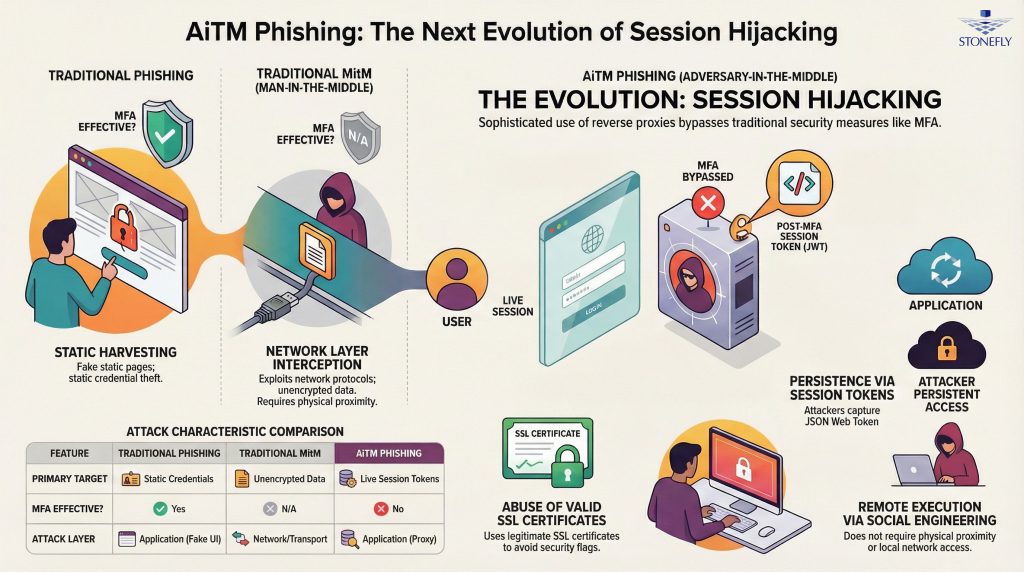
AiTM phishing, or Adversary-in-the-Middle phishing, involves an attacker placing a malicious proxy server between the user and a legitimate web application. This creates a mirror of the real login page, allowing the attacker to intercept both login credentials and session cookies. One of the most dangerous aspects of this technique is its ability to bypass multi-factor authentication (MFA) by stealing the session token after the user successfully logs in.
In practice, attackers use a reverse proxy setup to relay traffic between the victim and services like Microsoft 365, Google Workspace, or corporate web apps. Unlike typical phishing pages that statically imitate login forms, AiTM proxies interact with the session in real time. After the user finishes MFA, the attacker captures the authentication token, gaining full access to the account without the need for repeat authentication.
This method expands on traditional man-in-the-middle (MitM) attacks by shifting the focus away from network-level vulnerabilities to application-level deception. While older MitM techniques exploit unencrypted networks or insecure protocols, AiTM phishing abuses users’ trust in secure websites—without having to decrypt traffic or tamper with encryption protocols.
Classic phishing campaigns typically consist of emails containing links to counterfeit websites. These pages are designed to look like legitimate login portals to trick users into entering sensitive credentials. However, once MFA became widely adopted, these attacks started losing effectiveness. If MFA is in place, simply stealing a password isn’t enough; attackers are blocked unless they can also bypass the second layer of security—usually a one-time code, app notification, or hardware token.
This is where AiTM phishing stands apart. It doesn’t just collect passwords—it steals session tokens during a live login session, allowing unauthorized access even when MFA is enabled. This upgrade in technique makes traditional phishing seem outdated by comparison and calls for more advanced detection and prevention methods.
At the heart of AiTM phishing is the reverse proxy. It serves as an invisible middle layer between the victim and the legitimate service provider. This enables attackers to:
– Relay activity in real time
– Harvest credentials and session tokens
– Present a near-identical user interface
Tools such as Evilginx2, Modlishka, and Muraena make it easy to set up these deceptive campaigns. With minimal technical skills, attackers can deploy convincing proxy-based phishing pages using lookalike domains, valid SSL certificates, and reputable cloud infrastructure—further reducing the chance of detection.
A stolen session token delivered through this kind of setup can allow long-term account access, even if the victim changes their password. This makes session hijacking especially dangerous for organizations that rely solely on password resets for incident recovery.
Although AiTM bears some resemblance to conventional man-in-the-middle tactics, the two differ at a technical level.
MitM attacks often occur on the network layer, relying on vulnerabilities in transport protocols, unsecured Wi-Fi, or outdated certificate settings. These attacks are typically stopped by HTTPS encryption and strict transport security measures. AiTM phishing, on the other hand, operates at the application layer. By using valid SSL certificates and mimicking browser and device behavior, it avoids raising red flags in most security tools.
Unlike traditional MitM, AiTM phishing doesn’t require malicious software or access to the victim’s physical network. Instead, it relies on social engineering combined with carefully crafted domains and DNS tricks, enabling remote attacks with high success rates.
AiTM attacks bring a level of sophistication that traditional phishing lacks—requiring security leaders to take new approaches. Standard tools like spam filters or firewalls alone can’t address the evolving threat landscape of proxy-based phishing.
To stay ahead, organizations should enhance their defenses by implementing:
– Continuous monitoring of authentication tokens
– Real-time session analysis to spot unusual behavior
– Conditional access rules based on device, location, and user context
– Stronger MFA systems, including phishing-resistant options like FIDO2 or certificate-based authentication
Recognizing how AiTM phishing works is the first step in building smarter, more resilient security strategies. Without addressing the core tactics used in these attacks, businesses leave themselves vulnerable to credential and session hijacking—even when MFA is in place.
Phishing threats continue to grow in complexity, and Adversary-in-the-Middle (AiTM) phishing attacks mark a notable shift in the way attackers compromise accounts. Unlike standard phishing techniques that focus solely on stealing login credentials, AiTM attacks allow cybercriminals to bypass multi-factor authentication (MFA) and take over active user sessions. To build an effective defense, it’s essential to understand how these attacks unfold, the tools involved—including AiTM phishing kits—and the range of phishing methods attackers use to avoid detection.
Also known as “man-in-the-middle phishing” or “reverse proxy phishing,” AiTM phishing places a proxy between a victim and a legitimate service. Instead of collecting information through static fake pages, attackers intercept and forward live web traffic—making interactions appear legitimate while capturing login credentials and session tokens along the way.
Here’s a closer look at how a typical AiTM phishing attack works.
Many attackers begin by setting up a deceptive login page with the help of ready-made AiTM phishing kits available on the dark web. These kits are commonly configured to imitate enterprise login portals such as Microsoft 365, Google Workspace, or VPN services, and come pre-loaded with reverse proxy tools that allow attackers to intercept and relay communication between the victim and the actual service.
The fake sites are usually hosted on domains that closely resemble official websites—often registered with small spelling changes (typosquatting). A valid-looking SSL certificate is typically installed, so the site appears secure and uses HTTPS, increasing the chances the user will trust it.
To lure victims to these sites, attackers use spear phishing emails, SMS messages (smishing), or messaging apps, often mimicking legitimate business communication.
When the victim clicks the link and lands on the spoofed page, the reverse proxy begins intercepting all communication. Unlike traditional phishing, where the fake page collects data passively, the attacker-controlled server interacts with the victim and the real login service at the same time, forwarding information as it’s entered.
Fields, error messages, and even MFA prompts from the real service are passed along to the victim in real time. The experience is nearly identical to logging into the actual application. For instance, if a user enters their login details for Microsoft 365, the reverse proxy sends that data directly to Microsoft’s servers and passes the response—such as a 2FA prompt—back to the user through the fake site.
To the victim, everything looks and feels legitimate. That’s exactly what makes this approach so effective—even users trained to spot phishing attempts struggle to detect anything suspicious.
Once credentials and MFA responses are entered, they’re intercepted instantly. The attacker now holds both the username and password as well as any one-time passcodes or push approvals—captured via the live proxy connection.
This gives the attacker immediate access to the target’s account. If the credentials are confirmed to work, the attacker may act right away or save the data for future use, depending on the target’s role. Executives and IT administrators are prime targets for follow-up attacks like business email compromise (BEC) or lateral movement into other systems.
What sets AiTM attacks apart is what happens next. After the user successfully logs in—and while the attacker is proxied into the session—the attacker grabs the session cookies from the authentication process.
Session cookies are browser-stored tokens used to keep the user signed in. By reusing these cookies in another session, the attacker can effectively impersonate the user without logging in again or triggering MFA.
This is how AiTM phishing bypasses MFA—not by cracking it, but by sidestepping it entirely. With valid session tokens, attackers can access Outlook inboxes, corporate cloud environments, internal dashboards, and other systems tied to the authenticated platform.
Some advanced AiTM operations further manipulate session durations, blend IP addresses to avoid detection, and deploy techniques to bypass security tools like CAPTCHA and anti-bot systems.
What once required deep technical expertise is now accessible to a much larger pool of criminals. Tools such as Evilginx2, Muraena, and Modlishka have made AiTM phishing more widespread, offering ready-made templates for enterprise services, automation tools for harvesting credentials, and dashboards to manage stolen sessions.
These kits are often sold with features like email campaign distribution modules, session tracking, and integration with other phishing tools—packaging everything attackers need into an off-the-shelf phishing-as-a-service offering.
This increasing availability makes it easier than ever for attackers—regardless of their skill level—to launch sophisticated, targeted attacks.
AiTM attacks combine various techniques to maximize their effectiveness. Most start with social engineering—convincing users to click links via tailored emails, text messages, or online ads. In some cases, attackers use malicious ad networks (malvertising) to reach potential victims.
Users are often redirected through multiple websites before reaching the fake login portal. The real-time nature of proxy-based phishing allows attackers to mirror the actual login process, reducing signs of anything out of the ordinary.
Compared to traditional phishing—aspects like broken links, missing fields, or unusual behavior are absent. Some AiTM pages even incorporate realistic security features, such as CAPTCHA checks or additional login steps, to strengthen the illusion.
Common techniques observed in AiTM phishing include:
– Fake HTTPS portals for real-time credential harvesting.
– Session and token interception via man-in-the-middle channels.
– Targeted spear phishing emails that use stolen accounts to spread further.
Adversary-in-the-middle (AiTM) phishing attacks are quickly becoming one of the most pressing cybersecurity challenges for businesses today. These threats use techniques similar to man-in-the-middle attacks, where threat actors intercept communication between users and legitimate services—often cloud-based authentication systems—through the use of reverse proxies. The intent is to steal login credentials and session cookies, enabling unauthorized access to corporate resources, even when multi-factor authentication (MFA) is in place.
Traditional phishing tactics typically aim to trick users into revealing their credentials. AiTM phishing, however, goes a step further by hijacking entire browser sessions, allowing attackers to bypass MFA protections. This method has gained traction among cybercriminals targeting enterprise environments due to its efficiency and high success rate.
Here are real-world cases that illustrate how AiTM phishing tactics are evolving and the dangers they pose to corporate infrastructure.
Microsoft tracked a widespread AiTM phishing campaign aimed at Office 365 and Outlook Web Access (OWA) users across the United States and Europe. The attackers deployed a large, automated network of phishing sites using reverse proxy tools like Evilginx2. These sites closely replicated Microsoft’s login pages and functioned as intermediaries, forwarding authentication traffic between users and Microsoft’s servers in real time.
When employees logged in using their credentials and MFA codes, the malicious proxies harvested everything—including session tokens. With these tokens, attackers could access the user’s email accounts, Teams chats, SharePoint files, and OneDrive storage—without needing to reauthenticate. In several cases, compromised accounts were then used to propagate phishing messages within the organization, escalate privileges, and exfiltrate sensitive files.
What makes AiTM phishing particularly dangerous is its ability to operate undetected by traditional security tools. By placing a reverse proxy between the user and the actual service, attackers can conduct what’s known as “authentication passthrough”—capturing session data while maintaining all the signals of a legitimate login.
This approach is effective against widely used platforms like Google Workspace, Salesforce, VPN portals, and Citrix gateways. As a result, a login that appears normal to both the user and the system may in fact be compromised.
For example, an AiTM attack may unfold as follows:
– A threat actor sets up a HTTPS-enabled proxy server that mimics an identity provider login portal, such as Azure AD.
– A phishing email—often crafted to appear as an internal HR or finance request—directs the recipient to the spoofed login page.
– When the user enters their credentials and MFA code, the malicious proxy captures the full session data, including tokens and headers.
– The attacker uses this information to impersonate the user on enterprise platforms, often automating access using tools like Puppeteer or Selenium to maintain stealth and speed.
Because so many organizations rely on browser-based Single Sign-On (SSO) for authentication, the scope of these attacks extends to virtually any web app or cloud resource.
The fallout from a successful AiTM phishing attack can ripple through an organization in several ways: compromising data privacy, violating compliance requirements, and disrupting business operations.
Stolen login credentials are usually mitigated by strong MFA enforcement, but in AiTM attacks, MFA is rendered ineffective. Once attackers hijack a session, they can move laterally across systems, access internal tools, and spread within the organization without detection.
Access to email inboxes, file-sharing tools, and messaging platforms also makes data theft easier and stealthier. In many cases, attackers quietly extract business-critical data—legal documents, customer information, financial records—over an extended period.
Making matters worse, attackers often mimic legitimate user behavior by using the same IP locations, browsers, and device fingerprints as the victim. This makes it exceptionally difficult for detection tools such as SIEM and UEBA systems to flag any abnormal activity. As a result, the time it takes to discover and respond to a breach is significantly extended—amplifying the damage.
In industries bound by regulations such as GDPR, HIPAA, or CCPA, the exposure of personal or sensitive corporate data triggers mandatory disclosure. A single compromised session could force a company to notify regulators, customers, and partners, all while facing potential fines and reputational harm.
Phishing attacks have come a long way from simplistic email scams, evolving into complex strategies that exploit legitimate tools and services to target organizations. While classic phishing techniques remain a frequent cause of data breaches, a more advanced threat—Adversary-in-the-Middle (AiTM) phishing—has emerged, increasing the risk of compromise even for users with multi-factor authentication (MFA) enabled.
To understand the impact of AiTM phishing, it’s important to first look at the traditional methods it’s built upon.
Email phishing is still the most common method attackers use to gain initial access. These emails often mimic legitimate communication from internal departments, vendors, or service providers to trick recipients into clicking malicious links or downloading harmful attachments. Some emails lead to counterfeit login pages designed to steal login credentials.
Criminals rely heavily on brand impersonation and urgent messaging—for example, posing as Microsoft 365 security alerts or banking notifications—to create a sense of urgency. Basic email phishing tends to be generic, which helps modern email security systems flag and filter out many of these attempts.
However, when standard phishing emails are combined with reverse proxy infrastructure—central to AiTM phishing kits—they enable attackers to steal active session data and impersonate user identities in real time.
Spear phishing involves tailoring emails to specific individuals, such as IT administrators, finance managers, or executive assistants. Attackers often research their targets in great detail, reviewing social media profiles, public business announcements, and company websites to personalize their messages.
This makes the phishing attempt far more convincing and harder to spot. When combined with AiTM tactics, successful spear phishing can lead users to reverse proxy sites where their credentials and session tokens are captured during active logins—effectively handing over full access to the attacker.
Whaling is a type of spear phishing that targets C-level executives. These individuals often have access to sensitive data and core systems, making them especially attractive targets. Attackers craft highly specific messages—often disguised as legal correspondence, board updates, or financial documents—to prompt a quick response.
If these messages are used as a gateway to AiTM attacks, the damage can be severe. Even with MFA enabled, attackers can leverage AiTM kits to intercept a session and gain access to executive accounts—potentially compromising entire infrastructures or approving fraudulent activities.
Smishing (SMS phishing) and vishing (voice phishing) use text messages and phone calls to impersonate trusted contacts, banks, or IT departments. These techniques bypass traditional email-based defenses and reach users directly on their mobile devices.
Although not technically advanced on their own, smishing and vishing often serve as early steps in a broader attack strategy. Attackers might initiate a phone call to ensure the target responds to a malicious link sent via SMS, setting the stage for an AiTM attack using a spoofed login page.
In proxy phishing, a fraudulent login page acts as a “man-in-the-middle” between the user and the real service provider, such as Microsoft 365. As users enter their credentials, the site relays them to the legitimate service while capturing the login details and session cookies in real time.
This approach enhances traditional credential harvesting by enabling session hijacking and bypassing MFA protections. Attackers use pre-built AiTM phishing kits—with automated scripts, credential storage, and command-and-control integrations—to streamline and scale their operations across large organizations.
AiTM phishing takes traditional phishing methods a step further by inserting a transparent, real-time interception point between the target and the legitimate service. This allows attackers to gain access to live sessions, bypassing even strong MFA implementations.
What sets AiTM phishing apart is its layered and strategic nature. It often begins with an email, followed by a deceptive login interface powered by reverse proxy tools, then quietly transitions into unauthorized access and lateral movement throughout the network. AiTM phishing kits available on underground marketplaces make it possible for attackers with limited technical skills to launch these complex attacks.
Some of the most damaging examples include hijacking Microsoft 365 sessions, breaching cloud-based CRM platforms, or impersonating executives to authorize high-value transactions within SaaS applications.
Traditional defenses like spam filters and link scanning, while still useful, aren’t enough on their own. To stop AiTM attacks, organizations need to implement adaptive security measures including session behavior monitoring, endpoint-based threat detection, and TLS fingerprinting at the client level.
Techniques like basic email scams, spear phishing, executive-targeted attacks, and SMS-based lures are now just the beginning. AiTM phishing tactics combine these familiar strategies with real-time interception, raising the stakes and reshaping the threat landscape.
Adversary-in-the-Middle (AiTM) phishing is a sophisticated form of credential theft that presents a serious risk to enterprise cybersecurity. Unlike traditional phishing, these attacks use live, interactive methods to intercept authentication tokens during login sessions. Many organizations rely on multifactor authentication (MFA) for added security, but AiTM phishing can bypass MFA by capturing session cookies as users log in—making unauthorized access possible without needing usernames, passwords, or second factors.
AiTM phishing has become increasingly common, especially against platforms like Microsoft 365, Google Workspace, and other cloud management interfaces. Attackers use reverse proxy phishing and man-in-the-middle techniques to gain access, targeting both users and system administrators.
These attacks often start with proxy-based infrastructure, where attackers create fake login pages that replicate legitimate ones. When a user enters their credentials, the fake site relays the input through a reverse proxy to the real service. This allows the attacker to steal both login details and the session token generated after MFA is completed.
With the stolen session token, attackers can impersonate the user on the actual service without requiring additional authentication. This approach bypasses protections designed to verify identity and lets the attacker operate inside critical cloud services—accessing email, collaboration tools, and even privileged identity and access management (IAM) systems. This kind of session hijacking is particularly dangerous in environments where user accounts have wide-reaching access across business applications.
A real-world incident involving a global financial institution reflects how dangerous this can be. Attackers used a phishing kit to deploy fake login pages that acted as intermediaries for Microsoft 365 authentication. Once inside, they used the stolen session tokens to conduct surveillance and move across systems—viewing sensitive emails, sharing malicious documents, and exploiting internal systems largely undetected.
Cloud platforms and SaaS tools—designed for round-the-clock access from any location—are particularly vulnerable to these types of attacks. AiTM phishing kits make it easier for attackers to deploy reverse proxies that interact with services like Outlook, Google Drive, SharePoint, and Salesforce. Once a session token is stolen, attackers can explore corporate networks from inside, often without raising suspicion.
Single sign-on (SSO) and federated identity solutions make matters worse by centralizing access to multiple applications. This means one hijacked session can give an attacker entry into a wide array of systems. Even without administrative rights, attackers can download sensitive files, insert backdoors, tamper with workflows, and redirect email traffic.
Traditional security solutions, including email filters and sandbox analysis tools, often fall short. Because AiTM phishing uses encrypted, real-time proxies and randomized URLs, static detection methods aren’t enough. To make it harder to detect, the phishing page loads genuine login interfaces through the proxy, defeating content-based filters.
As more businesses adopt remote or hybrid work models, the risk of AiTM attacks grows. Employees frequently use personal devices, home networks, or mobile connections, exposing them to attacks that are harder for IT teams to monitor and protect against.
These distributed work environments often lack the active oversight of on-site infrastructure. Without tools like endpoint detection and response (EDR) platforms that recognize when a session token is being reused in suspicious ways, security teams may not catch these threats quickly enough.
Compromised accounts can also be used within workplace tools like Microsoft Teams, Zoom, or Slack to spread the attack internally. By impersonating trusted colleagues, attackers can harvest more credentials or spread malware while remaining unnoticed for extended periods.
Even organizations with solid security architectures—including secure email gateways, SIEM solutions, and threat intelligence feeds—can fall victim to AiTM phishing. These attacks don’t always set off typical alarms because they interact in real time with legitimate systems and come from domains that appear reputable or even carry valid SSL certificates.
Once attackers access a valid session token, they no longer rely on email links or attachments, minimizing digital clues. Detection becomes a post-incident effort, relying on analyses of user behavior, login patterns, or geolocation mismatches—often after damage has been done.
Security operations teams must go beyond conventional tools. They need monitoring systems that understand user behavior in real time, validate session integrity, and enforce adaptive security policies based on context and risk. Without this level of detail, attackers can operate inside systems unnoticed, even with MFA in place.
AiTM phishing isn’t just about stealing passwords—it’s about taking over legitimate sessions, impersonating users, and exploiting weaknesses in modern identity systems. To defend against it, enterprises must invest in real-time analytics, zero-trust frameworks, and stronger token validation mechanisms. Relying solely on MFA is no longer enough. Without better visibility into session activity and context-aware enforcement, organizations remain exposed to some of the most advanced phishing threats seen today.
Standard anti-phishing defenses aren’t enough to stop the growing threat of adversary-in-the-middle (AiTM) phishing. These attacks have evolved beyond simple email lures, using reverse proxy phishing sites to intercept login credentials and session cookies—giving attackers immediate access to enterprise systems. Stopping these attacks requires a layered security approach that moves beyond the basics and incorporates stronger controls across identity, endpoints, and user behavior.
Here’s a closer look at the strategies that truly mitigate the risks from AiTM phishing and help prevent credentials and sessions from being hijacked.
Multi-factor authentication remains a key part of any defense strategy—but methods that rely on passwords and one-time codes (sent via SMS or email) can be bypassed by AiTM techniques. Attackers use fake login pages and capture both the credentials and MFA responses in real time, allowing them to log in as the user, despite “having MFA” in place.
Phishing-resistant authentication—like FIDO2 tokens and passkeys tied to the user’s device—is far more effective. These cryptographic methods prevent credentials from being forwarded or replayed on fake sites, avoiding common proxy-based theft tactics.
When integrated into identity and access management (IAM) platforms or single sign-on (SSO) environments, FIDO2 strengthens the entire authentication process, making it significantly harder for attackers to gain access—even if users fall for a phishing lure.
Reverse proxies used in AiTM attacks often run on lookalike domains or seemingly harmless URLs. That’s why DNS filtering with up-to-date threat intelligence should be a standard part of your security stack. It helps block access to domains known to host proxy phishing sites—like those using tools such as Evilginx2 or Modlishka.
To add another layer of protection, browser isolation should be deployed for any suspicious or unfamiliar web domain. This technology prevents the browser from directly interacting with risky websites. Instead, it renders the site in a secure environment and streams a sanitized version to the user—blocking any chance for scripts to harvest login details or cookies.
Web security tools like Secure Web Gateways (SWGs) or Zero Trust Network Access (ZTNA) platforms should include these capabilities to help stop threats before they reach the user’s device.
AiTM phishing doesn’t just compromise usernames and passwords—it steals session cookies, letting attackers impersonate users without needing to re-authenticate. This makes real-time detection critical.
Behavioral analytics tools monitor how users normally access systems and flag unusual patterns, such as:
– Logins from unexpected locations immediately after normal login activity
– Session hijacks tied to valid credentials but abnormal activity
– Unusual access flows across cloud apps or internal systems
When paired with a Security Information and Event Management (SIEM) or Extended Detection and Response (XDR) platform, these insights can automatically trigger actions like session termination, token revocation, or additional authentication requirements.
Even with strong technical controls, users remain a potential weak link. AiTM phishing pages are highly convincing and often mirror enterprise login portals exactly. That’s why ongoing education is essential—and it needs to go beyond general phishing awareness.
Effective programs should:
– Show real examples of AiTM phishing, including how fake login pages work
– Teach users how to spot subtle warning signs—like certificate issues or URL discrepancies
– Encourage caution when responding to login prompts, especially after clicking email links
Training should be relevant to each department and aligned with real-world scenarios affecting your organization—not just generic training modules. Tailored simulations can better prepare employees for the types of phishing threats they are most likely to encounter.
Basic phishing simulations don’t account for the techniques used by advanced AiTM attackers. By using penetration testing tools that simulate reverse proxy attacks, red teams can test how users and infrastructure respond under real-world conditions.
These simulations help assess more than just the user’s behavior—they test the organization’s incident response, too. For example:
– Is the SOC alerted when session tokens are reused from a different IP?
– Will systems trigger step-up authentication when behavior seems off?
– Can the environment revoke tokens and isolate accounts fast enough to prevent lateral movement?
Insights from these drills should directly inform security policy updates, the deployment of risk-based MFA, and improvements in endpoint protections.
Phishing still typically starts with a well-crafted email. Email security gateways help reduce exposure by screening attachments, identifying suspicious links, and blocking incoming messages from known malicious sources.
One important feature is URL rewriting—automatically modifying links in emails so that when users click them, the link passes through a secure web scanner that checks the page before it opens. This step can prevent users from landing on fake login pages built with AiTM phishing tools.
Adversary-in-the-Middle (AiTM) phishing attacks have grown far more sophisticated than traditional credential theft methods. These attacks use reverse proxies to intercept user sessions and authentication tokens—effectively bypassing multi-factor authentication (MFA) and other session-based safeguards. For organizations that depend on cloud services, single sign-on (SSO), and federated identity systems, AiTM phishing stands out as one of the most serious modern threats.
Knowing how to detect and respond to these kinds of attacks requires a blend of live telemetry, behavioral analysis, and a well-structured incident response plan. In this section, we’ll break down the signs of an AiTM phishing attack, outline the role of log analysis and SIEM platforms, and share actionable steps for an effective response.
While traditional phishing campaigns usually aim to harvest usernames and passwords, AiTM attacks mirror legitimate login pages via a reverse proxy, sitting invisibly between the user and the application. As users enter their credentials, the attacker quietly captures both login details and session tokens—granting them full access with minimal trace.
Warning signs that may indicate a successful AiTM phishing attempt include:
– Sign-ins from unfamiliar devices or IP addresses that don’t match a user’s typical behavior.
– Session tokens being used without a recorded login event.
– Unusual MFA alerts or notices from the identity provider signaling token inconsistencies.
– Multiple logins from regions that would be impossible to travel between within a short timeframe.
– Identical browser fingerprint data or session headers from different sources, particularly impacting commonly targeted services such as Microsoft 365, Okta, or Google Workspace.
These signs often go unnoticed without robust monitoring. That’s why tracking historical behavior and using context-aware threat detection is essential.
Modern AiTM tactics are designed to feel seamless to the user, allowing attackers to move undetected. Security teams benefit from combining log analysis with real-time behavioral monitoring to surface suspicious patterns linked to proxy-based phishing and hijacked sessions.
Start by correlating data across different sources—identity providers, endpoint protection tools, and application access logs. Instead of focusing on isolated activity, establish rules that align and compare:
– Authentication token activity from SAML or OAuth flows.
– Login source IPs, devices, and browser user-agent strings.
– Conditional access outcomes, especially failed or blocked sign-in attempts.
User and Entity Behavior Analytics (UEBA) platforms add another layer of insight by establishing behavior norms. Sudden changes—for example, a login without prior keyboard activity or access from an unknown browser configuration—can raise immediate alerts.
Security Information and Event Management (SIEM) tools are critical for putting this puzzle together. By consolidating logs from firewalls, DNS servers, proxies, and cloud identities, SIEM platforms can detect the subtle, distributed signals that point to ongoing AiTM activity.
When evidence of an AiTM phishing attack surfaces, time is a critical factor. Unlike basic phishing, these attacks often succeed in stealing and using valid session tokens—granting the attacker live access.
Recommended steps to contain and recover from such incidents include:
1. Revoke all active sessions immediately – Use your identity management tools to log out compromised accounts and force users back through MFA.
2. Reset passwords and reconfigure MFA – Treat both credentials and second-factor methods as compromised. Require resets and re-registration for MFA devices.
3. Isolate impacted endpoints – Disconnect any affected device from the network if there’s a chance it was used during the phishing event, and review it before reinstating access.
4. Review and update conditional access policies – Scrutinize access settings tied to locations, devices, and behavior signals involved in the incident.
5. Preserve logs and evidence – Secure audit trails from endpoint tools, browsers, and email systems to understand how the attack was delivered and acted upon.
In addition to responsive measures, prevention planning should include hardening strategies such as rewriting URLs in inbound emails, blocking domains known for hosting phishing proxies, and deploying strong Content Security Policies (CSPs) to limit web injection tactics used by attackers.
A well-configured SIEM platform delivers the day-to-day visibility needed to detect AiTM phishing attempts at various stages of the attack. By combining data from endpoints, identity systems, CASBs, and DLP solutions, security teams achieve a more comprehensive, real-time picture.
Key capabilities within a SIEM platform should include:
– Custom detection rules designed to flag techniques used in AiTM attacks—such as repeated session token use or activity that avoids typical browser refresh behavior.
– Automated response workflows through SOAR (Security Orchestration, Automation, and Response) integrations, enabling actions like session termination or user notification through Teams or Slack.
– Cross-correlation of phishing delivery attempts traced across DNS logs, endpoint click tracking, and email attachments or embedded links.
With this layered visibility, security teams can prevent small signs from escalating into full-blown breaches. Your SIEM doesn’t just collect and report—it needs to guide swift, smart decisions to protect enterprise systems.
AiTM phishing is a persistent and evolving threat, using deceptive methods to exploit trust and speed. With coordinated visibility, intelligent analytics, and responsive playbooks, organizations can not only detect these breaches earlier but neutralize them before they become damaging.
Adversary-in-the-middle (AiTM) phishing attacks have become a common method used by threat actors to bypass multi-factor authentication (MFA) and compromise enterprise environments. Unlike traditional phishing techniques, AiTM phishing relies on a reverse proxy positioned between the user and the legitimate service, allowing attackers to intercept authentication credentials and session cookies—often without immediate detection.
Organizations operating in hybrid or multi-cloud environments, or with distributed teams, face greater exposure to these threats. To address the risks posed by AiTM phishing, security teams must adopt flexible and layered strategies that focus on identity protection, real-time monitoring, and effective communication across departments. Below are key best practices to help strengthen defenses against these sophisticated attacks.
Zero Trust Network Access (ZTNA) provides a strong foundation for minimizing the impact of AiTM attacks. Unlike traditional perimeter-based controls, Zero Trust continuously verifies the identity of users, devices, and applications regardless of network location or VPN status.
In the case of AiTM attacks, this approach reduces the attacker’s ability to move laterally after compromising a session. By enforcing identity-aware access policies, organizations can restrict access based on attributes such as device health, geographic location, user behavior, and application sensitivity.
Best practices for ZTNA implementation include:
– Using microsegmentation to separate users and applications
– Authenticating every connection request, no matter where it originates
– Expanding identity governance to flag unusual access behavior after login
ZTNA should be supported by ongoing identity access governance (IAG). Automated access reviews, role-based access control (RBAC), and enforcement of least-privilege policies help ensure users only have access to what they need. Additionally, applying adaptive access controls—such as risk-based authentication—can disrupt attackers even if they manage to hijack a session.
To stay ahead of evolving threats, enterprises must ensure that authentication procedures are adaptable and updated regularly. Static, predictable MFA rules can be exploited by attackers using AiTM techniques that replicate legitimate login flows and capture session tokens.
What organizations can do:
– Update authentication logic based on the latest threat intelligence
– Set sensible session expiration times and trigger reauthentication as needed
– Reevaluate MFA methods periodically to avoid reliance on vulnerable methods like SMS-based codes
Maintaining a log of privileged session activity is equally important. Alerts should be triggered for inconsistent login patterns, failed conditional access checks, or logins from unexpected geographic locations.
With AiTM toolkits like EvilProxy and browser-in-the-browser techniques becoming easier to access and more effective, integrating real-time threat intelligence with your security tools is essential.
Common indicators of AiTM phishing include:
– Suspicious TLS certificate injections
– The use of proxy IPs or anonymized traffic
– Sessions transferring to unauthorized user agents after MFA challenges
Many attackers clone login pages and proxy captured credentials to their own infrastructure. Linking your threat intelligence feeds with your SIEM or other detection platforms can help identify and block these operations before damage occurs.
Security teams should work with trusted sources to receive updates on:
– Known AiTM frameworks and their variants
– Newly registered phishing domains
– Domains and IPs associated with command-and-control infrastructure
Technical defenses alone can’t stop phishing attacks that target human behavior. Educating teams across all departments is necessary to lower risk and improve response times.
High-level executives, HR teams, and finance personnel often have elevated access and may not recognize targeted phishing attempts, making them prime targets. Keeping these teams informed strengthens your overall defense posture.
Effective communication strategies include:
– Monthly updates with real-world examples of AiTM phishing campaigns
– Internal workshops to walk through how these attacks work
– Simulated AiTM attack scenarios used as part of incident response testing
By raising awareness, staff are more likely to report suspicious activity early—speeding up detection and containment efforts.
AiTM phishing is designed to gain unauthorized access—even after bypassing MFA—by hijacking tokens used to authenticate sessions. Monitoring access tokens across cloud services is critical for early detection of misuse.
Organizations should leverage user behavior analytics (UBA) and threat detection tools across solutions like Microsoft 365, Google Workspace, and Salesforce. Special attention should be given to session and refresh tokens, which are commonly targeted in successful AiTM attacks.
Recommendations include:
– Watching for token reuse from unfamiliar IP addresses or regions
– Automatically revoking tokens when suspicious behavior is detected
– Cross-referencing logs from identity providers and SaaS apps to identify anomalies
Centralized token monitoring should be managed through a unified dashboard. Identity platforms with Conditional Access, such as Azure Active Directory, should be configured to enforce token revalidation upon environment shifts—even if MFA has already been completed.
In more complex ecosystems, Cloud Access Security Broker (CASB) tools can help fill visibility gaps and extend policy enforcement across all SaaS environments.
AiTM phishing presents a fast-growing category of cyberattacks that takes aim at a fundamental part of enterprise security: browser-based authentication. Using tools like reverse proxies, attackers are able to navigate around standard defenses and gain persistent access with minimal effort.
Organizations looking to strengthen their defenses need to recognize what makes these attacks effective, understand how they operate, and take proactive measures to monitor, detect, and block such threats before they take hold. AiTM campaigns are not theoretical—they are active, widespread, and increasingly sophisticated. Designing security strategies with this threat in mind is no longer optional—it’s essential.






Join our mailing list to receive the latest news, updates, and promotions from StoneFly.