
Here is a scenario that plays out in enterprises more than most security teams want to admit. A user authenticates at 9 AM, passes MFA, and gets a full session token. By 10:30 AM, that session has been hijacked via a stolen cookie or a remote access tool running quietly in the background. The attacker is now inside, moving through the network under a legitimate identity. The authentication system saw nothing wrong. It wasn’t designed to.
That is the core problem with point-in-time authentication. It confirms identity once, then assumes the session is clean until logout. For environments where users access sensitive data across cloud platforms, hybrid networks, and multiple endpoints, that assumption carries real risk.
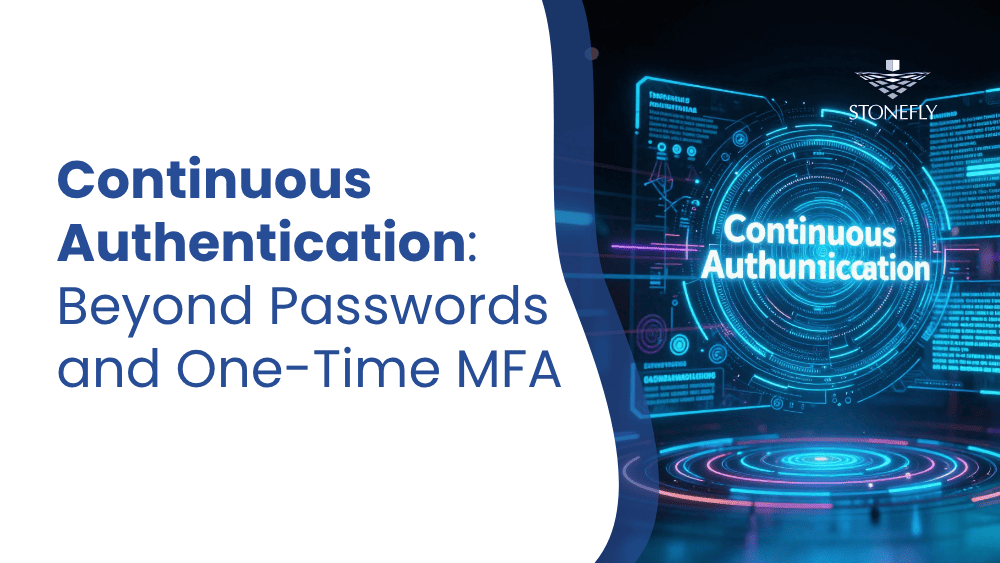
Continuous authentication fixes this by treating identity verification as an ongoing process rather than a single event. It monitors behavioral signals, contextual data, and risk indicators throughout every active session — catching anomalies that static login systems are structurally incapable of seeing. This guide covers how it works, what drives it, and how enterprises can implement it without making the user experience worse in the process.
Continuous authentication is the practice of verifying user identity throughout an active session, not just at login. Where traditional authentication ends the moment credentials are accepted, continuous authentication keeps running — analyzing behavior, context, and environmental signals to confirm that the person currently using the session is the same person who started it.
The need for this emerged from a straightforward vulnerability. Static authentication — passwords, tokens, even most MFA implementations — creates a binary state. You’re either authenticated or you’re not. Once authentication succeeds, the system grants access and moves on. Everything that happens after the login is invisible to the authentication layer. Session hijacking, credential sharing, and account takeovers all exploit this blind spot.
Continuous authentication closes that gap. Rather than granting a session and walking away, the system maintains an ongoing evaluation of trust. Every action — a keystroke, a navigation pattern, a file access, a location shift — contributes to a real-time picture of whether the current user is who they claim to be. If the picture starts to look wrong, the system responds: stepping up verification, restricting access, or ending the session.
Multi-factor authentication adds a second or third verification step at login. That’s a meaningful improvement over password-only systems, but it still operates on the same point-in-time model. MFA confirms who you are at 9 AM. It has no view of what happens at 11 AM.
Continuous authentication doesn’t replace MFA — it extends it. The initial login can still use MFA for strong credential verification. What continuous authentication adds is the layer that keeps verifying identity after that initial check passes. In a well-designed system, MFA and continuous authentication work together: MFA handles the front door, continuous authentication handles everything that happens inside.
Behavioral biometrics is the technology that makes continuous authentication practical at scale. Instead of relying on something you know (a password) or something you have (a token), behavioral biometrics analyzes something you do — the distinctive patterns in how you interact with devices.
Keystroke dynamics measure how a person types — the rhythm, timing, and pressure of key presses. These patterns are highly individual. Two people typing the same word produce measurably different keystroke profiles. Mouse movement analysis captures how users navigate: the speed, curvature, hesitation, and angles of cursor paths. On mobile and touchscreen devices, behavioral biometrics extends to swipe speed, gesture style, and the way someone physically holds and uses their phone.
These behaviors are difficult to fake consistently. An attacker who has stolen credentials can enter a username and password. They cannot reliably replicate the subtle physical patterns of the legitimate user’s typing rhythm and navigation style — especially under the scrutiny of a machine learning model trained on thousands of data points from that user’s actual behavior.
Continuous authentication systems build a behavioral baseline for each user over time. During an initial learning period, the system observes normal interaction patterns and constructs a reference profile. From that point forward, every session is compared against that profile in real time. Deviations from the baseline — a sudden change in typing rhythm, an unusual navigation sequence, behavior that doesn’t match the user’s established patterns — raise the risk score for that session.
The profiles are not static. Machine learning models update the baseline as the user’s behavior naturally evolves — accounting for things like injury, a new keyboard, or working from a tablet instead of a laptop. This adaptability is what separates behavioral biometrics from fixed-pattern checks that would produce constant false alarms as user behavior shifts over time.
Behavioral biometrics provides the identity signal. Real-time risk scoring is what the system does with that signal — translating behavioral and contextual data into a continuously updated trust level that drives authentication decisions throughout the session.
A risk score aggregates multiple data points: behavioral biometrics readings, device posture (patch level, security configuration), geolocation, IP reputation, network type, time of access, and session history. Each data point contributes to an overall trust assessment for the current session moment. The score updates continuously — not once per session, but with every interaction.
Machine learning models trained on historical user behavior and known attack patterns evaluate the significance of each signal. A login at 2 AM from an unfamiliar location carries more weight than a login at 2 AM from the user’s home network. A sudden change in typing rhythm matters more if it occurs while the user is accessing high-privilege systems. The risk engine weighs these factors in combination, not in isolation.
When the risk score crosses a defined threshold, the system doesn’t have to choose between doing nothing and locking the user out. Step-up authentication provides a middle path: request additional verification proportional to the detected risk level. A moderate risk increase might prompt a biometric confirmation. A high-risk event might require a hardware token or a push notification to a registered device.
For legitimate users, this is a minor interruption — a quick biometric scan before proceeding. For an attacker who has stolen credentials but cannot reproduce the user’s behavioral profile, the step-up request is a wall they cannot pass. This proportionality is what makes continuous authentication genuinely useful: it concentrates friction where risk is real and removes it where it isn’t.
The logical endpoint of continuous authentication is a system where passwords are not the primary authentication mechanism at all. Passwordless continuous authentication uses device certificates, cryptographic keys, biometric identifiers, and behavioral signals to verify identity — removing the password from the equation entirely. Since passwords are the most commonly exploited credential vector (phishing, stuffing, brute force), eliminating them as the primary factor addresses a significant portion of credential-based attack surface.
Passwordless systems still verify identity rigorously — they simply do it through factors that are harder to steal and more practical to verify continuously throughout a session.
Behavioral biometrics focuses on how a user acts. Context-aware authentication focuses on the environment in which that action takes place — and uses that context to refine trust decisions. The same behavior can carry different risk implications depending on where, when, and how it occurs.
Device posture covers the health and compliance status of the device used to access a system: operating system version, patch level, presence of endpoint security software, disk encryption status, and whether the device is enrolled in enterprise mobile device management. A user accessing critical systems from a managed, fully patched corporate laptop is a different risk profile than the same user accessing from an unmanaged personal device with an outdated OS.
Network signals add another layer. IP reputation databases flag known malicious IP ranges. Network type — corporate LAN, home broadband, public Wi-Fi, VPN — contextualizes the access request. Geolocation data identifies physically impossible access patterns: a user authenticated in New York cannot also be accessing from Tokyo 20 minutes later. These contextual inputs continuously feed the risk scoring engine, adjusting trust levels as environmental conditions change during a session.
User behavior analytics (UBA) builds on contextual data by establishing patterns at the session and activity level — not just the behavioral biometrics level. It tracks which applications a user typically accesses, at what times, from which locations, in what sequence, and for how long. A user who suddenly starts accessing financial systems they have never touched before, or who begins downloading large volumes of data outside their normal workflow, triggers UBA alerts that feed into the risk scoring engine.
The combination of behavioral biometrics (how the user physically interacts with devices) and UBA (what the user does within systems) creates a multi-layered identity picture. A single anomaly is a data point. Consistent deviation across multiple signals — behavioral, contextual, and activity-based — is a strong indicator of compromise or misuse.
Zero Trust is built on a single operating principle: never trust, always verify. That principle is easy to state and hard to operationalize — because traditional authentication only verifies at login, leaving the “always verify” part largely unimplemented after the session begins. Continuous authentication is the mechanism that makes the zero trust principle real throughout an active session.
In a zero trust model, no user, device, or session is inherently trusted simply because it passed an initial check. Every access request is evaluated on its current merits — the identity signal, the device posture, the network context, and the behavioral pattern. Continuous authentication provides exactly this: a real-time, ongoing evaluation of trust that can revoke or restrict access the moment conditions change.
This matters particularly for privilege escalation scenarios. An attacker who gains access through a low-privilege account and then attempts to move laterally or access higher-privilege systems will show behavioral patterns inconsistent with the legitimate user’s baseline. The continuous authentication system catches that inconsistency and responds — before the attacker reaches the data they’re after.
Continuous authentication generates a continuous stream of identity and risk signal data. The value of that data multiplies when it’s connected to the broader security infrastructure. Integration with Identity and Access Management (IAM) platforms allows authentication policy to be enforced dynamically across all applications — a rising risk score in the continuous authentication layer can trigger access restrictions in the IAM system without manual intervention.
SIEM integration feeds continuous authentication events into the broader security monitoring picture. When the SIEM correlates a behavioral anomaly flagged by continuous authentication with a network event from a firewall log and an endpoint alert from EDR, the combined signal is far more informative than any individual alert. SOAR platforms can then trigger automated responses — ending a session, revoking a token, quarantining an endpoint — based on the combined intelligence, without waiting for a security analyst to manually connect the dots.
Regulatory frameworks are increasingly specific about what constitutes adequate authentication and access control. Continuous authentication addresses several compliance requirements that point-in-time systems cannot.
HIPAA requires covered entities to implement technical safeguards that prevent unauthorized access to electronic protected health information — including controls that monitor and audit user activity. Continuous authentication’s session-level monitoring directly satisfies the ongoing access control and activity monitoring requirements. GDPR’s data protection principles extend to the systems that govern access to personal data. Demonstrating that user sessions are continuously evaluated for anomalies and that unauthorized access attempts are detected and responded to in real time strengthens a GDPR compliance posture.
PCI DSS Requirement 8 addresses identification and authentication of access to system components. The standard requires organizations to protect individual non-consumer user accounts and authenticate access to them. Continuous authentication’s behavioral monitoring — which can detect credential sharing and session hijacking that MFA alone cannot catch — provides a defensible mechanism for demonstrating compliance with the spirit and letter of Requirement 8.
Continuous authentication systems generate detailed event logs for every session: risk score changes, behavioral anomalies detected, step-up authentication events triggered, and access decisions made. This audit trail is valuable for compliance reporting and, in the event of a security incident, for forensic investigation. Rather than reconstructing what happened from fragmented logs across multiple systems, investigators have a continuous record of the identity and trust state throughout the affected session.
ISO 27001 controls for access management and monitoring expect documented evidence of how access is controlled and how anomalies are detected and addressed. Continuous authentication’s combination of automated monitoring and detailed logging provides that evidence in a format that auditors can review without requiring manual log correlation.
The most common objection to continuous authentication is that it will create friction — that users will be constantly interrupted with verification requests and that productivity will suffer. This concern is legitimate but largely addressed by how well-designed continuous authentication systems are built.
The key is that continuous authentication does not mean constant re-authentication. For users whose behavior matches their established profile, whose device is healthy, and whose environmental context is familiar, the system operates entirely in the background. There are no prompts, no interruptions, no friction. The verification is happening — it’s simply invisible because nothing is wrong.
Step-up authentication only surfaces when the risk score actually rises above a defined threshold. For the vast majority of sessions from legitimate users, that threshold is never crossed. When it is — because the user is genuinely doing something unusual, or because their session has actually been compromised — a brief verification request is a reasonable response. The friction is proportional to the risk, not constant.
Getting the threshold calibration right is the most important implementation task. Thresholds that are too sensitive produce false positives — legitimate users being interrupted constantly for behavior that is normal for them. Thresholds that are too permissive miss genuine anomalies. The right approach starts with a baseline learning period where the system observes normal behavior without making access decisions based on it. After baseline establishment, thresholds are tuned based on observed false positive rates and adjusted over time as behavioral patterns evolve.
Different user populations and risk profiles may warrant different threshold settings. A financial analyst accessing trading systems might have tighter thresholds than a general employee accessing internal collaboration tools. A privileged administrator account should have the strictest thresholds of all, given the blast radius of a compromised administrator session.
Deploying continuous authentication across an enterprise is not a single-step process. Organizations that try to roll it out everywhere at once tend to struggle with calibration, user adoption, and integration complexity. A phased approach produces better results.
Start by defining what you are trying to solve. Is the primary concern session hijacking? Insider threats? Compliance with specific regulatory requirements? The answer shapes which capabilities matter most in a continuous authentication platform. Evaluate vendors based on their behavioral biometrics accuracy (low false positive rates under real-world conditions), integration support for your existing IAM stack using open standards like SAML, OAuth 2.0, and OpenID Connect, real-time risk scoring granularity, and their approach to data privacy and behavioral data handling.
Conduct proof-of-concept testing with real users in a controlled environment before committing to a platform. Status reports from vendors are not a substitute for observing how the system performs with your actual user population and infrastructure.
Begin with a controlled pilot covering a defined set of applications and user groups. High-risk applications — financial systems, privileged access management tools, data repositories with sensitive information — are good candidates for early deployment because the benefit of continuous authentication is most tangible there.
During the pilot, run the system in observation mode first: collect behavioral data and build user baselines without taking enforcement action. This prevents disruption during the learning period and gives you real data on what normal behavior looks like for your user population. After baseline establishment, move to enforcement mode and monitor false positive rates, help desk ticket volume, and user feedback. Use this data to tune thresholds before expanding deployment.
Once the pilot demonstrates stable performance, expand deployment across the organization in waves. Prioritize the highest-risk systems and user populations first, then extend to broader populations as the team gains operational confidence with the platform.
Continuous authentication is not a set-and-forget system. As your infrastructure evolves, user populations change, and threat patterns shift, the authentication models need to evolve with them. Establish a regular review cadence for threshold settings, false positive rates, and detection efficacy. Integrate continuous authentication metrics into security operations dashboards so that trends are visible and actionable rather than buried in logs that nobody reviews.
Behavioral biometrics collects sensitive personal data. How that data is handled has direct implications for employee trust, regulatory compliance, and the long-term sustainability of the authentication program.
Behavioral data should be collected at the minimum fidelity needed for authentication purposes — not stored in a form that creates additional privacy exposure. Raw keystroke timings and mouse coordinates do not need to be stored indefinitely. What the system needs is the behavioral model derived from that data, not the raw data itself. Anonymization and pseudonymization of behavioral datasets reduce re-identification risk and limit the scope of data protection obligations under GDPR and CCPA.
Retention policies should define how long behavioral models and event logs are kept, with automatic deletion after the retention period expires. Role-based access controls should restrict who can view behavioral data logs to only those with a documented operational need.
Employees should know that continuous authentication is in place, what data it collects, how that data is used, and what triggers a step-up verification event. Transparency about the system’s purpose and data handling practices reduces concerns about surveillance and builds the trust needed for smooth adoption. Organizations should document this in clear, accessible language — not buried in an IT policy document that nobody reads.
Federated learning approaches, where behavioral models are trained on-device without sending raw behavioral data to a central server, offer a privacy-preserving alternative that is gaining traction in regulated industries. This architecture maintains authentication accuracy while significantly reducing the data privacy surface of the overall system.
The technology underlying continuous authentication is evolving quickly. Several trends are shaping where the discipline is going and what enterprises should be planning for.
AI models are making behavioral analysis more accurate and more adaptive. Where earlier generations of behavioral biometrics relied on relatively simple pattern matching, current systems use deep learning models that identify subtle behavioral indicators of compromise that rule-based systems miss. Future systems will move toward greater autonomy — not just flagging risks for human review, but automatically adjusting access policies, restricting privileges, and initiating responses in real time based on continuous risk assessment.
Federated learning allows behavioral models to be trained across distributed endpoints without centralizing raw user data. Each device performs local model training and shares only anonymized model updates with the central system. This architecture is particularly valuable for healthcare and financial services organizations that must maintain strict data residency and privacy controls while still achieving the authentication accuracy that behavioral biometrics requires.
As enterprise infrastructure expands into multi-cloud architectures and IoT device ecosystems, continuous authentication is extending to cover these environments. Authentication signals from cloud workloads, containerized applications, and connected devices feed into unified risk scoring engines that maintain a consistent identity picture across the full infrastructure stack. This cross-environment visibility is becoming a baseline expectation for enterprises operating at scale — and the platforms that deliver it are positioning continuous authentication as an infrastructure-level capability rather than an application-level add-on.
The session is the attack surface. That is the insight that continuous authentication is built around. Traditional systems secure the front door and then leave everything inside unmonitored. Continuous authentication changes that by maintaining verification throughout the session — using behavioral biometrics, real-time risk scoring, contextual signals, and adaptive step-up controls to keep the identity picture current from login to logout.
For enterprise security teams, the practical takeaways are straightforward. Deploy behavioral biometrics alongside your existing MFA infrastructure rather than replacing it. Invest in baseline learning before enforcement. Calibrate thresholds for your specific user populations and risk tolerance. Integrate continuous authentication signals with your SIEM and SOAR platforms so that identity risk feeds into the broader security operations picture. And treat behavioral data with the same privacy discipline you apply to other sensitive personal information.
Passwords will continue to exist in enterprise environments for years, and credential-based attacks will follow. Continuous authentication doesn’t eliminate that risk — but it breaks the assumption that a stolen credential automatically means a successful session. An attacker who can’t reproduce the legitimate user’s behavioral profile faces a significantly harder problem than one who just needs a username and password. That is the security value continuous authentication delivers, and it is one that point-in-time systems simply cannot match.


Join our mailing list to receive the latest news, updates, and promotions from StoneFly.