
In enterprise cybersecurity, authentication is the process of verifying the identity of a user or system before granting access to sensitive systems, applications, or data. For years, traditional methods like static passwords or even multi-factor authentication (MFA) have been the mainstay. But as cyber threats grow more advanced—with attacks like credential stuffing, phishing, and session hijacking becoming more common—these fixed methods are no longer enough.
Hybrid work models, a rising number of edge devices, and constantly changing user habits are challenging the effectiveness of rigid authentication systems. Static approaches simply can’t respond quickly or accurately to the evolving behaviors and contexts of users. This is where Risk-Based Authentication (RBA)—also known as adaptive or contextual authentication—steps in. RBA dynamically adjusts security requirements based on the specific details of each login attempt, using real-time data to make smarter access decisions.
Risk-Based Authentication evaluates each login attempt by analyzing a wide range of contextual signals, such as device type, geolocation, login time, behavioral patterns, and IP reputation. This information is assessed the moment a user tries to log in.
If the system detects behavior that matches an established baseline, access proceeds with minimal interruption. But if something’s off—like an unfamiliar device or a login attempt from an unexpected location—the system can trigger additional verification steps or block the request entirely. This intelligent, behind-the-scenes assessment strengthens security while allowing legitimate users to log in with less hassle.
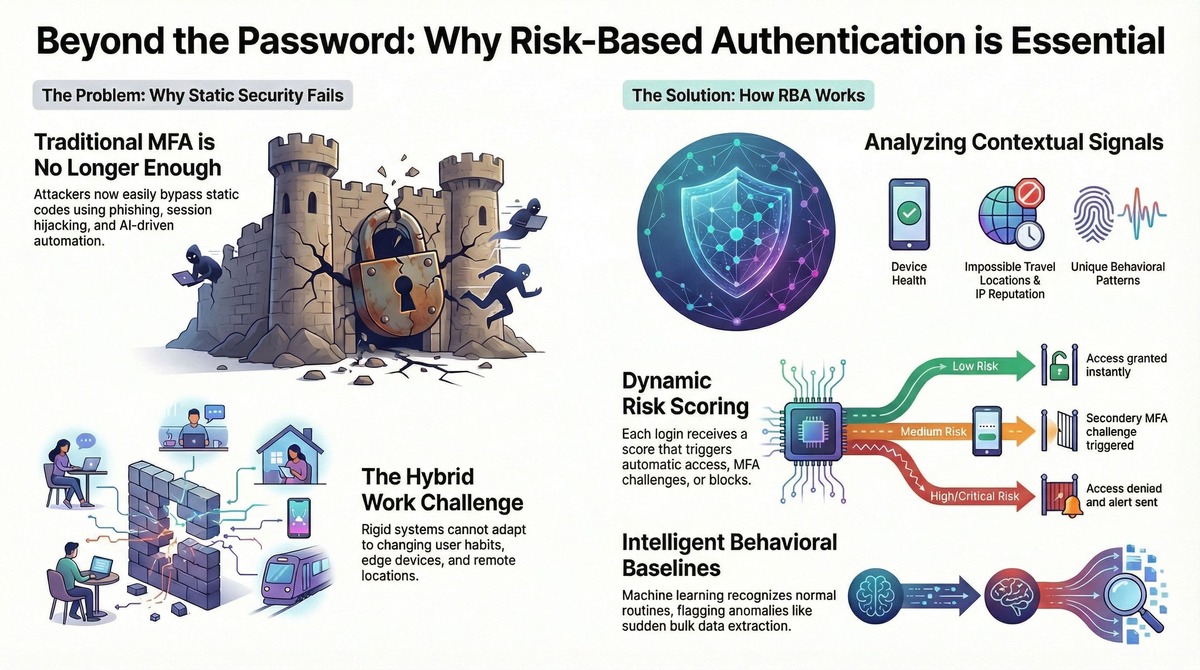
Today’s cyber threat landscape includes attackers who can mimic legitimate users by hijacking sessions or intercepting MFA codes. Threats fueled by automation and AI make it easier than ever for attackers to access systems even when users have followed standard authentication practices.
What makes risk-based systems more effective is that they don’t just check if a credential is correct—they evaluate whether everything surrounding the login makes sense. This layered analysis helps enterprises create policies that adapt based on risk, turning authentication into an ongoing process instead of a single checkpoint. When RBA is integrated with identity federation and access management frameworks, it becomes a core component of modern enterprise security.
Businesses are increasingly turning to RBA not just for internal workforce protection, but also to secure customer portals and mobile services. Real-world examples include banks detecting unusual transactions or healthcare providers adjusting access based on the sensitivity of a patient’s records or the context of a clinician’s session.
One of the most valuable aspects of adaptive authentication is that it enhances security without disrupting daily workflows. By applying machine learning to recognize normal user behavior, security teams can reduce false alerts while ensuring that actual threats don’t go undetected. This approach also supports broader initiatives like Zero Trust and aligns with standards such as the NIST SP 800-63 Digital Identity Guidelines, which promote continuous, context-aware validation.
For enterprises accelerating cloud adoption or digital services, risk-based authentication platforms such as those offered by StoneFly provide robust protection with flexibility. These solutions integrate with both cloud-based and on-prem environments, delivering consistent enforcement no matter where users are connecting from. By collecting contextual data in real time from every session, RBA systems can quickly adapt to new threats and support faster response times.
Risk-Based Authentication (RBA) is a flexible and intelligent security framework designed to protect access without adding unnecessary friction. Unlike traditional models that rely only on usernames and passwords, RBA evaluates the context of each login attempt in real time and adjusts authentication requirements based on the level of risk.
As cyberattacks become more targeted and credential theft continues to rise, organizations need more than just static defenses. Risk-based authentication introduces context-awareness, analyzing multiple signals to assign a risk score to every access request. This score determines whether to allow access, prompt for further authentication, or block the attempt outright.
The core idea behind RBA is to strengthen security without disrupting legitimate users. It looks beyond the password, evaluating details such as where the request originates, the device being used, and how closely the activity matches a user’s known behavior.
This approach lets organizations apply extra security measures only when there’s a reason to be cautious—making authentication more flexible. The system continuously monitors activity across sessions while scaling easily to accommodate large and distributed enterprise environments.
### What Goes Into a Risk Score? Multiple Signals Combined in Real Time
Instead of relying on a single indicator, RBA collects and analyzes many data points to determine whether a session appears risky. Some of the key signals include:
One key factor is whether a login attempt comes from a familiar device. If someone usually signs in from a work laptop and then tries to access an account from an unknown tablet, the unusual device flags elevated risk. Device profiling is a simple but effective method to spot new or potentially compromised sessions early on, without affecting regular access.
Advanced fingerprinting can identify browser details, operating systems, and even hardware elements. When these don’t match past records, the system may request an additional verification step such as multi-factor authentication (MFA).
Risk-based authentication also examines how a user typically interacts with systems over time. Behavioral analytics—such as patterns in mouse movement, typing speed, or navigation flow—help the system understand normal routines.
For example, if someone who usually checks their calendar and emails logs in and immediately pulls large volumes of sensitive data, that shift in behavior stands out. These patterns are tracked continuously, allowing security teams to detect suspicious activity as it unfolds.
Location data plays a vital role in risk assessment. If an account is accessed from the U.S. at noon, then from another country a few minutes later, the system flags this as highly suspicious. Known as an “impossible travel” event, it’s one of the clearest signs that something is off.
In addition to geographic checks, the system considers IP reputation. Traffic from anonymized or suspicious sources—like VPNs, proxies, or Tor nodes—generates higher risk scores. When cross-referenced with device and behavior data, these signals provide a broader security picture.
Once all signals are evaluated, the platform assigns a risk score—usually numeric or tiered into categories like low, medium, high, or critical. These scores directly impact how the system responds:
– Low risk: Access granted without interruption.
– Medium risk: Additional steps like MFA are triggered.
– High risk: Stricter measures, such as identity checks or temporary access hold, may apply.
– Critical risk: Immediate denial of access and alert sent to security operations.
This decision process unfolds before access is fully granted, catching potential threats early.
Risk-based authentication is not a one-time check. As conditions change, the system continues to monitor session variables and user actions, allowing it to make adjustments dynamically. This real-time adaptability supports modern enterprise environments—where employees access systems from multiple locations and devices throughout the day.
Depending on factors like location, login time, or recent behavior, a single user might face different authentication paths on different days. This flexible approach also supports Zero Trust principles, where users are never fully trusted by default—even after logging in—without continuous evaluation.
Unlike reactive, rules-based systems, RBA uses intelligent algorithms to respond to evolving risks swiftly and automatically. This makes it well-suited for large enterprises where threats evolve rapidly and fast decision-making is essential.
Risk-based authentication goes beyond stronger passwords or basic MFA. It’s a scalable, intelligent system that adapts to real-world usage patterns and evolving threats. For organizations embracing remote work, hybrid infrastructures, and cloud adoption, RBA enables strong identity verification with minimal disruption to end users.
By responding to real-time context and behavior, risk-based authentication helps reduce attack surfaces, improve detection of suspicious activity, and maintain secure, uninterrupted access across the enterprise.
Adaptive authentication is a flexible, context-aware security approach that evaluates a range of factors in real time to determine whether a login attempt should be allowed. Unlike traditional multi-factor authentication (MFA), which applies the same verification steps to every session, adaptive authentication adjusts based on variables such as device type, location, time of access, user behavior, and IP reputation.
In large enterprise networks, where thousands of employees connect remotely from a variety of devices and across multiple time zones, relying solely on static MFA solutions falls short. Adaptive authentication goes a step further by continuously learning user habits and using machine learning to assess risk. This allows it to seamlessly verify trusted users while identifying and responding to unusual activity.
By incorporating adaptive authentication into identity and access management systems, IT teams can assign trust levels to each session. If something seems out of the ordinary—such as an unrecognized device or unusual login time—the system can respond immediately by prompting for additional authentication, restricting access to certain resources, or blocking entry altogether.
This method aligns with the principles of Zero Trust security, where every access request is evaluated based on real-time context rather than preset credentials alone. Adaptive authentication not only raises the bar for identity protection but also minimizes disruption for verified users, creating a smoother and more secure login experience.
Risk-based authentication (RBA) and adaptive authentication are related but distinct approaches. Both are designed to manage access based on the potential risk of a login attempt, but they work in different ways and serve different purposes.
Risk-based authentication uses static rules and predefined metrics to assess each login. These criteria might include IP reputation, device type, time, or known login history. Based on this information, the system evaluates the risk and determines whether to grant access, request additional verification, or block the attempt. It’s a rules-driven model used mainly during login to enforce policy requirements.
Adaptive authentication builds on this concept by analyzing behavior and evolving over time. Rather than checking against a fixed set of rules, it uses behavioral analytics and machine learning to learn how users typically access systems. For example, if an employee regularly signs in from two different regions due to business travel, adaptive authentication can recognize and accommodate this behavior—whereas static RBA might consider it suspicious.
In simpler terms, risk-based authentication focuses on whether a login attempt meets a set of policy conditions, while adaptive authentication evaluates whether the behavior fits an individual’s usage pattern. The latter offers a more nuanced, flexible response to threats, especially in complex or high-traffic environments.
Adaptive authentication also supports ongoing session monitoring, sometimes referred to as Continuous Risk-Based Authentication. This means it can reassess risk even after login and respond if a user begins behaving in a way that appears abnormal—capabilities that standard RBA systems typically lack.
Risk-based authentication is well-suited for industries and scenarios that prioritize compliance and policy enforcement. Sectors like banking, finance, and government often implement strict controls based on clear conditions such as geographic restrictions or known device identities.
For instance, a bank might use risk-based authentication to block all login attempts from IP addresses originating outside of specific countries or organizational networks. If a login crosses a predefined threshold—like coming from an unfamiliar or flagged location—the system quickly applies stronger verification requirements or denies access altogether.
Adaptive authentication, on the other hand, is a better fit for dynamic enterprise environments that value scalability and adaptability. Businesses with distributed teams, flexible work policies, or bring-your-own-device (BYOD) practices benefit from the responsiveness and learning capabilities of adaptive systems.
These systems can evaluate a wide range of contextual data, such as application sensitivity, browser type, or access time, and adjust access protocols based on real-world behavior. For companies that rely heavily on cloud services and SaaS platforms, adaptive authentication provides a security framework that accounts for complexity without slowing down users.
It also allows security teams to prioritize access based on risk—granting seamless access for verified users while applying stricter checks in real time where needed. This helps reduce potential attack vectors while maintaining productivity.
Integrating both risk-based and adaptive authentication creates a layered approach to identity protection. By combining rule-based logic with behavioral analysis, organizations can detect a broader range of identity threats—from brute-force login attempts to subtle abnormalities in user behavior.
In practice, merging the two methods allows for faster and more intelligent decision-making. For example, a login attempt from a trusted device might pass through a risk-based rule check. But if adaptive monitoring detects something unusual—such as changes in mouse movement patterns or login velocity—the system can trigger additional verification without needing manual intervention.
This hybrid model is especially effective for securing high-priority platforms like ERP systems, customer records, or remote development tools. It gives security teams more context while cutting down on false positives, and it keeps authentication workflows smooth for everyday users.
From a technical perspective, both authentication methods can be integrated into modern identity and access management (IAM) platforms. Risk-based systems often support quick integration through APIs and connectors, while many adaptive tools offer built-in machine learning and behavioral analysis capabilities. Together, they form a cohesive security framework that grows with the organization.
Incorporating both risk-based and adaptive authentication into enterprise security strategies enables continuous, intelligent access monitoring. It enhances user experiences, improves threat detection and response, and aligns with evolving enterprise needs across local and cloud-native environments. For organizations focused on strengthening security without adding complexity, this layered model delivers practical and sustainable protection.
Risk-Based Authentication (RBA) provides a smarter, more flexible approach to enterprise access control by adjusting authentication requirements based on the contextual risk of each login attempt. Unlike traditional static methods, RBA evaluates contextual signals and adapts authentication measures in real time. For enterprises with diverse user environments, this approach not only strengthens security but also maintains a smooth user experience. Here’s how organizations can benefit from implementing RBA in their access control strategy.
One of the key advantages of RBA is its ability to provide secure, low-friction access for legitimate users in low-risk scenarios. By evaluating signals such as IP reputation, device recognition, location data, time-of-access trends, and behavioral patterns, RBA can determine when it’s safe to allow users through without added verification steps.
For internal teams or users who follow consistent behavior patterns, RBA systems reduce login complexity, especially when integrated with Single Sign-On (SSO) or federated identity solutions. This leads to faster logins, fewer access issues, and smoother workflows across departments.
In high-traffic environments, RBA continuously evaluates ongoing sessions in the background, reducing interruptions while keeping the system safeguarded against unusual behavior or threats.
Risk-Based Authentication enhances enterprise defenses by identifying and responding to suspicious activity automatically. Access attempts from anonymized networks, changes in device fingerprinting, or logins occurring at unusual hours can be flagged and escalated through additional security measures such as multi-factor authentication (MFA), biometric verification, or out-of-band authentication options.
This risk-aware, asynchronous evaluation allows security systems to act decisively without slowing down legitimate users. For organizations looking to counter threats like credential stuffing or automated attacks, the contextual awareness built into RBA provides more accurate and effective protections.
Backed by machine learning and behavioral analytics, RBA systems can also detect more complex threats such as identity impersonation or account hijacking, helping organizations stay ahead of evolving cybersecurity risks.
One major benefit of RBA is operational cost reduction. Traditional access control systems often generate false positives, triggering manual reviews or helpdesk support for otherwise valid users — a drain on both time and resources.
By scoring each session based on risk, RBA platforms quickly allow access when factors meet the organization’s thresholds. Only when anomalies are detected does the system trigger further verification, which significantly reduces the need for manual review.
This also means fewer locked accounts or failed login escalations reaching IT support, freeing up technical staff to prioritize more strategic security initiatives. With intelligent automation in place, enterprises can enforce strong security policies without creating excess administrative overhead.
Industries subject to regulation—such as healthcare, finance, or government—must be able to prove that user identity and data access are tightly controlled. RBA solutions support this need by logging every authentication event with relevant contextual data and risk metrics.
With detailed audit trails and clear authentication history, IT teams can confidently demonstrate compliance with frameworks like GDPR, HIPAA, and PCI-DSS. These records also simplify audits and assist in incident response investigations, giving organizations greater transparency and control over who accessed data and under what conditions.
By actively mitigating access risks and internally documenting decisions, RBA helps organizations reduce the chances of regulatory penalties while improving overall security posture. The system’s adaptability also positions businesses to respond quickly to evolving compliance requirements.
As organizations grow—through expansion, increased remote work, or digital service offerings—authentication systems must scale to meet broader access demands without compromising speed or consistency.
Modern RBA solutions are designed to scale with enterprise growth. Cloud-native or hybrid-delivery options are built for high performance across millions of authentication events daily. Microservices architecture allows the environment to scale individual components dynamically, matching usage peaks and regional requirements.
Thanks to built-in support for SAML, OAuth 2.0, and OpenID Connect, RBA platforms integrate smoothly with existing SSO and Identity and Access Management (IAM) systems. Enterprises can centrally manage policies across all users — including employees, third-party vendors, and external customers — and enforce consistent security standards across locations and applications.
Globally distributed operations also benefit from optimized response times and rapid authentication decisions, even during peak usage. As enterprises evolve, RBA scales right alongside, ensuring security systems never become a bottleneck.
Access control systems play a critical role in enterprise cybersecurity. They define who can access specific systems, applications, and data—and under what circumstances. But as cyber threats become more advanced and harder to detect, traditional access models like Role-Based Access Control (RBAC) are falling short. To stay ahead of these evolving risks, organizations need access controls that are smarter, more flexible, and capable of adapting to changing conditions in real time. This is where risk-based authentication (RBA) makes a significant impact.
Access control mechanisms are designed to restrict and regulate access to digital and physical resources within IT environments. These systems work by enforcing rules around authentication and authorization, ensuring that only verified users can carry out specific tasks—like accessing a database or logging into a secure platform.
At the core of any access control system is identity verification. Traditional methods—such as passwords, smartcards, and even static multi-factor authentication (MFA)—often fall short when it comes to detecting behavioral anomalies or responding to emerging threats. Attacks such as credential stuffing, phishing, and session hijacking can slip past these fixed defenses.
Risk-based authentication adds a crucial adaptive layer to this process. Instead of granting access purely based on credentials, RBA evaluates the risk associated with each login attempt by using contextual data. It adjusts the level of authentication required depending on what it observes about the session, helping ensure that users are who they claim to be—without slowing down legitimate access.
Conventional access control models like RBAC and Attribute-Based Access Control (ABAC) function on consistent sets of permissions tied to individual roles or attributes. While these systems are effective for clearly defined environments, they’re less capable of responding to the nuances of real-time user behavior.
Risk-based access control evaluates risk dynamically, modifying access privileges on the fly. This approach involves monitoring user behavior, geolocation, device metadata, and other contextual indicators throughout a session.
By analyzing this information, risk-based systems decide whether to grant access, ask for further identity verification, or block the attempt altogether. These systems often incorporate machine learning to continually refine their assessments, learning from previous behaviors to make more nuanced access decisions over time.
Modern authentication requires more than matching usernames and passwords. Context-aware or contextual authentication looks at the full picture—considering time of access, IP reputation, geographic location, device type, and historical user behavior to assess the likelihood of a legitimate login.
Take a scenario where a user typically logs in from a company-managed device in California, but suddenly attempts access from an unknown device in another country at an unusual hour. That activity—while not definitive proof of malicious intent—is a red flag. Risk-based systems can respond accordingly by requesting additional verification, such as biometric factors, or blocking access altogether.
This approach reduces false positives while maintaining strong security. Trustworthy users aren’t disrupted, while users who present a higher risk face more thorough verification methods. It creates a more efficient workflow and reduces friction where it’s not needed, without compromising safety.
Unlike traditional systems that assess user identity only at the beginning of a session, continuous authentication re-evaluates user behavior throughout the entire interaction.
This includes monitoring data such as keystroke patterns, mouse movement, application usage, and access behavior. If something changes—say a user suddenly tries to download sensitive files in bulk or exhibits actions that deviate from their history—the system can automatically enforce a re-authentication or suspend the session entirely.
This approach is especially valuable in scenarios involving privileged access or sensitive data. It allows security teams to detect suspicious behavior in progress and act quickly—without waiting for the next login attempt.
For example:
– A user who logs in normally but later initiates mass data extraction can be stopped before information is exfiltrated.
– If a remote employee begins operating outside a secure VPN or switches to an unsecured Wi-Fi network, the system can detect the risk, limit access, or shut it down automatically.
By pulling in behavioral data continuously, enterprises build a real-time risk profile that evolves with the session. It not only reinforces access control but creates a comprehensive audit trail for compliance and investigation purposes.
Rolling out Risk-Based Authentication (RBA) in enterprise environments involves more than just deploying a new security feature. It requires careful integration with existing identity and access management (IAM) and single sign-on (SSO) platforms, thoughtful user experience design, thorough staff training, and strong monitoring capabilities. A well-executed implementation can significantly enhance access control without disrupting daily operations or frustrating users.
Most enterprise IAM and SSO solutions are built to be modular, making it feasible to incorporate risk-based features. However, incorporating risk analysis into these systems demands detailed planning—especially in environments that involve federated identity, multi-tenant access, or hybrid cloud deployments.
Start with an authentication risk assessment. This should identify the key variables that inform risk decisions—such as device health, login location, time-of-access anomalies, and behavioral patterns. These parameters form the basis for policy design.
Next, integrate RBA policies into the IAM workflows. Major identity providers like Azure AD and Okta typically offer adaptive risk management tools. Administrators can create rules that trigger multi-factor authentication (MFA) or deny access based on real-time conditions, such as a sign-in from an unrecognized device or unusual location. These decisions are guided by live contextual signals—not fixed user attributes.
For custom-built or federated SSO deployments, RBA elements can be added using proxies, custom policies, or third-party services that support protocols like SAML, OpenID Connect, or LDAP.
It’s important that the RBA engine supports real-time analysis during active sessions—not just at login. This aligns with modern zero trust strategies and supports dynamic access decisions as user context evolves.
One common implementation misstep is setting overly strict policies, which can frustrate legitimate users. Risk-Based Authentication should be configured to step up security measures only when needed, based on actual activity.
Security teams can adjust policy thresholds to accommodate normal behavior. For instance, users who travel often shouldn’t be prompted for MFA every time they log in from a new location. Instead, combine location data with other context—like access time or device risk level—before escalating to stronger authentication methods.
User interface feedback also matters. Clear notifications like “We’ve detected a new device” help users understand why additional verification is needed and reduce confusion. Vague or ambiguous messages can lead to support requests and negatively impact the user experience.
Where possible, enable silent authentication options such as biometric revalidation, token reuse, or context-aware conditional access—especially for low-risk sessions. These features help reduce unnecessary friction while maintaining security.
Regular feedback sessions with departments that require elevated access—such as DevOps, finance, or IT—can help fine-tune policies and ensure the RBA system is aligned with how people work.
A successful RBA deployment depends on buy-in from teams across the organization. IT administrators, security teams, and even DevOps must understand how contextual authentication works and what to expect during implementation.
Begin with a phased rollout, testing policies with lower-risk groups or in parallel with existing systems. Provide IT and security operations teams with full visibility into the RBA engine so they can monitor access attempts, adjustment needs, and potential false positives.
Key areas for training should include:
– Understanding of contextual signals: Device health, user behavior, IP trust levels, and more.
– Policy configuration: Building, testing, and evolving adaptive access rules within the IAM framework.
– Incident response: Creating playbooks for how to handle potentially malicious sign-in attempts.
To support long-term success, link RBA results—such as reduced credential abuse or successful MFA challenges—to broader organizational security goals.
Unlike static MFA, RBA requires sustained evaluation of users and sessions. This is especially important in distributed or hybrid work models where context can shift quickly—from location to device posture to network behavior.
Ensure comprehensive logging for all key actions: login events, token refreshes, MFA challenges, authentication downgrades, and session terminations. Each log entry should include the risk score, how the decision was made, what triggered it, and the outcome. Integrate these data points into your SIEM platform for cross-system visibility.
More advanced platforms offer machine learning models that track user behavior patterns over time. These tools can detect subtle anomalies, flag compromised accounts early, and work in tandem with detection systems like EDR or XDR.
Also, build dedicated incident workflows for RBA-related events. These might include:
– High-risk alerts triggered by login attempts from low-trust network zones
– Repeated failed MFA prompts, which may signal brute-force attacks
– Simultaneous logins from geographically distant regions
Such anomalies should feed into automated responses—whether that’s requiring additional authentication, temporarily suspending access, or initiating a supervised reauthorization process.
Policy and threat model audits should happen regularly as part of your broader governance strategy. RBA rules must stay aligned with evolving attack techniques and internal business changes.
Implementing Risk-Based Authentication effectively is a multi-faceted effort. When integrated thoughtfully, it strengthens security posture without creating unnecessary barriers. Success requires a balance—intelligent policy design, a smooth user experience, well-prepared teams, and continuous monitoring.
By committing to a strategic rollout, enterprises can turn RBA into a core part of their identity management strategy—protecting critical systems while allowing users to work efficiently and uninterrupted.








Join our mailing list to receive the latest news, updates, and promotions from StoneFly.