
A financial services company ran a full suite of automated security scans on every build. Their SAST tool had a 94% coverage rate across the codebase. Their DAST tool ran against every staging deployment before release. In a post-incident review after a major breach, their security team traced the root cause to a privilege escalation flaw in their loan approval workflow. The logic error allowed a standard user account to approve its own loan applications by making a specific sequence of API calls. Every automated scan they ran had passed. The flaw was not a code pattern any scanner was configured to detect — it was a business logic error that required understanding how the application was supposed to work.
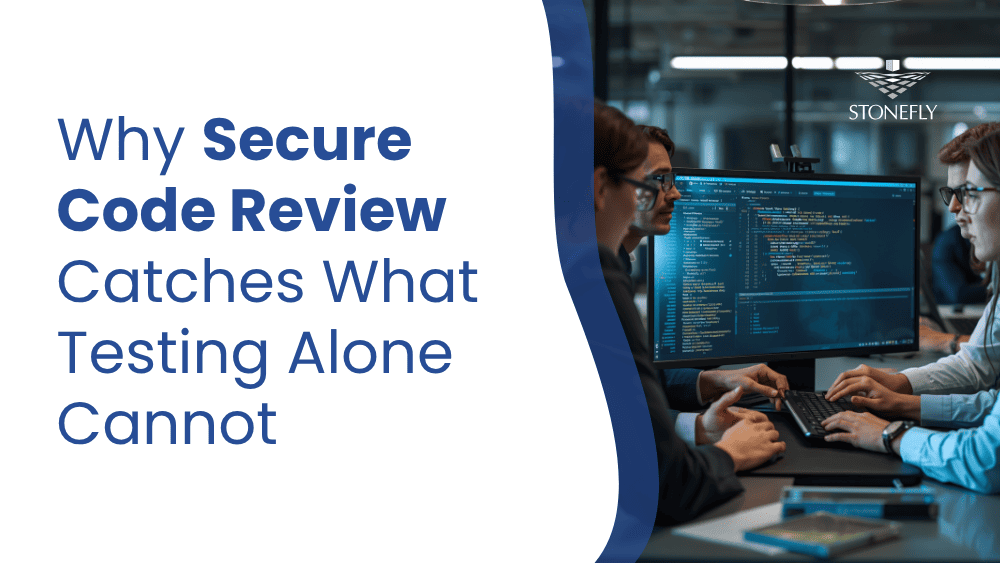
This is the gap that secure code review fills. Automated scanning finds known vulnerability patterns at scale. Penetration testing finds exploitable configurations and common attack vectors in running systems. Secure code review — the structured examination of source code by someone who understands both the code and the security implications of design decisions — finds the flaws that neither of those methods can reach.
This guide covers what secure code review is, how it differs from automated testing, how SAST, DAST, and IAST each contribute different types of coverage, what a review checklist should actually contain, and how to build a continuous code security program that catches vulnerabilities at the point where fixing them costs the least.
Secure code review is the structured examination of application source code to identify security vulnerabilities, design flaws, and violations of secure coding standards. It can be performed by human reviewers, automated tools, or a combination of both. The defining characteristic that separates it from functional code review is its focus: a functional review asks whether the code does what it is supposed to do; a secure code review asks whether the code does anything it is not supposed to do, and whether it handles adversarial inputs and conditions correctly.
Secure code review is not a replacement for application security testing. Testing validates how the application behaves when it runs. Code review examines the code that determines that behavior. Both are necessary because they find different types of problems. A runtime misconfiguration that exposes a debug endpoint will be found by testing and missed by code review. A logic error in an authorization check that requires reading the code to understand will be found by code review and missed by automated testing that does not know what the correct authorization behavior should be.
Manual secure code review relies on security-aware developers or dedicated security engineers who read the code with the question “How could this be attacked?” in mind. Manual review is most effective for complex authentication and authorization logic, cryptographic implementations, business logic that has security implications, input validation paths, and the integration points where data crosses trust boundaries. It is slow and does not scale to entire large codebases, which is why it is applied selectively to the highest-risk code rather than universally.
Automated scanning applies predefined rules and pattern matching to identify known vulnerability classes across the entire codebase rapidly. It scales where manual review cannot, catches consistent classes of problems reliably, and provides immediate feedback in development workflows. Its limitation is that it only finds what it is programmed to look for. Novel vulnerabilities, logic errors unique to the application’s business context, and flaws that require understanding the intent of the code rather than its syntax are not caught by automated scanning.
The practical approach for enterprise organizations combines automated scanning for breadth — covering the full codebase for known vulnerability patterns — and manual review for depth — examining the highest-risk code components with human expertise that understands the security implications of design and logic decisions.
The earlier in the development lifecycle a vulnerability is found, the cheaper it is to fix. A vulnerability found during code review before a feature ships costs significantly less to remediate than the same vulnerability found during a production incident after it has been in production for six months. This cost differential is the primary business case for integrating secure code review throughout the development process rather than treating it as a pre-release gate.
In a DevSecOps model, automated code scanning runs on every commit, providing immediate feedback at the point where code is written. Manual review occurs at pull request or merge request stages for high-risk components. Periodic comprehensive reviews of critical systems supplement the continuous scanning. Post-release monitoring and periodic penetration testing validate that the controls implemented through code review are functioning as intended in the production environment.
Three automated testing methodologies — Static Application Security Testing (SAST), Dynamic Application Security Testing (DAST), and Interactive Application Security Testing (IAST) — address different phases of the application lifecycle and find different categories of vulnerability. Understanding what each method does and what it cannot do is necessary for designing a testing program that provides real coverage rather than the appearance of coverage.
Static Application Security Testing analyzes source code, bytecode, or compiled binaries without executing the application. SAST tools scan for patterns associated with known vulnerability classes: SQL injection points where user-controlled data flows into database queries without sanitization, buffer overflow conditions in memory management, hardcoded credentials in configuration files, use of known-insecure cryptographic functions, and missing input validation on user-supplied data.
SAST’s major advantage is that it can be integrated directly into the developer’s IDE or the CI pipeline, providing feedback at the point where code is written or committed. Developers receive immediate notification when they introduce a known vulnerability pattern, before the code leaves their workstation. This immediacy reduces the cognitive gap between writing the code and fixing the security issue, which produces faster remediation and better developer learning.
SAST’s significant limitation is false positive rate. SAST tools often flag code paths as vulnerable when the vulnerability cannot actually be triggered in the application’s deployment context, or when sanitization occurs in a different code module than the one the tool is analyzing. High false positive rates erode developer trust and produce alert fatigue — developers who have learned that most SAST findings are false positives start dismissing findings without investigating them, which means genuine vulnerabilities get missed. Tuning SAST tools to the specific application’s architecture and coding patterns reduces false positives and restores the signal-to-noise ratio that makes the tool actionable.
Dynamic Application Security Testing interacts with a running application, sending crafted inputs and analyzing responses to identify vulnerabilities that manifest at runtime. DAST simulates attacker behavior: it probes endpoints for injection vulnerabilities, tests authentication mechanisms for bypasses, checks session management for token predictability and fixation vulnerabilities, and verifies that error handling does not expose sensitive internal state.
DAST finds vulnerabilities that SAST cannot because it operates on a running application with real configuration, real network behavior, and real integration with external services. A misconfigured web server that exposes a debug endpoint, a session cookie without the Secure or HttpOnly flags set, or an authentication flow that behaves differently when requests arrive in an unexpected sequence — these are all DAST findings that SAST would not detect because they involve runtime behavior rather than code patterns.
DAST’s limitation is coverage. It can only test what it can reach through the application’s external interfaces. Complex authentication flows, multi-step business transactions, and APIs that require specific session context or sequenced calls are difficult for automated DAST tools to navigate without custom configuration. DAST also cannot directly examine source code, which means it can detect that a vulnerability exists but cannot tell developers exactly where in the code the vulnerability originates.
Interactive Application Security Testing embeds instrumentation agents within the running application that monitor its internal behavior during testing. When the test suite or a QA environment exercises the application, the IAST agent observes how data flows through the application’s internal logic, identifies when that data reaches sensitive operations like database queries or file system access in a potentially unsafe state, and reports the vulnerability with direct reference to the specific code location where it originates.
Because IAST observes actual data flows during execution, it produces findings with lower false positive rates than SAST and more precise code-level attribution than DAST. The trade-off is that IAST coverage is bounded by the test coverage of the test suite executing the application — code paths that are not exercised during testing are not analyzed by the IAST agent. IAST is most effective when integrated into comprehensive QA test suites that exercise the full range of application functionality.
Runtime Application Self-Protection (RASP) is a production defense mechanism that embeds protection logic within the running application to detect and block attacks in real time. Unlike SAST, DAST, and IAST, which are testing tools used before or during development and QA, RASP is a production control. It is most valuable for applications where known vulnerabilities cannot be immediately remediated in the code — providing a defensive layer while the development team works through remediation. RASP is not a substitute for secure code review and testing; it is a residual risk control for vulnerabilities that have made it to production.
No single testing method provides complete coverage. A mature application security testing program uses all three — SAST in the CI pipeline for immediate feedback on code commits, DAST against staging environments before production deployment, and IAST during QA testing for deep code-level insight with lower false positive rates. The findings from each method are correlated in a unified vulnerability management platform, deduplicated, and prioritized based on severity and business risk. Manual code review focuses expert attention on the high-risk code components that automated tools are least equipped to assess.
A secure code review is a structured process with defined stages. Organizations that run ad hoc reviews — looking at code when someone has time, without a consistent scope or methodology — produce inconsistent results and miss systematic vulnerability classes. A defined process applied consistently produces reproducible results that can be measured, improved, and used as evidence for compliance purposes.
Not all code carries the same risk, and review depth should reflect risk level. The scoping phase identifies which code components require the most intensive review based on their security significance: authentication and session management code, authorization and access control logic, cryptographic implementations, input validation and sanitization, data persistence and retrieval operations, API endpoints that handle sensitive data, and third-party integration points where data crosses trust boundaries.
The scoping decision also covers which review methods are appropriate. A new authentication module being deployed to a customer-facing application handling payment data warrants manual expert review, SAST analysis, and DAST testing against a staging deployment. A minor update to a low-risk internal reporting tool may require only automated SAST scanning. Applying the same level of review to everything is neither feasible nor necessary; applying insufficient review to high-risk components is the failure mode that produces serious incidents.
During the analysis phase, reviewers examine code against a structured checklist of security requirements. The OWASP Code Review Guide and OWASP Application Security Verification Standard (ASVS) provide the most widely used checklists for this purpose. Key areas the review covers include input validation — whether all user-supplied data is validated and sanitized before being used in sensitive operations; output encoding — whether data is encoded correctly when rendered in contexts like HTML, SQL, or operating system commands to prevent injection; authentication and session management — whether credentials are handled correctly, session tokens are generated with sufficient entropy, and sessions are invalidated correctly on logout; authorization — whether every data access and sensitive operation verifies that the requesting user has permission; cryptography — whether encryption uses current, appropriate algorithms and whether key management is implemented correctly; and error handling — whether error conditions are handled in ways that do not expose sensitive information to users or logs.
Review findings should be documented with enough specificity that a developer who did not participate in the review can understand exactly what the vulnerability is, where it is in the code, why it is a security concern, and what the recommended remediation is. Generic findings — “input validation is missing” without a specific code location and a concrete remediation — produce delays as developers seek clarification and sometimes result in incomplete fixes that address the symptom rather than the root cause.
Severity classification should reflect both technical severity and business context. A SQL injection vulnerability in a table that contains only non-sensitive configuration data is technically severe but may be lower actual risk than a medium-severity authorization flaw in a function that processes customer financial data. Prioritization that accounts for business context produces a remediation order that reduces actual risk rather than just resolving technically high-severity findings first.
A secure code review checklist provides the structured framework that ensures reviews cover all relevant security domains consistently, regardless of which reviewer is conducting them. A checklist that is too generic — just listing “authentication” and “encryption” as categories — does not guide reviewers to the specific checks that matter. A checklist that is too specific to a single technology stack does not apply when the organization’s applications use different languages or frameworks.
Input validation covers all paths through which external data enters the application: HTTP parameters, headers, cookies, API request bodies, file uploads, data from external services, and data read from databases that was originally provided by users. The checklist should verify that input is validated against an allowlist of expected values or formats rather than a blocklist of known-bad values (blocklists are always incomplete), that validation occurs in a consistent central location rather than being implemented inconsistently across many individual functions, and that invalid input causes a controlled rejection rather than being passed to downstream processing with unpredictable results.
Output encoding is the complement of input validation: it ensures that data is rendered in its destination context in a way that prevents it from being interpreted as executable code. SQL queries should use parameterized queries or prepared statements, not string concatenation. HTML output should encode user-controlled data to prevent XSS. Operating system commands should never be constructed from user-controlled input. These are the technical implementations of the injection vulnerability mitigations that the OWASP Top Ten identifies as the most critical application security concern.
Authentication review verifies how the application establishes user identity: whether passwords are hashed with a current, appropriate algorithm (bcrypt, Argon2, or scrypt — not MD5 or SHA-1), whether multi-factor authentication is implemented for sensitive operations, whether credential storage follows the principle that plaintext credentials are never stored anywhere in the system, and whether brute force and credential stuffing mitigations are in place.
Session management review covers how the application maintains authenticated sessions: whether session tokens are generated with sufficient entropy (not sequential or predictable), whether session tokens are rotated after privilege changes like login or elevation, whether sessions are correctly invalidated on logout and after a period of inactivity, and whether session tokens are transmitted and stored with appropriate security properties (HTTPS only, HttpOnly and Secure flags on cookies).
Authorization review is where the business logic privilege escalation vulnerability from the opening scenario would have been caught. The checklist should verify that every operation that accesses data or executes a privileged function performs an authorization check, that the authorization check verifies not just that the user is authenticated but that the specific user is authorized to perform the specific operation on the specific resource, and that authorization logic is implemented centrally rather than duplicated across many individual endpoints where inconsistencies can emerge.
Cryptographic review verifies that the application uses current, appropriate algorithms for the purpose: AES-256-GCM or equivalent for symmetric encryption, RSA-2048 or elliptic curve cryptography for asymmetric operations, bcrypt or equivalent for password hashing, and TLS 1.2 or higher for transport encryption. It also verifies that key management is implemented correctly — that keys are not hardcoded in source code, are stored in appropriate key management systems, and are rotated on a defined schedule.
Third-party dependency review verifies that the libraries and frameworks the application relies on are current versions without known vulnerabilities and that a software composition analysis (SCA) process tracks the dependency inventory and alerts when new vulnerabilities are disclosed against dependencies in use. Outdated or vulnerable dependencies are consistently in the top vulnerability categories in application security assessments because they are easy to overlook in large applications with many dependencies.
Error handling review verifies that error conditions are handled in ways that do not expose sensitive information. Stack traces, database error messages, internal file paths, and system configuration details should never be returned to users in error responses. Generic error messages should be returned to users while detailed error information is logged internally for debugging. Logging review verifies that security-relevant events — authentication attempts, authorization failures, input validation failures, significant data access — are logged with enough detail to support incident investigation, and that log content does not include sensitive data like plaintext passwords or payment card numbers.
Secure code review and automated security testing deliver their full value when integrated into the development process rather than applied as a separate security gate at the end of the development cycle. End-of-cycle security reviews create bottlenecks, produce large backlogs of findings that developers must address under release pressure, and miss the opportunity to prevent vulnerabilities at the point where they are easiest and least expensive to fix.
A CI pipeline with security gates runs SAST analysis on every code commit and blocks the commit from progressing if critical or high-severity vulnerabilities are detected. This gate is the most cost-effective security control in the development lifecycle — it prevents vulnerable code from being merged into the main branch, where it becomes progressively more difficult and expensive to remove as other code builds on top of it.
Dependency scanning runs alongside SAST, checking the dependency inventory against vulnerability databases and blocking builds that include dependencies with known critical vulnerabilities. Secret scanning detects accidentally committed credentials, API keys, and certificates before they reach the repository where they could be exfiltrated or exploited.
Shifting security left means moving security feedback as close as possible to the point where code is written. IDE plugins that surface SAST findings as the developer types, pre-commit hooks that run lightweight security checks before code is committed, and code review tooling that surfaces security-relevant patterns during pull request review all reduce the time between introducing a vulnerability and receiving feedback about it. The faster the feedback cycle, the lower the cognitive distance between writing the code and fixing the security issue, which produces better developer learning and faster remediation.
Developer security training is the organizational complement to technical tooling. Developers who understand why SQL injection works, what makes a session token predictable, and how authorization logic can be bypassed will write more secure code than developers who encounter security findings only as abstract checklist items. Threat modeling workshops that walk development teams through the attack surface of the applications they are building produce security intuition that improves code quality beyond what any tool can achieve.
Code security programs need metrics that reflect actual risk reduction, not just activity. The number of scans run is an activity metric. The mean time to remediate high-severity findings is an outcome metric. The defect recurrence rate — how often vulnerabilities of the same class reappear in code after being found and fixed — indicates whether the remediation process is producing lasting fixes or just patching specific instances of systemic problems.
A security gap analysis that benchmarks the current application portfolio against OWASP ASVS or relevant compliance frameworks identifies which vulnerability classes are most prevalent and which controls are weakest. This analysis should drive investment in the training, tooling, and process changes that will reduce the most frequent vulnerability classes rather than addressing findings on an ad hoc basis without identifying the systemic causes.
Regulatory and compliance requirements increasingly specify secure coding and code review as explicit requirements. PCI DSS Requirement 6.3 requires that custom application code be reviewed for vulnerabilities before deployment, with the review either performed by an organization other than the development team or conducted using automated tools. SOC 2 security controls include requirements for secure development practices. ISO 27001 Annex A includes controls for secure system development. GDPR’s data protection by design principle requires that applications handling personal data be designed and coded with data protection built in.
Compliance requirements are met through evidence: records that demonstrate that required controls were applied, that findings were documented, and that vulnerabilities were remediated before deployment. Secure code review programs should produce audit-ready documentation as a standard output rather than assembling evidence reactively when an audit is announced. Code review findings, severity classifications, remediation actions, and the dates on which vulnerabilities were identified and closed should all be captured in a system that can produce compliance reports on demand.
Automated tools that integrate with ticketing systems and version control provide the documentation trail that compliance requires. When a SAST finding is created, escalated, assigned to a developer, resolved with a code commit, and verified by a re-scan, the entire chain of events is recorded with timestamps and responsible parties. This documentation satisfies compliance requirements and provides the historical record needed to demonstrate program maturity during audits.
The OWASP Application Security Verification Standard (ASVS) provides the most detailed, testable specification of application security requirements organized by maturity level. ASVS Level 1 covers the basic security requirements that all applications should meet. Level 2 covers the requirements for applications that handle sensitive data. Level 3 covers the highest-risk applications where a security failure could cause significant harm. Using ASVS as the basis for secure code review checklists ensures that reviews are aligned with a defensible industry standard rather than an internally developed standard whose completeness cannot be independently verified.
NIST SP 800-218 (Secure Software Development Framework) and NIST SP 800-53 provide additional governance structure for integrating secure code review into enterprise software development programs. These frameworks are particularly relevant for organizations in regulated industries or working with government clients where compliance with NIST standards is a contractual requirement.
AI-assisted code analysis is changing what automated tools can detect and how quickly they provide feedback. Traditional SAST tools operate on pattern matching against predefined rules — they find what they are programmed to look for. AI-based code analysis uses machine learning models trained on large corpora of code and vulnerability data to identify patterns that do not match any predefined rule but statistically resemble vulnerable code.
The practical effect is that AI-assisted tools surface a broader class of potential vulnerabilities than rule-based tools, including some logic-level issues that traditional SAST misses. They also tend to produce different false positive patterns — less noise on well-understood vulnerability classes, more noise on novel or ambiguous code patterns where the model is less certain. As with traditional SAST, AI-assisted tools require tuning and human validation to produce actionable signal.
AI code generation tools have introduced a new dimension to secure code review. Developers using AI assistants to generate code are incorporating code that may be syntactically correct and functionally adequate but contains security vulnerabilities that reflect the biases or gaps in the model’s training data. Research has documented that AI-generated code frequently contains known vulnerability patterns — SQL injection, improper error handling, missing input validation — at rates comparable to or higher than human-written code.
This development makes secure code review more important, not less. AI-generated code should be subject to the same review standards as human-written code, with reviewers aware that AI-generated code may contain vulnerability patterns that look syntactically correct and superficially reasonable but are semantically insecure. The speed at which AI tools generate code also means that the volume of code requiring review is increasing, which creates pressure to automate more of the review process while maintaining the human oversight that catches what automation misses.
The financial services company from the opening scenario had automated scanning. What they did not have was a review process that could examine business logic for security implications. Their SAST tools scanned for code patterns. Their DAST tools tested endpoints for known attack classes. Neither asked: “Could a user approve their own loan by calling these APIs in this sequence?” That question requires a reviewer who understands both the code and the business process it implements.
A mature secure code review program uses SAST for continuous coverage of known vulnerability patterns, DAST for runtime validation of deployed applications, IAST for code-level precision during QA testing, and manual review for the high-risk code components where understanding intent matters more than pattern matching. A structured checklist ensures consistent coverage. Integration into CI/CD ensures findings surface at the point where they are cheapest to fix. Metrics track whether the program is actually reducing risk over time.
The organizations with the fewest serious application security incidents are not those with the most sophisticated tools. They are those where security review is a normal part of how code is written and shipped — not an obstacle imposed before release, but a practice that developers trust because it catches real problems and provides actionable guidance on how to fix them. That culture is built through consistent process, useful tooling, and the developer education that connects security findings to the business consequences they prevent.





Join our mailing list to receive the latest news, updates, and promotions from StoneFly.