
“If we get hit by ransomware tomorrow, can we recover without paying?”
It’s the board-level question behind a lot of 2026 infrastructure decisions. And for most enterprise IT teams, the honest answer — if the recovery path depends on a backup target that’s reachable from the production network — is “probably not.”
That’s not a config problem. It’s an architecture problem. And the distinction between the two is the entire difference between surviving a ransomware attack and paying the ransom.
Here’s what’s true, and what the CRN 2026 Storage 100 criteria for ransomware resilience — in the Software-Defined Storage category — actually measure.
What Ransomware Attackers Actually do in 2026
The 2023-era ransomware playbook — encrypt production, demand payment — has evolved. The 2026 playbook looks like this:
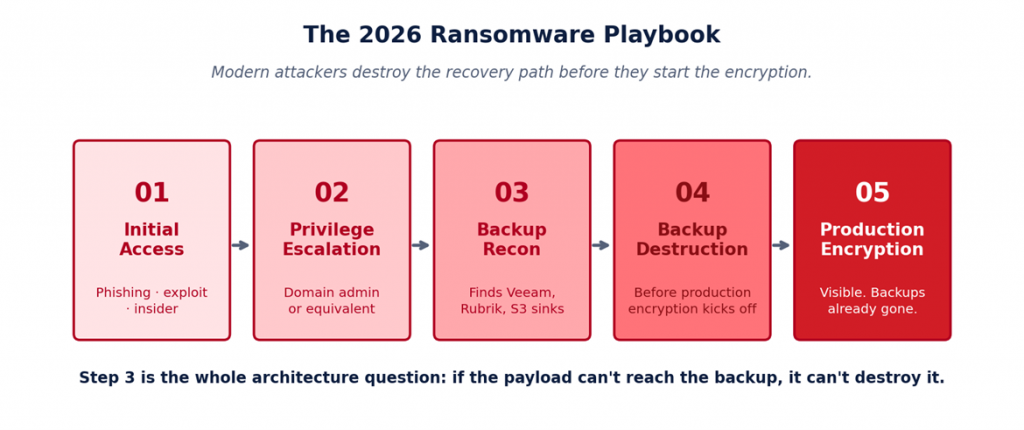
- Initial access. Phishing, vulnerability exploit, insider compromise. Sometimes all three.
- Privilege escalation. Domain admin or equivalent cloud credentials. Often within hours.
- Backup target reconnaissance. Modern ransomware payloads look for backup repositories first. Veeam, Rubrik, Commvault targets. Unstructured file shares. S3 buckets that look like backup sinks. The goal is not to fight the recovery — it’s to prevent the recovery.
- Backup destruction or encryption. Before the production encryption kicks off. Sometimes weeks before.
- Production encryption + extortion. The part that’s visible. By the time it’s visible, the backups are already compromised.
Notice what step 3 implies. The ransomware payload needs to reach the backup target to compromise it. If it can’t reach it, it can’t compromise it.
That’s the entire architecture question.
Why Configuration-Based Protection doesn’t Hold Up
The most common “ransomware protection” claim at the storage layer in 2025 was some combination of:
- Object lock on an S3-compatible bucket. A setting that prevents deletion and modification within a retention window.
- Immutable retention flags on a backup repository. A policy that the backup software honors.
- Network rules separating the backup VLAN from production.
- Role-based access controls on the backup target.
Every one of these is a configuration. And every configuration has a failure mode:
- Object lock can be disabled by a privileged user. It’s a setting, not a physical constraint.
- Retention flags are honored by the backup software. If the software’s credentials are compromised, the flags can be overridden.
- Network rules exist in a firewall config. Firewall configs get changed. By humans. Under pressure. At 2 AM. During an incident.
- RBAC depends on an identity provider. If the identity provider is compromised, so is the RBAC.
The 2025 post-incident reports are full of organizations that had every one of these configurations in place and still lost their backups. The configurations weren’t wrong. The architecture was.
What an Air-Gap Actually Has to do
The word “air gap” has been used loosely enough in 2024-25 storage marketing that it’s lost most of its technical meaning. Here’s what it has to mean to be credible in 2026:
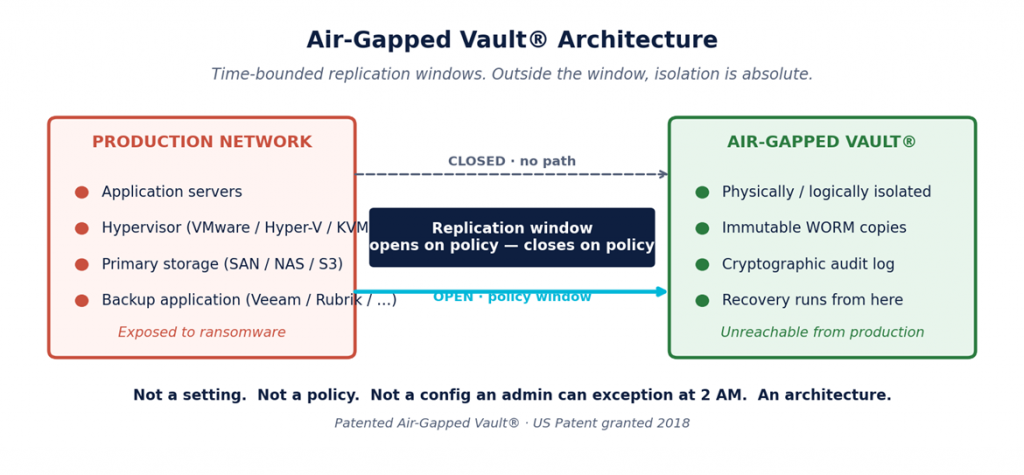
- Physical or logical isolation from the production network. Not “a separate VLAN.” Not “a separate VPN.” A storage plane the production network cannot route to under any normal operating condition.
- Time-bounded replication windows. Not continuous replication. A window that opens on a schedule, writes, and closes. Outside the window, the isolation is absolute.
- Immutable WORM copies inside the isolated vault. Not retention flags. Not object lock. Write-once storage with chain-of-custody audit logs.
- Recovery path that runs out of the vault, on validated copies, not back into whatever’s left of compromised production.
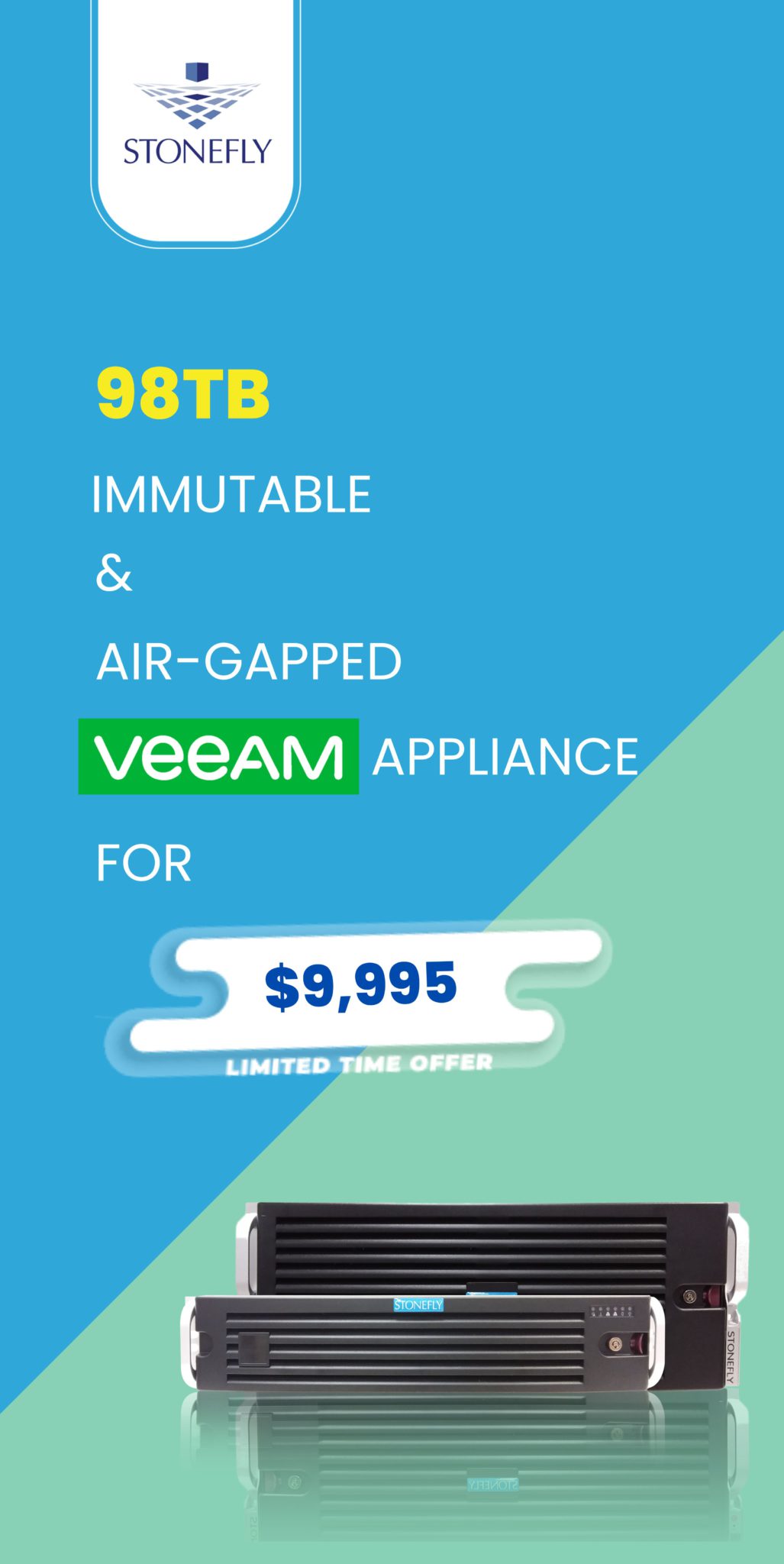
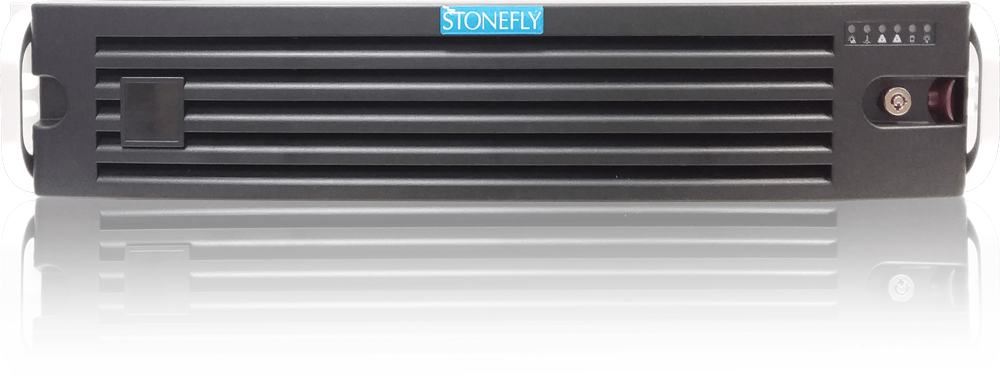
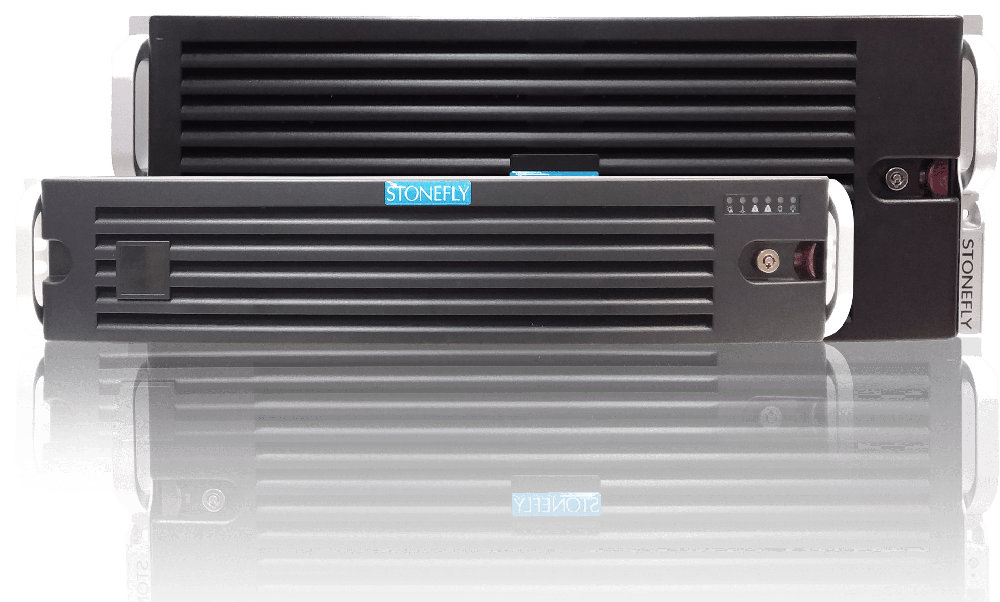
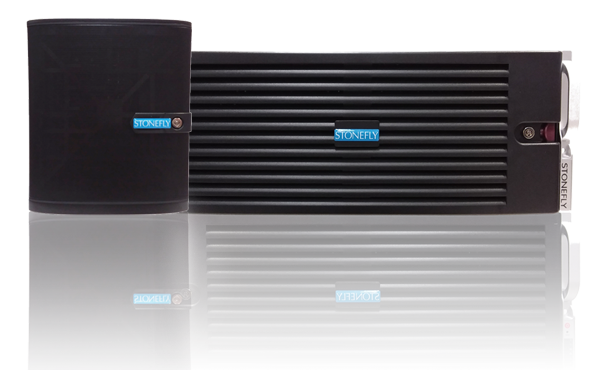
This is what StoneFly’s patented Air-Gapped Vault® does. It’s not a setting, not a policy, not a configuration that can be exceptioned. It’s an architecture, built into the platform.
What the CRN 2026 Storage 100 Criteria Actually Look For
The CRN 2026 Storage 100 Software-Defined Storage category recognition — which StoneFly earned for the fifth consecutive year — reflects what enterprise IT teams are actually putting into RFPs this year. On the ransomware-resilience axis, the criteria converge on:
- Air-gap credibility. Is the isolation architectural or configurational? Can it be defeated by a privileged credential?
- Immutability depth. Does the platform satisfy SEC 17a-4, FINRA Rule 4511, HIPAA, and GDPR retention requirements — or just the marketing definition of “immutable”?
- Integration with backup ecosystems. Veeam, Rubrik, Commvault, HYCU, Veritas. Is the air-gap transparent to the backup software, or does it require a new tooling purchase?
- Recovery time from inside the vault. Can a workload be restored directly from vault copies? How fast? What’s the automation path?
- Chain-of-custody logs. Cryptographic proof that a copy hasn’t been modified. Evidence a compliance auditor or a board can review.
StoneFly clears these because they were the design targets, not the afterthought.
What This Looks Like in a Real Incident
A regional hospital system we work with took a ransomware hit in the fall of 2024. The attack encrypted active production and reached the Veeam backup repository within minutes.
Their Veeam repository sat inside StoneFly Air-Gapped Vault®. The replication window had closed an hour before the attack. The vault never saw a packet from the encrypting payload.
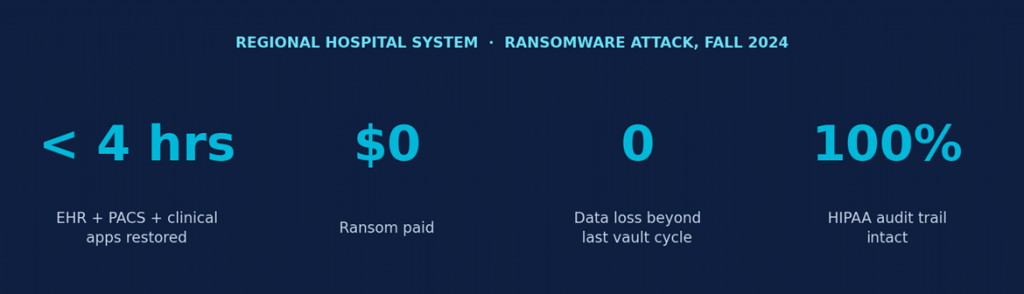
The architectural feature that mattered: the vault’s replication windows closed. When the production side was compromised, there was no path from the infected hosts to the vault. Recovery ran out of the vault on validated copies. That’s the difference between configuration-based protection and architectural protection.
What to Ask on Your Next Vendor Call
If you’re evaluating storage platforms in 2026 and the ransomware-resilience axis is anywhere in your RFP, here are the questions that sort the credible answers from the marketing ones:
- “Is your air-gap a configuration setting or a platform-level architecture? What happens if a privileged user tries to disable it?”
- “What does your replication window model look like? Are the vault copies reachable from the production network outside the window?”
- “Walk me through a recovery that runs out of your vault — not back into compromised production. What’s the automation path?”
- “Show me the audit log. Is it cryptographically signed? Can a compliance auditor verify it hasn’t been tampered with?”
- “Which of the following compliance requirements can your immutability satisfy as-is, without additional tooling: SEC 17a-4, FINRA 4511, HIPAA, GDPR?”
If the answers aren’t immediate and specific, the platform may not survive what 2026 is actually bringing.
The Framework
The full 12-criteria framework — including the air-gap evaluation scorecard and the side-by-side vendor comparison sheet — is in the 2026 SDS Buyer’s Guide. It’s the same framework CRN, DCIG, and independent analysts converge on. Built from real enterprise RFPs. No form required to read.
Download the 2026 buyer’s guide: stonefly.com/crn-2026
If you’d rather see patented Air-Gapped Vault® running against a real workload, the four-minute walkthrough and the 30-minute technical demo are on the same page.