
In 2025, the average eCrime breakout time — the window between an attacker’s initial access and lateral movement across the network — collapsed to just 29 minutes. That is 65% faster than the year before. In some documented incidents tracked by Google Cloud’s M-Trends 2026 report, the gap between initial access and a secondary threat group taking control was as short as 22 seconds.
Perimeter defenses alone cannot operate at that speed. Firewalls enforce policy at known ports and protocols. They do not catch credential stuffing, lateral movement using legitimate admin tools, or threat actors who have been dormant in the environment for weeks. That is the problem intrusion detection systems exist to solve.
An intrusion detection system watches from inside the network. It analyzes traffic, behaviors, and events after they have entered your environment — identifying what a firewall never saw. For enterprise IT teams operating in a threat landscape where CrowdStrike’s 2026 Global Threat Report found that 82% of detections in 2025 involved no malware at all, that distinction is critical.
This blog covers what an IDS is, how it works, the types of network-based and host-based detection, the IDS vs IPS distinction that confuses most teams, SIEM integration, and what a production enterprise deployment looks like.
An intrusion detection system (IDS) is a security tool that monitors network traffic, system logs, and user activity for signs of malicious behavior, policy violations, or suspicious anomalies. When the IDS identifies a potential threat, it generates an alert for security teams to investigate — but unlike a prevention system, it does not block traffic on its own.
IDS operates as a passive monitoring layer inside the network perimeter. It sees what a firewall does not: the lateral movement of an attacker who is already inside, the behavior of a compromised credential, the callback traffic from a host reaching a command-and-control server, the file integrity changes that indicate ransomware deployment beginning.
The term “IDS in cyber security” covers a wide range of technologies — from network-based sensors that analyze packet streams to host-based agents that monitor process execution on individual servers. Modern enterprise deployments typically combine both, with a SIEM platform correlating their output into a unified picture.
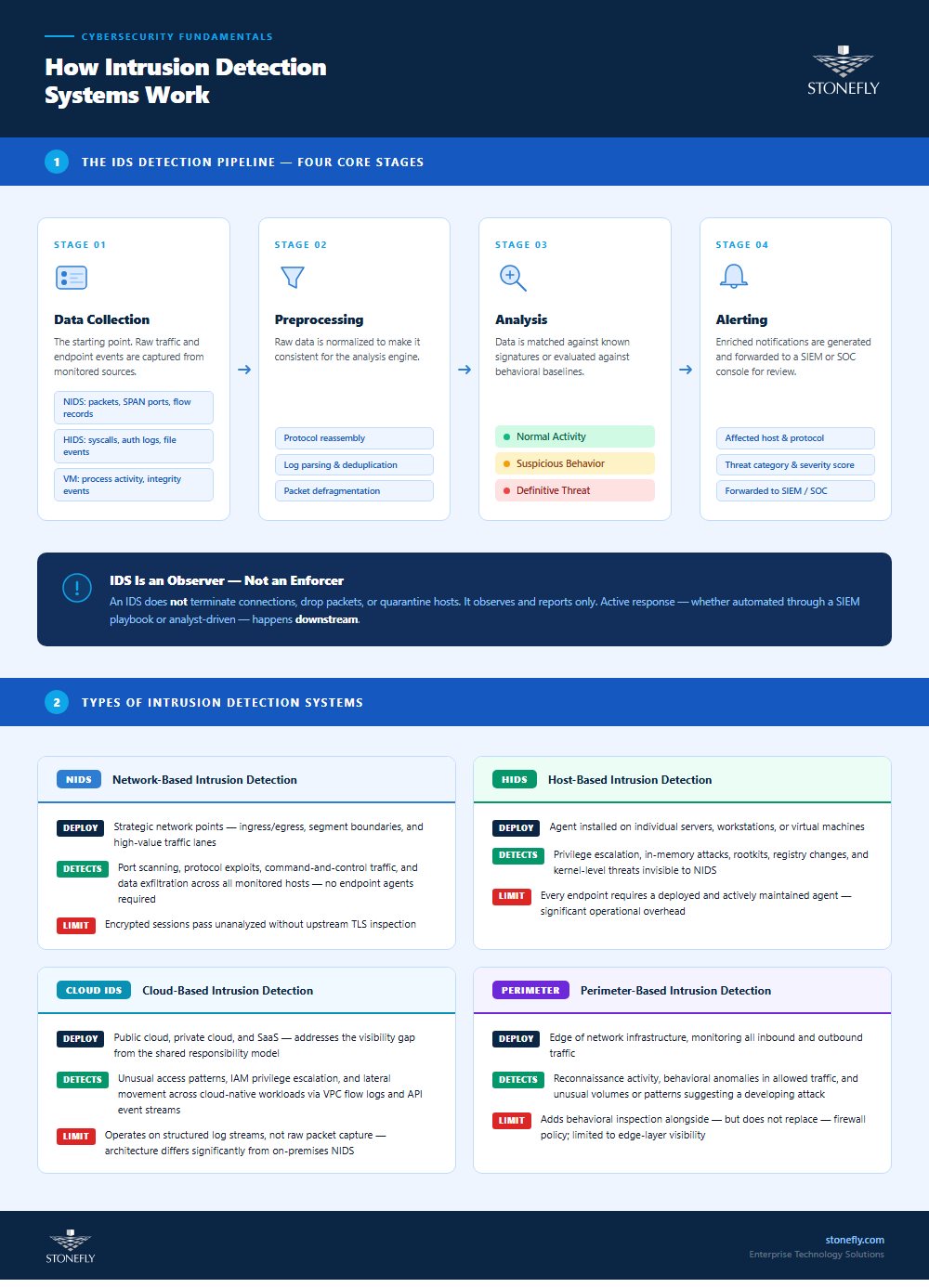
The detection pipeline of an IDS consists of four core stages: data collection, preprocessing, analysis, and alerting.
Data collection is the starting point. Network-based systems capture raw packet data or flow records from mirrored network segments, taps, or SPAN ports. Host-based systems collect system calls, file integrity events, authentication logs, and process activity directly from the endpoint or virtual machine.
Preprocessing normalizes the collected data — handling fragmented packets, protocol reassembly, log parsing, and deduplication — to make it consistent for the analysis engine.
Analysis is where detection happens. The IDS compares collected data against known attack signatures, evaluates it against a behavioral baseline, or applies both methods in a hybrid approach. This stage determines whether activity is normal, suspicious, or definitively malicious.
Alerting generates structured notifications when the analysis engine identifies a threat. Modern IDS platforms enrich alerts with context — the affected host, protocol, potential threat category, and severity score — before forwarding them to a SIEM or SOC console for analyst review.
Critically, the IDS itself does not terminate connections, drop packets, or quarantine hosts. It observes and reports. The response — whether automated through a SIEM playbook or analyst-driven — happens downstream.
Enterprise deployments draw from several distinct IDS architectures, each designed for a different visibility layer. Understanding which type addresses which gap is the starting point for any IDS deployment decision.
A network-based intrusion detection system (NIDS) is deployed at strategic points in the network — typically at ingress and egress points, segment boundaries, and high-value traffic lanes. It captures and analyzes packet-level data in real time, looking for attack patterns across all hosts on the monitored segment.
NIDS provides broad coverage without requiring agents on individual endpoints. It is effective at detecting port scanning, protocol exploits, command-and-control traffic, and data exfiltration. The significant limitation in modern environments is encrypted traffic: without TLS inspection upstream, encrypted sessions pass through a NIDS without analysis. This is why NIDS is most effective in combination with decryption capabilities or alongside HIDS agents on critical hosts.
A host-based intrusion detection system (HIDS) runs as an agent on individual servers, workstations, or virtual machines. It monitors system calls, file system changes, running processes, registry modifications, authentication events, and log activity on that specific host.
HIDS catches threats that NIDS misses entirely: privilege escalation, in-memory attacks, rootkits that manipulate the kernel, and any attacker behavior that occurs exclusively within a host without generating distinctive external network traffic. The tradeoff is deployment overhead — every endpoint needs an agent managed and maintained.
Cloud-based intrusion detection extends IDS capabilities into public cloud, private cloud, and SaaS environments. It addresses the visibility gap created by the shared responsibility model — cloud providers secure the physical infrastructure, but workloads, access patterns, and application behavior are the customer’s responsibility to monitor.
Cloud-based IDS ingests VPC flow logs, cloud audit trails, API call logs, and identity and access management events to detect unusual access patterns, privilege escalation in cloud IAM, and lateral movement across cloud-native workloads. The architecture differs significantly from on-premises NIDS: rather than packet capture, it operates on structured logs and event streams generated by the cloud control plane.
Perimeter-based IDS solutions sit at the edge of an organization’s network infrastructure, monitoring all traffic entering and leaving the environment. While firewalls enforce policy at the perimeter, perimeter IDS adds behavioral inspection — looking for anomalies in allowed traffic, detecting reconnaissance activity, and flagging unusual volumes or patterns that suggest a developing attack.
How an IDS analyzes traffic is as important as where it is deployed. There are three foundational detection approaches, each with distinct strengths and limitations that determine what it can and cannot see.
Signature-based IDS matches network traffic and system activity against a database of known attack patterns — specific byte sequences, protocol behaviors, malware hashes, or command strings associated with documented exploits and vulnerabilities.
The advantages are speed and precision. Signature detection has low false positive rates for known threats and can process high-throughput environments efficiently. The limitation is equally clear: it cannot detect what it does not know. Zero-day exploits, novel malware variants, and living-off-the-land techniques that abuse legitimate tools leave no signature to match. Signature databases also require continuous updates — a reality complicated by attack timelines where exploitation routinely begins before patches are even released.
Anomaly-based IDS builds a statistical or behavioral model of normal activity — typical traffic volumes, connection patterns, login times, process trees, and user behaviors — and flags deviations from that baseline as potentially malicious.
This approach can detect previously unknown attacks, insider threats, and compromised credentials being used outside normal patterns. The significant operational challenge is false positives. Legitimate changes to the environment — new application deployments, maintenance windows, organizational changes — can trigger anomaly alerts that require investigation. Modern anomaly-based systems use machine learning models to reduce this noise. According to enterprise SIEM vendors, AI-driven analytics now reduce false positive rates by 40–70% compared to static rule-based anomaly detection.
Hybrid IDS combines signature and anomaly detection. Signature detection handles known threats quickly and with high confidence. Anomaly detection covers unknown threats and behavioral deviations that no signature would catch. Modern enterprise IDS platforms — and most integrated IDPS solutions — operate in hybrid mode by default, applying both engines to every monitored traffic stream and correlating their outputs.
The IDS vs IPS distinction is architectural, not just functional. Many security teams conflate the two; the difference in operational posture is significant.
An intrusion detection system (IDS) is passive — it sits out-of-band, monitoring a copy of network traffic via a SPAN port or network tap. It analyzes traffic, generates alerts, and forwards them to security teams or a SIEM. Because it is not in the direct path of traffic, it cannot block anything — but it also adds no latency to live traffic flows.
An intrusion prevention system (IPS) is active — it sits inline in the network path between the upstream router and the internal network. Every packet passes through the IPS before reaching its destination. When the IPS identifies a threat, it drops the packet, resets the connection, or takes automated action before the traffic reaches the target. This gives the IPS the ability to block attacks in real time, but also means that a false positive blocks legitimate traffic.
| IDS | IPS | |
| Deployment | Out-of-band (passive — monitors a copy of traffic) | Inline (active — sits in the direct traffic path) |
| Traffic impact | None — adds no latency to live traffic | Adds processing latency to all traffic flows |
| Response capability | Alert only — notifies security teams | Block, drop, reset — acts automatically |
| False positive risk | Lower operational risk — a missed alert, not a blocked service | Higher operational risk — a false positive blocks legitimate traffic |
| Best for | Visibility, forensic investigation, threat hunting | Automated enforcement, real-time threat blocking |
Many vendors now offer combined intrusion detection and prevention systems (IDPS) — platforms that run both engines and can be configured in monitor-only mode or enforcement mode depending on use case and risk tolerance. For organizations that need visibility without risk of blocking legitimate traffic, IDS mode is the starting point. As confidence in detection accuracy grows, teams migrate to inline enforcement.
An IDS in isolation generates alerts. An IDS integrated with a Security Information and Event Management (SIEM) platform generates intelligence.
A SIEM ingests alert feeds from across the security stack — IDS/IPS, firewalls, endpoint detection and response (EDR), identity providers, cloud audit logs, and application logs. It then correlates events across these sources using temporal proximity, behavioral baselines, and user and entity analytics to identify multi-stage attack sequences that no single system would detect on its own.
Consider a realistic attack sequence: A NIDS flags a port scan at 2:00 AM. Simultaneously, the authentication system logs a failed login attempt for a service account. Three minutes later, a HIDS agent on a financial server logs a new process spawning from a legitimate Windows admin tool. Each event, viewed in isolation, might be dismissed as noise. Correlated in the SIEM, they describe reconnaissance, credential access, and execution — the first three stages of a MITRE ATT&CK kill chain — compressed into under five minutes.
Modern SIEM platforms apply temporal correlation, UEBA (User and Entity Behavior Analytics), and integrated threat intelligence to produce a unified incident context rather than a flood of individual alerts. This directly addresses one of the most persistent operational challenges in enterprise security: alert fatigue. It also supports compliance workflows — providing audit trails, detection records, and event logs required under HIPAA, PCI-DSS, CMMC, and GDPR.
Traditional IDS architectures were designed for perimeter-defended, on-premises networks. Enterprise IT in 2026 operates across multiple data centers, public cloud providers, private cloud infrastructure, and remote edge locations — a distributed environment that traditional IDS architectures cannot adequately cover from a single deployment point.
A distributed enterprise generates network telemetry and security events across every environment it operates in. An IDS deployment that covers only on-premises traffic creates systematic blind spots: an attacker who pivots from a compromised cloud workload to on-premises infrastructure may be invisible to a NIDS that only sees on-premises traffic.
Distributed intrusion detection solves this by deploying sensors and agents across each environment — NIDS sensors at data center egress points, cloud-native IDS components ingesting VPC flow logs and cloud audit trails, HIDS agents on critical workloads regardless of where they run. All detection feeds aggregate into a centralized analysis platform or SIEM, enabling cross-environment correlation.
The challenges are real. Encrypted east-west traffic between microservices limits packet inspection. High-volume cloud environments generate log volumes that can overwhelm detection engines. And the dynamic nature of cloud workloads — containers starting and stopping, auto-scaling events, ephemeral instances — makes behavioral baselining harder to establish and maintain. Effective distributed IDS architectures address these challenges through selective deep packet inspection at defined inspection points, structured log-based detection for cloud workloads, and centralized correlation to synthesize signal from all sources.
Advanced persistent threats (APTs) are specifically engineered to evade standard intrusion detection. APT actors operate slowly, blend into legitimate traffic patterns, use living-off-the-land techniques with tools already present in the environment, and maintain long-term footholds before executing their primary objectives.
The M-Trends 2026 report from Google Cloud documented a threat landscape shaped by “faster, coordinated, and industrialized cyberattacks.” In practice, this means IDS configurations tuned for high-confidence, low-noise alerting will miss APTs entirely — because sophisticated threat actors deliberately operate below the detection threshold of any single rule or signature.
Effective APT detection requires IDS capabilities that go well beyond basic signature matching:
Enterprise IDS deployments draw from a range of commercial and open-source platforms. The right choice depends on existing infrastructure, traffic volumes, required integration points, and whether the team needs detection-only visibility or inline prevention capability.
Intrusion detection identifies threats. What an organization does after detection — how quickly it can isolate the incident, preserve forensic evidence, and restore operations from clean backups — determines whether an attack becomes a recoverable incident or a ransomware payout.
StoneFly addresses this gap with infrastructure that integrates threat detection directly with the backup and DR stack.
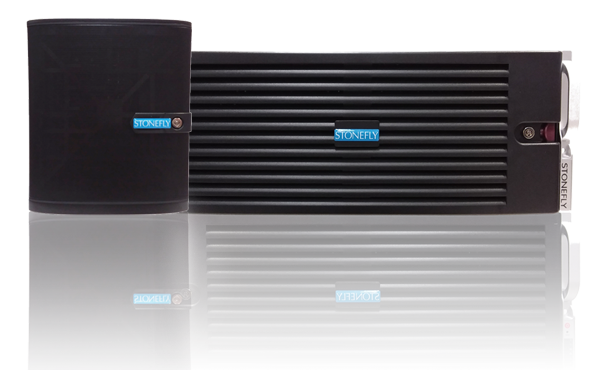
The StoneFly DR365VS is a Veeam Ready backup and disaster recovery appliance with integrated threat detection. It combines air-gapped, immutable backup storage with real-time monitoring for ransomware and malicious activity patterns — including system time anomalies, unauthorized service creation, and security engine alerts. When the DR365VS detects encryption behavior in progress, it can trigger automated backup isolation, ensuring that backup copies remain completely untouched even as production systems are under attack. This directly addresses the most dangerous gap in most enterprise security architectures: attackers who specifically target backup infrastructure to eliminate the recovery option before executing ransomware.
For organizations that need a unified detection and response platform, StoneFly offers the 365GDR — a threat detection and response solution that combines Extended Detection and Response (XDR) and SIEM capabilities in a single management console. The 365GDR aggregates alerts from across the infrastructure, correlates security events, and enables automated incident response — addressing the detection-to-response gap that leaves enterprises vulnerable even when IDS catches the initial threat.
Both solutions are built for enterprise environments where IDS is one layer in a defense-in-depth architecture. When your network intrusion detection system identifies a threat, StoneFly’s DR infrastructure ensures your recovery path remains clean, isolated, and ready.
→ Veeam Ready Backup and DR with Threat Detection (DR365VS)
→ StoneFly Air-Gapped and Immutable Backup and DR Appliance
→ StoneFly Ransomware Protection Solutions
Intrusion detection is not a product you deploy once and forget. It is an architecture decision — about where you place visibility, how you correlate signals across environments, how you manage detection thresholds to minimize noise without creating blind spots, and how you connect detection to response.
The fundamentals remain consistent: know your network baseline, instrument every critical segment and host, integrate detection feeds with a SIEM for cross-environment correlation, map detections to ATT&CK TTPs for adversary context, and build response workflows that act in minutes rather than hours.
What changes is the threat environment. Attackers in 2026 operate faster, use legitimate administrative tools to avoid signatures, target backup and recovery infrastructure to maximize leverage, and industrialize their campaigns to reduce the time between initial access and impact. The 29-minute breakout window documented by CrowdStrike is not a warning — it is a benchmark your detection and response capability needs to beat.
Effective intrusion detection — integrated with air-gapped, immutable backup infrastructure and a unified response platform — is how enterprise IT closes that window.
Contact StoneFly to discuss how DR365VS and 365GDR integrate with your existing IDS and security stack.








Join our mailing list to receive the latest news, updates, and promotions from StoneFly.