
When an executive’s email archive is corrupted or a critical financial record is accidentally deleted, the first question from the business is always the same: how quickly can you get it back? The follow-up — the one that determines whether the answer is minutes or hours — is whether your backup infrastructure supports granular recovery technology.
Traditional backup restore processes are all-or-nothing. A full-system restore from a backup consumes hours of recovery time, takes production systems offline during the process, and returns far more data than the incident required. In environments where a single deleted email or a corrupted database record triggers the recovery event, that approach is operationally unacceptable.
Granular Recovery Technology (GRT) solves this by decoupling the recovery unit from the backup unit. Rather than restoring the entire backup image, GRT allows administrators to recover individual files, email items, database records, or application objects directly from within a backup — leaving everything else untouched. For enterprises managing thousands of mailboxes, large SQL databases, and distributed SharePoint environments, granular recovery technology is not a convenience feature. It is the difference between a two-minute item-level restore and a four-hour planned recovery event.
This guide covers what granular recovery technology is, how GRT works, the types of granular restore capability available, the impact on RPO and RTO, enterprise deployment best practices, and how leading organizations integrate granular recovery technology into a complete data protection and compliance strategy.
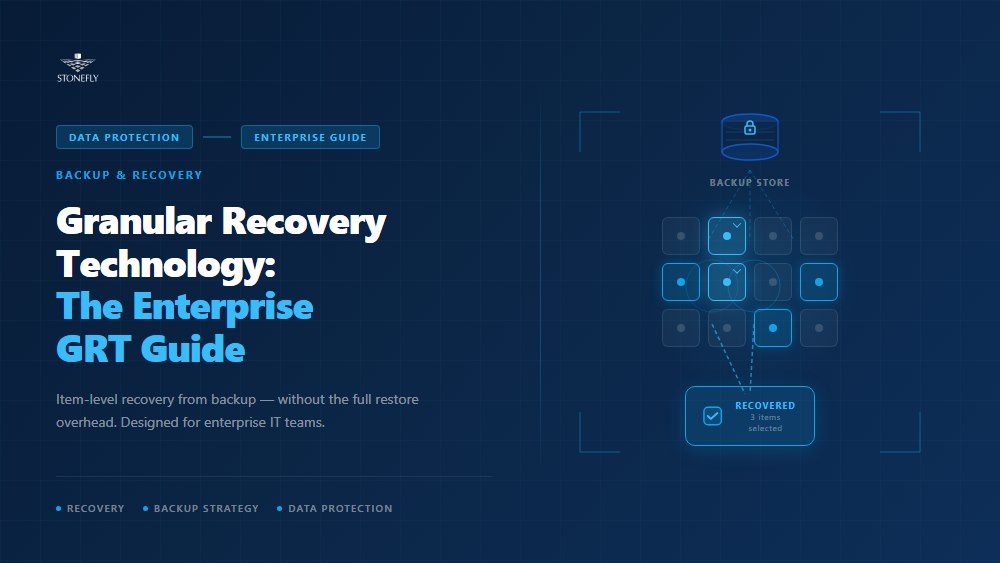
Granular Recovery Technology (GRT) is a backup and recovery capability that enables the restoration of individual data items — files, folders, emails, database records, application objects, or virtual machine components — from within a backup set, without requiring a full restore of the entire system or dataset.
Rather than treating a backup as a single monolithic image that must be fully restored before any data can be accessed, granular recovery technology indexes the contents of each backup and presents them as a browsable, searchable catalog. When a specific item needs to be recovered, the GRT engine retrieves only that item and writes it to the target — leaving the rest of the backup untouched and the production system online.
The term Granular Recovery Technology was formalized in the enterprise backup market through Veritas Backup Exec’s GRT implementation, but the underlying capability — item-level restore from image-level backup — is now a standard feature across enterprise backup platforms including Veeam Backup and Replication, Commvault, and others. Regardless of platform, what defines granular recovery technology is the same: the ability to restore the smallest meaningful unit of data, not the largest recoverable unit.
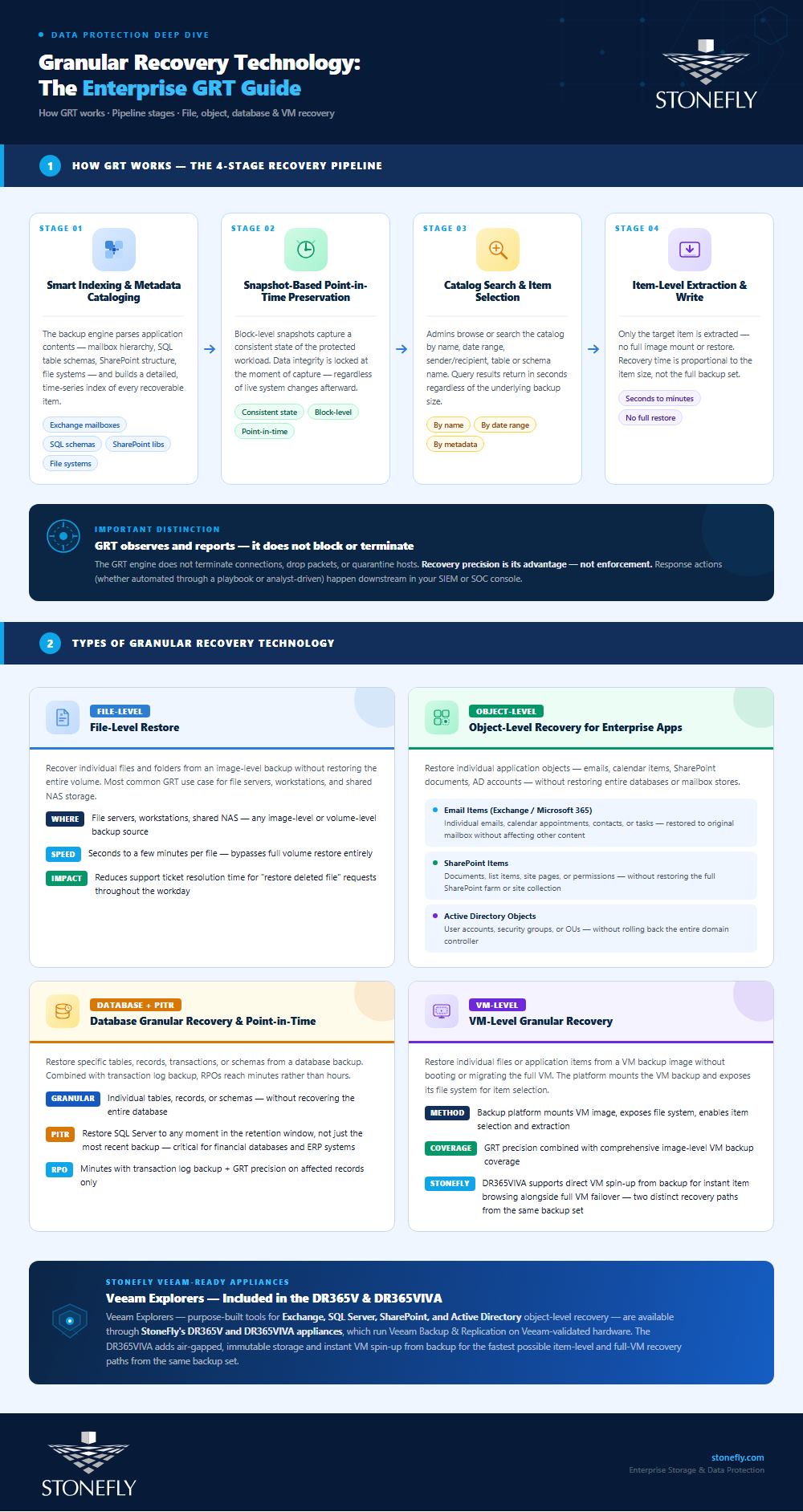
Granular recovery technology operates through a structured pipeline that begins at backup time and completes at the moment of item retrieval. The process has four interdependent stages.
When a GRT-enabled backup runs, the backup engine does more than write data blocks to the repository. It parses the contents of supported applications — the mailbox hierarchy of an Exchange server, the table and schema structure of a SQL database, the site and document library structure of SharePoint, the file system of a protected volume — and builds a detailed index of every recoverable item. This index is stored alongside the backup data and updated with each backup job, building a time-series catalog of all indexed items across the retention window.
GRT relies on block-level snapshots to capture a consistent point-in-time state of the protected workload. The snapshot preserves data integrity at the moment of capture, ensuring that the indexed items can be reliably restored to the precise state they were in at backup time — regardless of changes that occur to the live system afterward. This snapshot foundation is what makes point-in-time recovery possible at the item level, not just at the system level.
When recovery is needed, the administrator opens the GRT catalog through the backup platform’s management console and searches or browses for the target item. Modern granular recovery technology interfaces support search by item name, date range, sender and recipient for email, table or schema name for databases, and other metadata attributes. The catalog query returns results in seconds regardless of the size of the underlying backup.
Once the target item is identified, the GRT engine extracts only that item from the backup — without mounting or restoring the full backup image — and writes it to the specified destination. For most item types, this process completes in seconds to a few minutes rather than the hours required for a full backup restore. This is the core operational advantage of granular recovery technology: recovery time is proportional to the size of the recovered item, not the size of the backup set it came from.
Granular recovery technology is not a single recovery method — it spans several distinct granular restore capabilities, each designed for a different data class and recovery scenario.
File-level restore is the most common granular recovery use case. It allows administrators to recover individual files and folders from an image-level or volume-level backup without restoring the entire volume. A file that was accidentally deleted or overwritten — on a file server, workstation, or shared NAS storage — can be retrieved directly from the last backup that captured it.
File-level restore within granular recovery technology is significantly faster than traditional full restore methods because it bypasses the need to restore the full volume image before file access becomes possible. Recovery time for individual files typically ranges from seconds to a few minutes, depending on file size and the performance of the backup repository. For enterprise IT teams responding to restore deleted files requests throughout the workday, this is the GRT capability that reduces support ticket resolution time most visibly.
Object-level recovery extends granular restore capability to application-specific data structures. Rather than recovering entire application databases or mailbox stores, administrators restore individual application objects:
Veeam Explorers — included in Veeam Backup and Replication Enterprise and Enterprise Plus editions — are purpose-built tools for object-level recovery, providing browsable and searchable recovery interfaces for Exchange, SQL Server, SharePoint, and Active Directory. These same Veeam Explorers are available through StoneFly’s DR365V and DR365VIVA appliances, which run Veeam Backup and Replication on Veeam-validated hardware.
Database granular recovery allows administrators to restore specific tables, records, transactions, or schemas from a database backup without recovering the entire database. This is where granular recovery technology intersects directly with point-in-time recovery (PITR) — the ability to restore a database to any specific moment within the backup retention window, not just to the most recent backup.
For SQL Server environments, granular recovery technology enables restoration of individual tables to a clean staging instance for data extraction, or recovery of a database to a specific point in time that precedes a corruption or data loss event. Point-in-time recovery at the transaction level is particularly critical for financial databases, ERP systems, and any workload where data integrity must be verifiable to the individual transaction, not just the most recent daily backup.
When database granular recovery is combined with transaction log backup, RPOs for database workloads can reach minutes rather than hours — with GRT providing the precision to restore only the affected records rather than the entire database.
In virtualized environments, VM-level granular recovery allows administrators to restore individual files or application items from within a VM backup image, without booting or migrating the full VM. The backup platform mounts the VM backup, exposes the file system of the backed-up virtual machine, and makes the contents available for item selection and extraction — combining the efficiency of granular recovery technology with the comprehensive coverage of image-level VM backup.
StoneFly’s DR365VIVA supports direct VM spin-up from backup, enabling instant access to a running recovery VM environment for item browsing and retrieval alongside full VM failover capability — giving administrators two distinct granular recovery paths from the same backup set.
Understanding when to deploy granular recovery technology versus a full backup restore is as important as understanding how GRT works. The two approaches serve fundamentally different recovery scenarios and should coexist in any mature enterprise backup strategy.
| Granular Recovery Technology | Full Backup Restore | |
| Recovery unit | Individual file, object, or record | Entire system, database, or volume |
| Recovery time | Seconds to minutes | Hours to days |
| Primary use case | Accidental deletion, item corruption, compliance requests | Catastrophic system failure, ransomware attack |
| Production impact | Minimal — target system stays online | High — target system typically offline during restore |
| Storage during recovery | Minimal — only the target item is staged | Full backup size must be staged |
| Compliance use | Specific record retrieval for legal and audit requests | Full-system DR in compliance-mandated disaster recovery tests |
A complete enterprise backup and recovery strategy needs both capabilities. Granular recovery technology addresses the high-frequency, lower-severity data loss events that represent the majority of recovery operations in any large environment — accidental deletions, item-level corruption, compliance-driven record retrieval. Full backup restore addresses catastrophic failure scenarios where entire systems or workloads are unavailable.
Granular restore technology is not a replacement for full-system backup and restore capability. It is a complementary recovery layer that makes routine recovery faster, more targeted, and operationally non-disruptive — while full restore remains the mechanism for worst-case scenarios.
Recovery Point Objective (RPO) defines the maximum acceptable data loss window — how far back in time a recovery can take the organization before it violates business continuity requirements. Recovery Time Objective (RTO) defines the maximum acceptable downtime — how long the organization can tolerate being without access to specific data or systems.
Granular recovery technology directly improves both metrics, but in distinct ways.
RPO improvement: Granular backup enables more frequent backup intervals for critical application data without the storage overhead of frequent full-system backups. GRT-enabled incremental backups capture only changed blocks while preserving item-level indexing — allowing organizations to achieve sub-hour RPOs for email, database, and file data, recovering from a point far closer to the loss event than daily full backups allow.
RTO improvement: GRT’s most significant operational benefit is RTO compression for item-level events. When recovery is limited to a single email, a deleted file, or a corrupted database record, granular recovery technology reduces the RTO for that specific event from hours to minutes — often to seconds. Production systems remain online throughout the process. The administrator locates the item in the GRT catalog, extracts it, and delivers it — frequently resolving the incident before the affected user has filed a second support ticket.
In regulated industries where HIPAA, PCI-DSS, and GDPR require specific records to be recoverable within defined timeframes, granular recovery technology is often the mechanism that makes compliance-level RTOs achievable at enterprise scale. The shift toward per-application-tier RTO and RPO definitions — rather than blanket organizational objectives — further increases the relevance of GRT as the precision instrument for meeting those granular objectives.
Modern enterprise data environments extend beyond traditional servers and databases to include automated data pipelines — ETL processes, analytics workflows, machine learning data ingestion systems, and event-driven processing architectures that transform and move data continuously.
When a failure occurs in a distributed data pipeline — a transformation error, a schema change that breaks downstream processing, a data quality issue introduced mid-pipeline — restoring the pipeline to a correct state requires granular rollback at the processing-stage level, not a full system restore. A full rollback would undo valid processing that occurred before the failure point, creating data integrity problems in downstream systems that had already consumed the output.
Granular rollback and recovery in data pipelines involves fine-grained data lineage capture during execution — recording the state of each processing stage, the inputs and outputs of each transformation, and the dependencies between pipeline components. When rollback is required, the recovery system uses this lineage map to restore only the affected pipeline stage and its downstream dependencies, returning the pipeline to a consistent known-good state without discarding valid processed data from unaffected upstream stages.
This form of granular recovery — applied to stateful, event-driven processing systems rather than traditional databases — represents a growing operational requirement as enterprises scale their data engineering infrastructure. Backup and recovery solutions that only address traditional workloads leave this class of recovery ungoverned.
As enterprise workloads distribute across on-premises infrastructure and cloud environments, granular recovery technology must operate consistently across all deployment models. Cloud backup recovery introduces specific challenges for granular restore that differ from on-premises implementations.
Cloud-native workloads generate data across object storage buckets, managed databases, SaaS applications, and containerized services — each with different APIs, log formats, and recovery mechanics. Granular recovery in cloud environments may use native platform capabilities (AWS Backup with point-in-time recovery for Aurora and DynamoDB, Azure Backup with file-level recovery for Azure VMs) or third-party backup platforms that extend consistent GRT capabilities across hybrid infrastructure.
For Kubernetes environments, granular recovery technology now extends to container-native workloads — enabling restoration of individual pods, persistent volume claims, secrets, or config maps from namespace or cluster-level backups, without restoring the full namespace. This is a significant extension of granular restore capability as organizations shift critical workloads to containerized infrastructure.
Hybrid cloud backup recovery strategies that combine on-premises GRT-enabled backups with cloud-tier replication must ensure that item-level indexing and catalog data replicates alongside backup data. If the catalog does not replicate, granular recovery capability exists only at the primary site — not at the cloud recovery destination — which defeats the purpose of cloud backup recovery for item-level events.
Regulatory frameworks increasingly require not just that backup data exists, but that specific items can be identified and recovered from it on demand. This elevates granular recovery technology from an operational efficiency tool to a data protection and compliance requirement in regulated industries.
HIPAA (Health Insurance Portability and Accountability Act): Section 164.308 mandates that covered entities implement data backup plans, disaster recovery plans, and emergency mode operation plans. In practice, the ability to recover specific patient records, encounter documentation, or audit trails on demand — without restoring entire systems — requires granular recovery technology. HIPAA also mandates six-year data retention, meaning GRT-indexed backup catalogs must be maintained across that retention period. Recovery testing is required at minimum annually.
GDPR (General Data Protection Regulation): The right of erasure requires that organizations can identify and delete specific records belonging to an individual data subject. Meeting GDPR obligations while maintaining backup retention requires granular restore capability: organizations must be able to locate and verify specific records within backup data without full system restores. Audit logging of all GRT operations — who accessed the catalog, what was searched, what was recovered — is a compliance obligation alongside the recovery capability itself.
CMMC (Cybersecurity Maturity Model Certification): For defense contractors, CMMC Level 2 and Level 3 require documented backup and recovery procedures with tested restoration capabilities. Granular recovery testing for specific data classes — controlled unclassified information (CUI) in particular — is increasingly expected as evidence of mature data protection practices rather than simply having a backup policy in place.
Across all frameworks, granular recovery operations must produce a complete audit trail: who searched the GRT catalog, what items were selected, when extraction occurred, and where recovered items were written. A compliant GRT implementation logs all of this automatically and retains the audit record for the duration of the compliance retention window.
Deploying GRT-enabled backup is the starting point. Making granular recovery technology operationally reliable across an enterprise environment requires adherence to practices that keep indexes current, storage performance predictable, and recovery paths tested. These practices are validated by Veritas, Veeam, and enterprise backup teams operating large-scale GRT deployments.
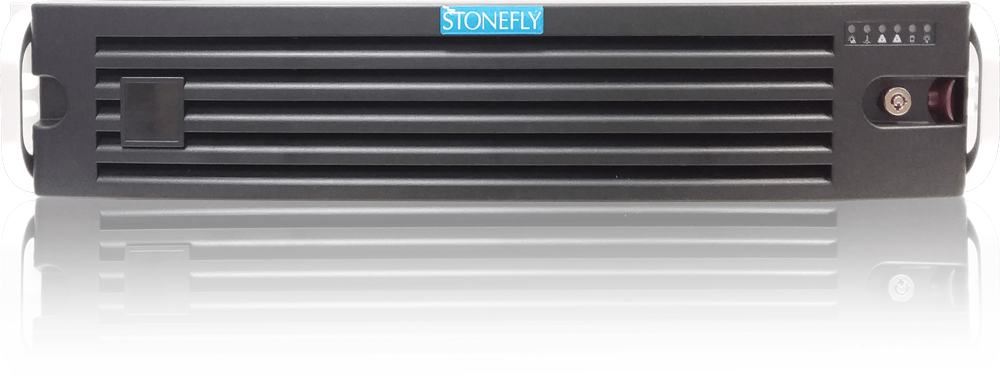
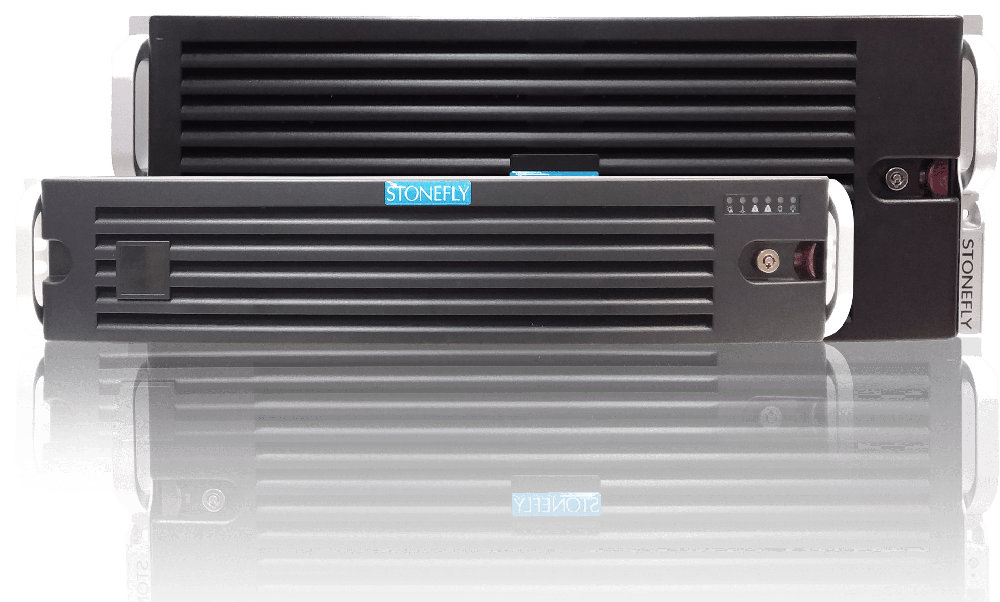
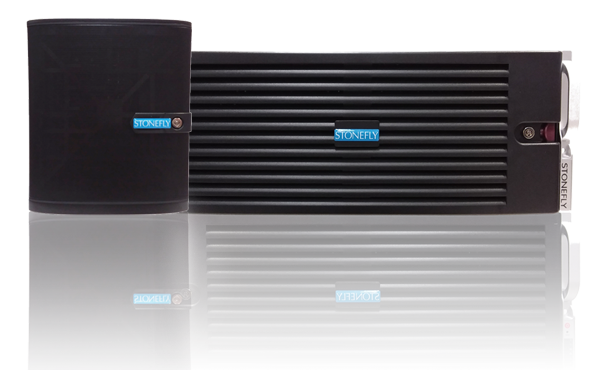
StoneFly’s DR365V and DR365VIVA backup and disaster recovery appliances run Veeam Backup and Replication — giving enterprise customers access to Veeam’s full granular recovery technology stack, delivered on purpose-built, Veeam-validated hardware with air-gapped and immutable storage. The result is a platform where granular restore capability and ransomware-resilient backup architecture coexist in the same appliance.
Through Veeam Explorers integrated into the DR365V platform, organizations can perform the full range of granular recovery operations:
Both appliances are Veeam Ready Object and Veeam Ready Object with Immutability validated, ensuring backup data is stored in an immutable, air-gapped repository. This is critical for granular recovery scenarios that follow a ransomware event: when the GRT catalog is used to retrieve a clean version of a file or database record from a pre-attack backup, the immutability of the backup repository guarantees that the item retrieved is genuinely clean — not a copy of already-encrypted or corrupted data.
The DR365V supports a three-tiered storage architecture optimized for GRT performance: block-level iSCSI for high-I/O Veeam database workloads, file-level shared repositories for unstructured data and GRT catalog storage, and S3 object storage for backup and long-term archive. This tiered design keeps GRT indexing and catalog operations on the appropriate storage tier — maintaining fast recovery times across all protected workload types at enterprise scale.
-> Veeam Ready Backup and DR Appliance (DR365V)
-> DR365VIVA — Veeam Ready Appliance with Direct VM Spin-Up
Granular recovery technology has moved from an optional backup feature to a strategic data protection requirement. The shift happened for compounding reasons: RPO and RTO expectations tightened, compliance frameworks evolved to require item-level recovery capability on demand, and the volume of item-level recovery requests in large enterprise environments made full-system restore operationally untenable as the default response to routine data loss.
The practical implication is direct. Enterprise backup systems that do not support granular recovery technology are inadequate for the recovery demands organizations face today — where a legal hold may require retrieval of specific emails from backups years old, where a data quality incident in a pipeline requires rollback of a specific processing stage, and where an accidental deletion of a single SharePoint document should not trigger a multi-hour recovery event.
Granular restore technology — deployed on validated, immutable backup infrastructure, integrated with application-aware backup engines, tested on a defined cadence, and logged for compliance audit — is the architecture that closes the gap between the speed of data loss events and the speed of recovery operations. For enterprise IT teams measured on RTO, RPO, and compliance posture simultaneously, granular recovery technology is not an option. It is the baseline.
Contact StoneFly to discuss how DR365V delivers enterprise granular recovery technology for your Veeam environment.





Join our mailing list to receive the latest news, updates, and promotions from StoneFly.