
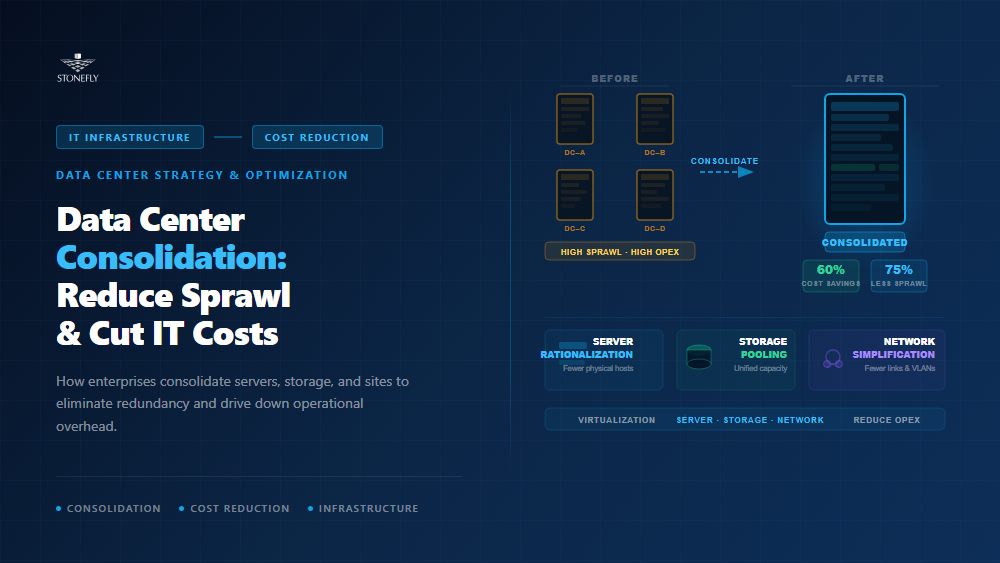
The average enterprise data center runs servers at 12–18% utilization. The rest of the capacity sits idle, consuming power, cooling, floor space, and maintenance budget. It accumulates over years of organic growth — new projects get new hardware, old hardware never gets decommissioned, and nobody has a complete picture of what is actually running where. Data center consolidation is the structured process of fixing that problem: rationalizing the infrastructure footprint, retiring redundant systems, and modernizing what remains so that what the organization actually runs matches what the infrastructure actually needs.
The business case has sharpened in recent years. Power costs have risen sharply across North America and Europe. Hybrid cloud adoption has created pressure to reduce on-premises complexity. And aging hardware refresh cycles — many organizations are running equipment that is five to eight years old — are coinciding with the availability of far more capable and energy-efficient platforms. According to the Uptime Institute’s 2024 Global Data Center Survey, data center energy and operating costs now represent one of the largest uncontrolled IT budget line items for enterprise organizations, with most reporting no formal plan to address it.
This blog covers what data center consolidation is, how to build a consolidation and rationalization strategy, the migration and virtualization approaches that work in practice, and how to improve data center efficiency and reduce operational costs through a structured modernization roadmap.
Data center consolidation is the process of reducing an organization’s data center footprint — the number of physical facilities, servers, storage arrays, and network devices in operation — by rationalizing workloads, retiring underutilized hardware, and migrating remaining workloads to fewer, more capable, and more efficient platforms. It typically includes a combination of physical infrastructure reduction (fewer racks, fewer servers), logical consolidation (fewer distinct environments running the same workloads), and modernization (replacing aging hardware with current-generation equipment or cloud-based alternatives).
Data center consolidation is distinct from, though related to, data center optimization.
Optimization addresses efficiency within an existing footprint — improving PUE (Power Usage Effectiveness), tuning cooling systems, right-sizing storage allocations, and eliminating configuration waste. Consolidation addresses the footprint itself. The two usually happen together: consolidation creates the opportunity to optimize the reduced footprint by applying modern practices to a cleaner infrastructure baseline.
Consolidation also differs from migration. A data center migration moves workloads from one location to another without necessarily reducing complexity. Consolidation explicitly reduces the number of systems, environments, or facilities required to run the organization’s workload portfolio. Done well, data center consolidation and migration together produce an infrastructure that costs less to run, is easier to manage, and is better positioned for future modernization.
No consolidation strategy survives contact with infrastructure that is not fully inventoried. The first and most commonly skipped step is a comprehensive rationalization assessment: documenting every server, storage device, network appliance, and application in scope, along with its current utilization, dependencies, age, support status, and business criticality. Without this inventory, consolidation decisions are made on assumptions rather than data — and the result is either workloads that get migrated to the wrong target, or critical dependencies that only surface during cutover.
Rationalization tools — including ServiceNow, Flexera, and dedicated IT asset management platforms — can automate much of the discovery process by scanning the network, pulling utilization metrics from hypervisors, and mapping application dependencies. The output is a rationalization register: a structured view of every asset, its disposition (retire, retain, migrate, modernize), and its priority in the consolidation sequence. This register becomes the operational backbone of the consolidation plan.
Once the rationalization assessment identifies what will be retained or migrated, capacity planning determines what the target infrastructure needs to support it. Data center capacity planning goes beyond raw compute and storage requirements — it accounts for peak load headroom, projected growth over the planning horizon, power and cooling constraints at the target facility, and redundancy requirements for availability. Getting this wrong in either direction is expensive: undersized target infrastructure creates performance problems immediately after migration, while oversized infrastructure recreates the utilization waste the consolidation was meant to eliminate.
Infrastructure capacity planning for a consolidation project should model utilization at the 70–80% ceiling for sustained workloads, with headroom for peak bursting and workload growth over a 3-year horizon. Virtualization ratios — how many virtual machines per physical host — depend on workload type: memory-intensive databases require conservative ratios (4:1 to 8:1), while VDI and lightweight application servers can run at much higher consolidation ratios (20:1 to 40:1) without performance degradation.
Consolidation projects fail for predictable reasons: inadequate dependency mapping, poor change communication, underestimated migration complexity, and attempting to do too much too fast. The following best practices address each of these failure modes based on patterns from successful enterprise consolidation programs.
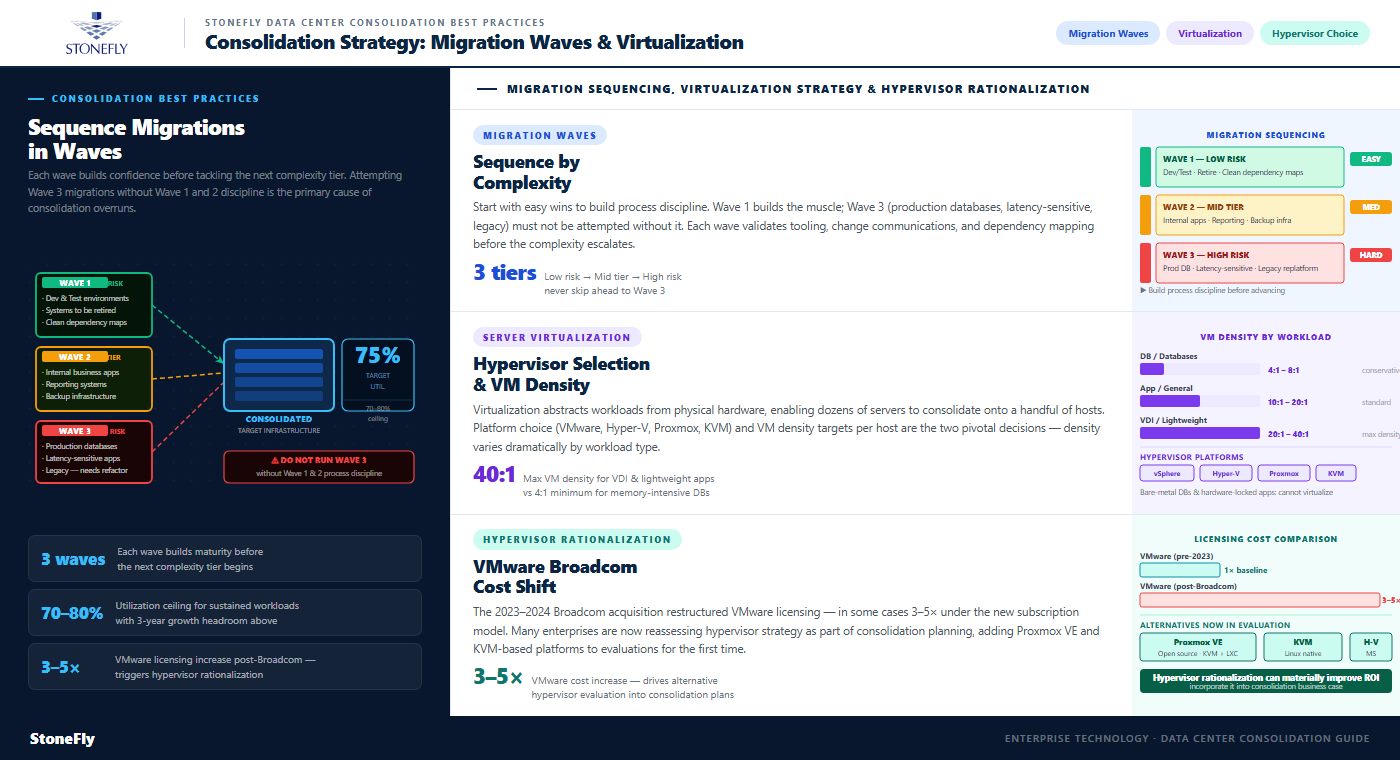
Workload migration sequencing is one of the highest-leverage decisions in any consolidation project. The temptation is to start with the easiest workloads — low-criticality, well-understood systems — to build momentum. This is correct, but only up to a point: if the consolidation project stalls after the easy migrations, the hard migrations (production databases, legacy applications with undocumented dependencies) never happen, and the infrastructure footprint only partially shrinks. A sound workload migration strategy sequences migrations in waves, with each wave building confidence and process maturity before tackling the next tier of complexity.
Wave 1 addresses the straightforward cases: development and test environments, decommissioned systems being retired rather than migrated, and modern application workloads with clean dependency maps. Wave 2 addresses the mid-tier: internal business applications, reporting systems, backup infrastructure. Wave 3 — the hardest — addresses production databases, latency-sensitive workloads, and legacy applications that require refactoring or re-platforming before migration. Attempting to run Wave 3 migrations without the process discipline built in Wave 1 and 2 is a primary cause of consolidation project overruns.
Server virtualization is the enabling technology for most data center consolidation programs. By abstracting workloads from physical hardware, virtualization allows dozens of servers to be consolidated onto a handful of physical hosts without losing workload isolation or management granularity. A server virtualization strategy for consolidation needs to address three things: hypervisor platform selection (VMware vSphere, Microsoft Hyper-V, Proxmox VE, or KVM-based platforms), VM density targets per host, and the treatment of workloads that cannot be virtualized (bare-metal databases, hardware-locked applications).
For organizations running VMware environments, the Broadcom acquisition and subsequent licensing restructuring in 2023-2024 has prompted many enterprises to reassess their hypervisor strategy as part of consolidation planning. The cost increase for VMware vSphere licensing — in some cases 3–5x under the new subscription model — has made alternative hypervisors economically attractive for the first time, particularly for organizations running large numbers of VMs. Incorporating hypervisor rationalization into the consolidation strategy can produce cost savings that significantly improve the overall business case.
| Approach | What It Consolidates | Primary Benefit | Best Fit |
| Physical server consolidation via virtualization | Physical servers onto fewer hosts via hypervisor | Reduces hardware count, power, and floor space | Most enterprise server environments |
| Storage consolidation | Siloed storage arrays into unified scale-out pool | Eliminates capacity waste, simplifies management | Organizations with multiple disparate storage arrays |
| Data center facility consolidation | Multiple sites into fewer, optimized locations | Reduces facility costs, lease, and staffing overhead | Multi-site enterprises with underutilized facilities |
| Application rationalization | Redundant or duplicated applications into fewer platforms | Reduces license and maintenance costs | Post-merger integrations, large enterprises |
| Cloud migration and consolidation | On-premises workloads to cloud or hybrid-cloud platforms | Eliminates CapEx, enables elasticity | Workloads with variable demand profiles |
When consolidation involves reducing the number of physical facilities — moving from three data centers to one, or from an owned facility to a colocation provider — a data center relocation strategy must address site selection, physical migration logistics, and the transition period during which workloads exist simultaneously in both the source and target locations. Site selection criteria for the target facility should include power availability and redundancy (N+1 or 2N), cooling capacity and PUE rating, network carrier diversity, physical security certifications, and proximity to the organization’s primary workforce and disaster recovery requirements.
The relocation timeline needs to account for network provisioning at the target site (often 60–90 days for dedicated circuits), hardware procurement and rack build-out, and the migration windows available for each workload tier. For regulated workloads, the relocation may require regulatory notification or approval before the physical move can occur. Building 30-day buffer windows into each phase of the relocation timeline is standard practice — consolidation projects that run to the day consistently overrun when any single dependency slips.
Enterprise workload migration for consolidation projects typically uses one of two approaches: phased migration, in which workloads move incrementally over weeks or months with the source environment remaining partially operational, or big-bang cutover, in which all workloads move in a single planned maintenance window. Phased migration reduces risk by limiting the scope of any single migration event but extends the period during which the organization pays for both source and target infrastructure simultaneously. Big-bang cutover minimizes the dual-infrastructure window but concentrates risk into a single event where everything must work correctly from the moment the cutover completes.
For most enterprise consolidation projects, a phased approach with defined wave structures is the right choice. The exception is small-scale migrations — under 50 workloads, a single facility, and a clean dependency map — where the operational simplicity of a single cutover window outweighs the risk concentration. In either case, the migration plan must include validated rollback procedures for every workload: if a migrated system fails validation at the target, the team needs a tested procedure for reverting to the source within the maintenance window, not a plan written the night before the cutover.
Data center power efficiency is measured by PUE — Power Usage Effectiveness, the ratio of total facility power to IT equipment power. A PUE of 1.0 is theoretically perfect (all power goes to IT equipment); the industry average for legacy enterprise data centers is 1.6–2.0, meaning 60–100% of IT power consumption goes to overhead: cooling, lighting, UPS losses, and power distribution. Modern purpose-built colocation facilities and hyperscale-designed enterprise data centers achieve PUEs of 1.2–1.4, representing 30–40% reduction in overhead power costs for the same IT workload.
Consolidating to fewer, modern facilities directly improves energy efficiency: newer cooling systems (rear-door heat exchangers, aisle containment, free cooling economizers) are dramatically more efficient than the legacy CRAC units common in older enterprise data rooms. Modern power distribution hardware reduces conversion losses. And a higher-density, better-utilized server fleet produces more compute per watt than the same number of underutilized older servers. For organizations with sustainability commitments or facing rising energy costs, the power efficiency improvements from consolidation can justify the project cost on their own.
Reducing data center operational costs through consolidation operates across several dimensions simultaneously. Hardware consolidation reduces the volume of equipment under maintenance contract, cutting annual support costs proportional to the number of devices decommissioned. Facility consolidation eliminates the fixed costs — lease, power, cooling, and staffing — associated with each facility retired. Virtualization reduces the licensing and management overhead associated with physical server proliferation. And application rationalization, where duplicate systems are merged, reduces software license costs and the operational staff time required to maintain them.
The Uptime Institute estimates that the average enterprise data center costs $7–15 million per year to operate when all facility, staffing, power, and hardware costs are fully loaded. Consolidating from three facilities to one — with appropriate virtualization and modernization — can reduce that cost by 40–60% on a steady-state basis. The capital investment in migration and new infrastructure typically achieves payback in 18–36 months, with ongoing savings thereafter. IT cost reduction strategies that include consolidation consistently outperform strategies focused only on negotiating better hardware or software contracts.
For most enterprises, the destination of a data center consolidation program is not a single on-premises data center — it is a hybrid architecture in which a rationalized, modernized on-premises core handles latency-sensitive, compliance-driven, and data-intensive workloads, while cloud platforms handle variable-demand workloads, development environments, and disaster recovery targets. The consolidation project creates the clean infrastructure baseline that makes hybrid cloud adoption practical: organizations with sprawling, undocumented on-premises environments cannot effectively manage a hybrid cloud strategy because they don’t have control of their on-premises half.
The IT modernization roadmap that emerges from consolidation typically has three phases. Phase 1 completes the rationalization and migration, establishing the reduced and documented infrastructure footprint. Phase 2 modernizes the retained infrastructure — upgrading hardware to current-generation platforms, standardizing hypervisor and management tooling, and establishing consistent backup and disaster recovery across the consolidated environment. Phase 3 extends the architecture outward: connecting the modernized on-premises core to cloud services for DR, burst capacity, and workloads that benefit from cloud economics.
A data center transformation strategy addresses not just the hardware but the operating model. Legacy data centers often run with fragmented management tooling — different teams owning different infrastructure layers, manual change management processes, and limited visibility into utilization or cost attribution. Consolidation is the opportunity to reset the operating model alongside the infrastructure: implementing unified monitoring and observability, adopting infrastructure-as-code practices for the modernized environment, and establishing clear capacity governance so the new infrastructure doesn’t accumulate the same sprawl over time that drove the consolidation in the first place.
Infrastructure upgrade planning for the post-consolidation environment should also account for refresh cycles on the new hardware. One of the most common consolidation project failures is investing in a modernized infrastructure platform and then not funding its refresh cycle — so that in five years, the organization faces another consolidation event driven by the same aging hardware problem. Building a 5-year hardware lifecycle plan into the consolidation business case from the start, and allocating budget for it in the IT operating model, is the difference between a one-time project and a lasting architecture improvement.
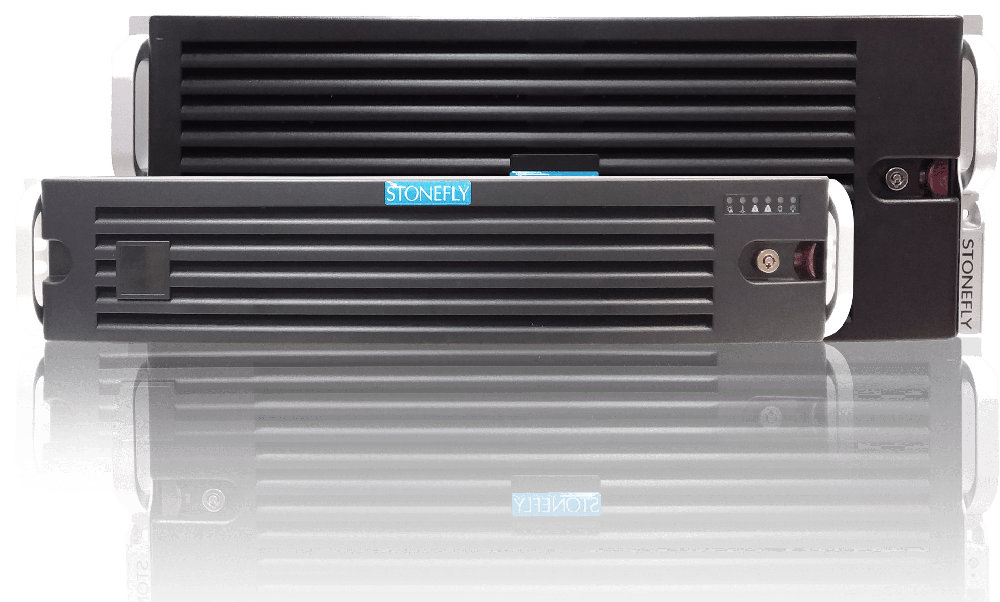
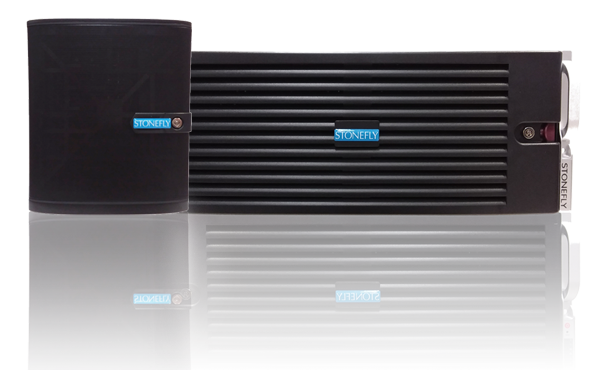
Data center consolidation projects converge on a common challenge: the replacement target infrastructure needs to do more with less — higher storage density, better compute efficiency, and integrated data protection — without reintroducing the management complexity the consolidation was designed to eliminate. StoneFly’s infrastructure platforms are designed for exactly this use case.
StoneFly’s USS (Unified Storage and Server) hyperconverged infrastructure delivers compute, storage, and networking in a consolidated appliance form factor that replaces multiple separate components — the typical consolidation scenario where a rack of aging servers and a legacy SAN array are replaced by a single integrated platform. USS supports VMware, Hyper-V, and Proxmox VE workloads with NVMe-backed storage and built-in replication, reducing the hardware count and management surface area that consolidation is trying to achieve.
For storage consolidation specifically, StoneFly’s USO (Unified Scale-Out SAN, NAS, and S3 Object Storage) replaces siloed storage arrays — a common source of infrastructure sprawl — with a single scale-out pool that serves block, file, and object workloads simultaneously. Organizations consolidating from three or four separate storage arrays to a single USO deployment typically reduce storage management overhead by 60–70% while improving performance through NVMe-backed tiering and eliminating the capacity waste inherent in maintaining multiple separate pools.
StoneFly’s DR365V addresses the data protection requirement that consolidation projects must not compromise: as workloads consolidate onto fewer, more critical platforms, the backup and disaster recovery architecture protecting those platforms becomes more important, not less. The DR365V provides air-gapped, immutable backup repositories integrated with Veeam, ensuring that the modernized consolidated environment is protected against ransomware and hardware failure regardless of how the production infrastructure is restructured.
Data center consolidation delivers measurable results — reduced infrastructure costs, lower energy consumption, simplified management, and a modernized foundation for hybrid cloud adoption — but only when it is approached as a structured program rather than an ad hoc cleanup effort. The organizations that realize the full benefit of consolidation are the ones that invest in the rationalization assessment before moving anything, build the capacity planning model before selecting target infrastructure, and execute migration in disciplined waves with validated rollback procedures for every phase.
The post-consolidation environment is also not the end of the story. A data center transformation strategy that doesn’t include governance to prevent sprawl from re-accumulating will produce the same problem in five years. Consolidation is the opportunity to reset the infrastructure operating model — to move from reactive, fragmented management to proactive, unified governance — and that governance is what makes the investment last. The IT modernization roadmap that follows consolidation, connecting a rationalized on-premises core to cloud services and modern data protection, is where the long-term strategic value is realized.
Contact StoneFly to discuss how USS, USO, and DR365V fit into your data center consolidation and modernization strategy.


Join our mailing list to receive the latest news, updates, and promotions from StoneFly.