
Most enterprise storage problems trace back to the same root cause: compute and storage were designed to scale together, and now they can’t be separated. That design made sense when workloads were predictable and hardware was expensive. It doesn’t make sense anymore. Disaggregated storage breaks that coupling at the architecture level — and the performance, cost, and operational consequences are significant enough that most enterprise IT teams evaluating new storage infrastructure in 2026 need to understand it before they buy anything.
The shift gained momentum alongside the rise of NVMe-over-Fabrics (NVMe-oF) and high-speed Ethernet, which finally made it practical to separate storage from compute without paying a latency penalty. At the same time, the Broadcom acquisition of VMware and subsequent licensing restructuring pushed many enterprises to reconsider their entire infrastructure stack — including whether hyperconverged infrastructure (HCI) still made sense as a default architecture. That reconsideration has accelerated adoption of disaggregated storage architectures across financial services, media, healthcare, and cloud-native enterprise environments.
This blog covers what disaggregated storage is, how the architecture works at a technical level, what it means for storage performance optimization and high availability, and which enterprise workloads benefit most from the disaggregated model.
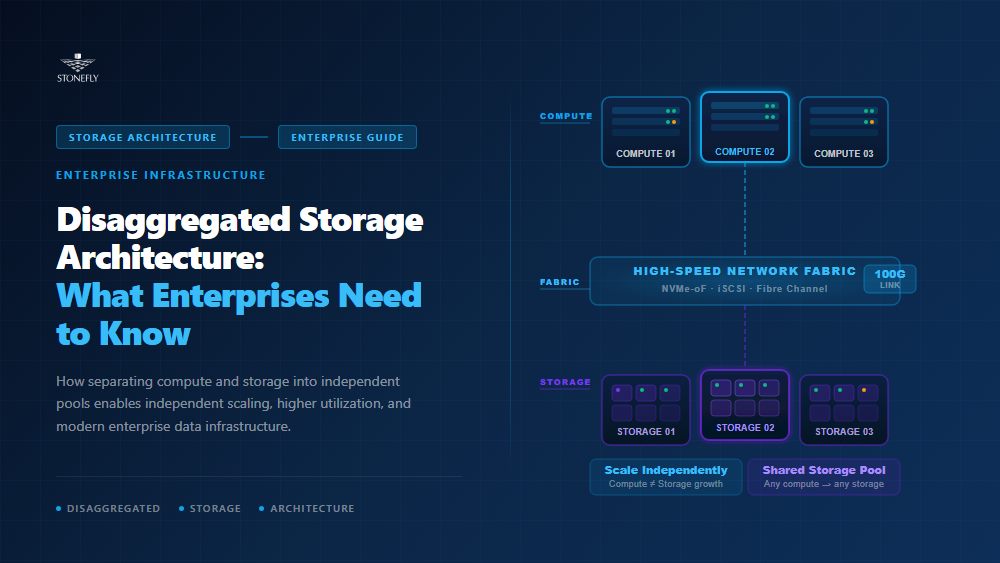
Disaggregated storage is a data center storage architecture in which storage resources — drives, controllers, and capacity — are physically and logically separated from compute resources, and accessed over a high-speed network fabric rather than through local attachment. Instead of each server owning its own storage, a shared pool of storage nodes is accessible to any compute node in the cluster.
In a traditional server architecture, each compute node has its own directly attached storage (DAS) — SSDs or HDDs installed locally. In a hyperconverged architecture, storage is still local to each node but software abstracts it into a shared virtual pool. In both cases, storage and compute are co-located on the same physical hardware. Disaggregated storage removes that co-location entirely: compute nodes have no local storage, and storage nodes have no compute workloads. Resources scale independently on separate hardware.
The practical implication is this: when a workload needs more compute capacity, you add compute nodes. When it needs more storage capacity or IOPS, you add storage nodes. You never have to overprovision one to get more of the other.
Hyperconverged infrastructure packages compute, storage, and networking into a single node type. To scale storage, you add nodes — but those nodes also include compute CPUs and memory that you may not need. According to IDC’s 2025 Worldwide Quarterly Converged Systems Tracker, the majority of enterprise organizations that adopted HCI for initial consolidation workloads report hitting scaling bottlenecks within three years as storage-intensive workloads — databases, backup repositories, AI training datasets — grow faster than compute requirements.
The problem compounds under mixed workloads. A cluster running both latency-sensitive OLTP databases and high-throughput analytics jobs has very different storage requirements per workload type. HCI forces both onto the same node design, which means either the OLTP workload gets insufficient IOPS or the analytics job gets insufficient throughput — typically both. Tuning is limited because the hardware is homogeneous by design.
Storage disaggregation solves this by introducing distinct node types: compute nodes that run workloads without local drives, and storage nodes that provide capacity and IOPS without running application workloads. The two communicate over a fabric — traditionally Fibre Channel or iSCSI, but increasingly NVMe-oF over RDMA or high-speed Ethernet (25GbE/100GbE) in modern disaggregated deployments.
From the compute node’s perspective, the disaggregated storage pool behaves identically to a locally attached device — block volumes appear as local NVMe namespaces, object storage exposes an S3-compatible API, and file storage mounts via NFS or SMB. The abstraction is transparent to applications, but the physical separation enables independent scaling, hardware optimization per resource type, and non-disruptive capacity additions without compute downtime.
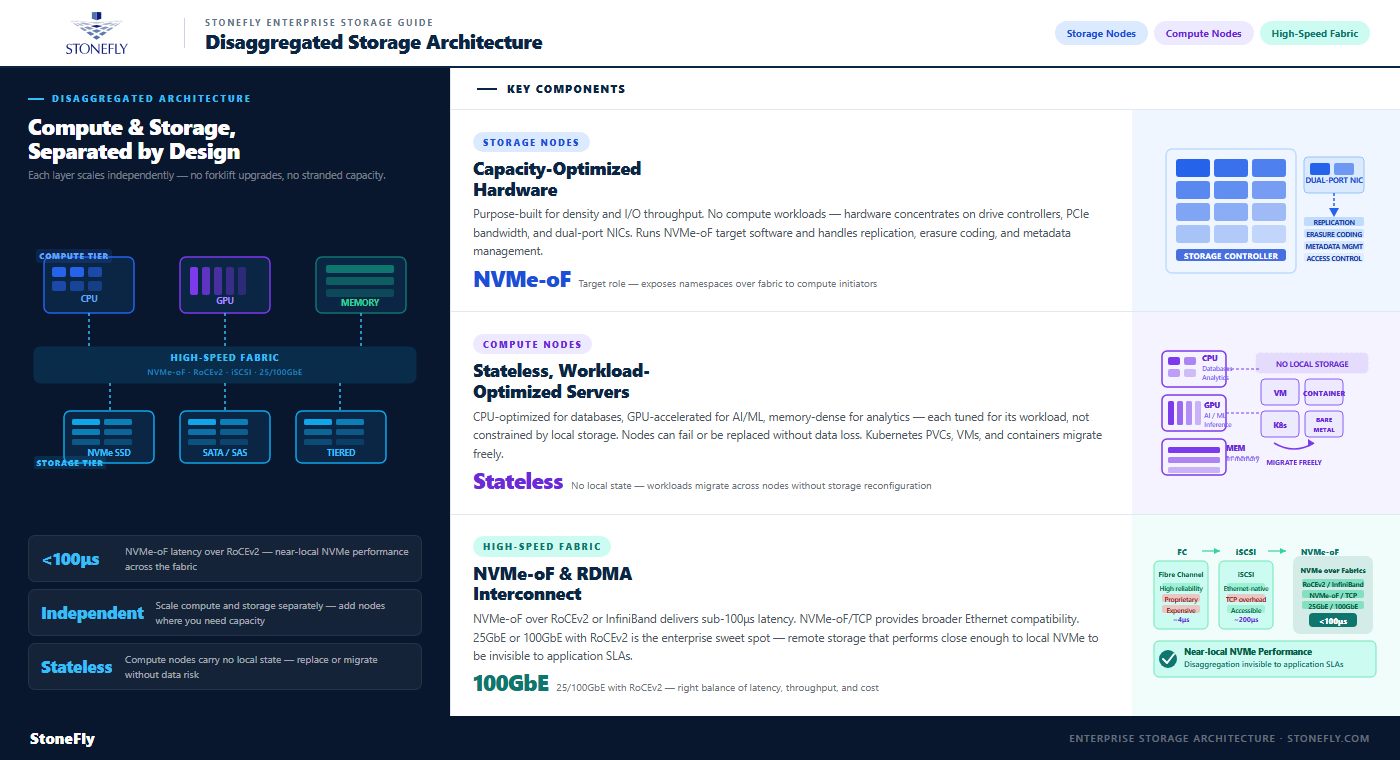
Storage nodes in a disaggregated architecture are purpose-built for storage density and I/O throughput. They typically house high-density NVMe SSDs or large-capacity SATA/SAS drives (or a tiered combination), with dedicated storage controllers and dual-port network interfaces for fabric connectivity. Because they don’t run compute workloads, they don’t need high-core-count CPUs or large memory footprints — hardware resources concentrate on what matters: drive controllers, PCIe bandwidth, and network I/O.
Modern storage nodes often implement NVMe-oF target roles, exposing NVMe namespaces over the fabric to initiator-side compute nodes. Storage software running on these nodes handles replication, erasure coding, metadata management, and access control — entirely separate from the applications consuming the storage.
Compute nodes in a disaggregated environment are stateless with respect to storage. They can be CPU-optimized for database workloads, GPU-accelerated for AI/ML inference, or memory-dense for in-memory analytics — hardware tuned entirely for the workload, not constrained by the need to also house storage. Because storage is network-attached and shared, compute nodes can fail or be replaced without data loss, and workloads can migrate between compute nodes without storage reconfiguration.
This statelessness is operationally significant: bare-metal provisioning, containerized workloads, and VM migrations all become simpler when the compute node carries no local state. Kubernetes clusters deployed on disaggregated infrastructure benefit particularly, since persistent volume claims can be satisfied by the shared storage fabric without requiring node-local storage provisioning.
The interconnect between compute and storage is the defining constraint of any disaggregated architecture. Early disaggregated systems used Fibre Channel SANs — high reliability, but proprietary and expensive. iSCSI over Ethernet expanded accessibility but introduced latency overhead from TCP/IP processing. The current state of the art is NVMe-oF (NVMe over Fabrics), which extends NVMe’s command queue and latency characteristics across a network.
NVMe-oF can run over RDMA (RoCEv2 or InfiniBand) for ultra-low latency — sub-100 microsecond in validated configurations — or over TCP/IP (NVMe-oF/TCP) for broader compatibility with existing Ethernet infrastructure. For most enterprise deployments, 25GbE or 100GbE with RoCEv2 provides the right balance of latency, throughput, and cost. The result is remote storage that performs close enough to local NVMe that the disaggregation is invisible to application performance SLAs.
| Architecture | Scaling Model | Latency Profile | Hardware Flexibility | Best For |
| Direct-Attached Storage (DAS) | Per-node, tightly coupled | Lowest (local PCIe) | None — fixed per node | Single-server, isolated workloads |
| Hyperconverged (HCI) | Scale-out, coupled | Low (software-defined) | Low — homogeneous nodes | VDI, SMB, general virtualization |
| SAN/NAS (Traditional) | Scale-up or out, shared | Low-medium (FC/iSCSI) | Moderate — separate array | Mixed enterprise workloads |
| Disaggregated Storage | Independent compute + storage | Near-local (NVMe-oF) | High — optimize each independently | AI/ML, databases, cloud-native, HPC |
The central performance advantage of modern disaggregated storage is the elimination of the latency gap that made earlier shared-storage architectures problematic for latency-sensitive workloads. NVMe-oF with RoCEv2 achieves round-trip latencies of 50–150 microseconds end-to-end on properly configured 25GbE or 100GbE networks — compared to 20–30 microseconds for locally attached NVMe. For most enterprise database workloads, that difference is not measurable in application-level throughput or response time.
Beyond raw latency, storage performance optimization in disaggregated systems benefits from the ability to provision storage quality of service (QoS) per volume or namespace. Because all compute nodes access the same storage fabric, the storage layer can enforce IOPS limits, throughput ceilings, and priority tiers per workload — preventing a high-throughput batch job from consuming IOPS that a production database needs. This kind of cross-workload QoS is impossible with direct-attached storage and difficult to enforce accurately in HCI environments.
Disaggregation doesn’t eliminate the need for caching — it changes where caching happens. In a disaggregated architecture, compute nodes typically run a host-side cache layer (usually NVMe SSDs or persistent memory) that holds hot data locally, while the shared storage fabric serves as the authoritative persistent tier. This approach captures the latency benefit of local storage for frequently accessed data while keeping the operational flexibility of shared, pooled storage for the full dataset.
Tiering within the storage pool follows a similar principle. Storage nodes typically implement automatic tiering across NVMe SSDs (for hot data), SATA SSDs (for warm data), and high-density HDDs (for cold data) — managed by storage software that monitors access patterns and promotes or demotes data transparently. The result is that storage performance optimization happens at multiple layers: host-side caching, fabric-level QoS, and within-pool tiering — without any application-level configuration.
High availability in a disaggregated storage architecture is implemented at the storage layer, not the compute layer. Because storage nodes are shared and pooled, fault tolerance policies apply to data objects or volumes rather than to individual servers. Most enterprise disaggregated storage platforms support both synchronous replication (maintaining identical copies on separate storage nodes) and erasure coding (distributing data and parity stripes across nodes to tolerate multiple simultaneous failures with lower capacity overhead than full replication).
Erasure coding configurations such as 4+2 (four data fragments plus two parity fragments) or 8+3 tolerate two or three simultaneous storage node failures without data loss or service interruption — a stronger fault tolerance guarantee than local RAID in an HCI environment, which typically protects against disk failure within a single node but not against node failure itself. For enterprise deployments with strict availability SLAs, this is a material difference.
One of the operational advantages of disaggregated storage over traditional SAN arrays or HCI is the ability to scale capacity non-disruptively. Adding a new storage node to a disaggregated pool triggers automatic data rebalancing — the storage software redistributes data across the expanded node set, increasing both capacity and aggregate IOPS without taking volumes offline. Compute nodes continue to access storage throughout the rebalancing process.
Firmware upgrades and hardware maintenance on storage nodes follow the same pattern. Because no compute workload runs on storage nodes, a storage node can be drained of active I/O, taken offline for maintenance, and returned to service without impacting the applications using the storage pool. This is the definition of high availability storage systems in practice: not just fault tolerance after a failure, but operational agility that prevents planned maintenance from becoming an availability event.
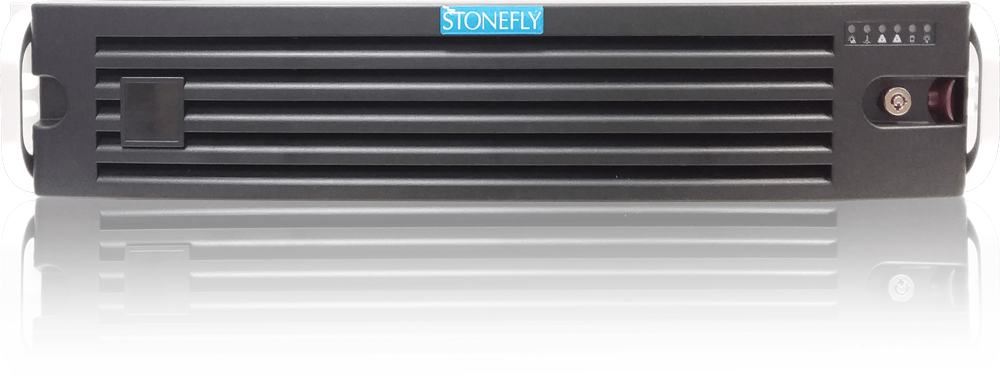
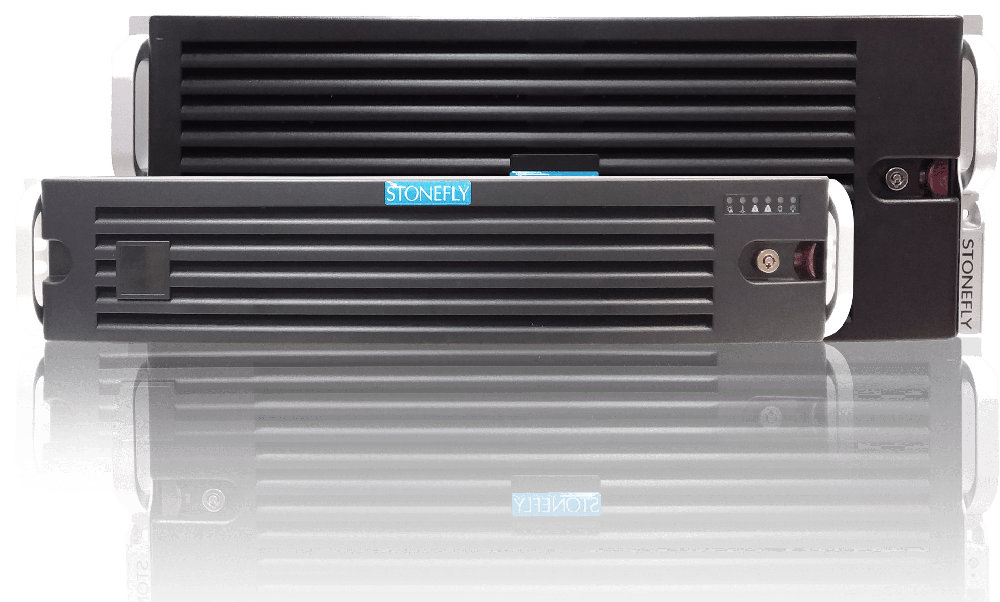
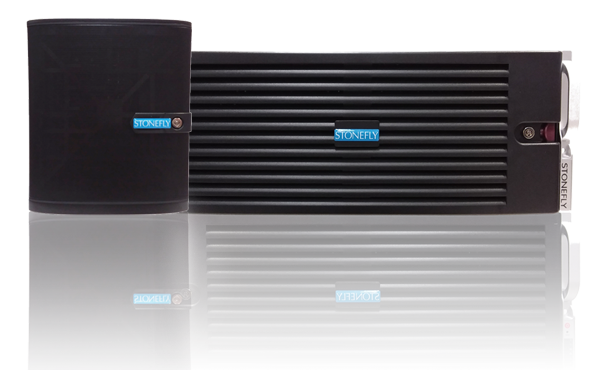
StoneFly’s Unified Scale-Out (USO) platform is built on disaggregated storage architecture principles designed for enterprise data center environments. The USO provides unified SAN (iSCSI, Fibre Channel), NAS (NFS, SMB/CIFS), and S3-compatible object storage from a single scale-out storage pool — with compute and storage resources separated so each can be sized and scaled to match actual workload requirements.
The USO architecture supports NVMe-over-Fabrics connectivity for latency-sensitive database and analytics workloads, automated multi-tier storage tiering across NVMe, SSD, and HDD tiers, and synchronous or asynchronous replication for disaster recovery across sites. Capacity scales non-disruptively by adding storage nodes to the pool without taking volumes or namespaces offline — consistent with the operational model that disaggregated storage enables.
For organizations running mixed workloads — virtualized applications alongside AI training pipelines, database clusters alongside backup repositories — the StoneFly SSO NAS and SCVM software-defined storage appliances extend the disaggregated model to scale-out NAS and software-defined block storage, providing the same independent resource scaling across heterogeneous workload types.
Disaggregated storage architecture is not a trend — it’s a correction to a fundamental constraint that co-located compute and storage designs built into enterprise infrastructure over the past decade. The constraint is simple: when compute and storage scale together, every infrastructure decision becomes a compromise. Disaggregation eliminates the compromise by letting each resource type scale on hardware optimized for that resource, connected by a fabric that delivers near-local latency.
The practical outcomes are measurable: storage performance optimization without compute overprovisioning, high availability storage systems that tolerate node failures without application impact, and enterprise data storage solutions that add capacity non-disruptively as datasets grow. For organizations managing AI workloads, large-scale databases, or mixed-use data center environments, those outcomes translate directly into lower infrastructure cost per usable terabyte and better application performance SLAs.
The question for enterprise IT leadership is not whether disaggregated storage makes sense architecturally — at this point, the performance and operational evidence is clear. The question is which deployment model fits the organization’s existing fabric, protocol investments, and workload mix. That’s an architecture decision worth making deliberately, before the next storage refresh cycle, not after.
Contact our experts at [email protected] to discuss disaggregated storage architecture design for your environment.





Join our mailing list to receive the latest news, updates, and promotions from StoneFly.